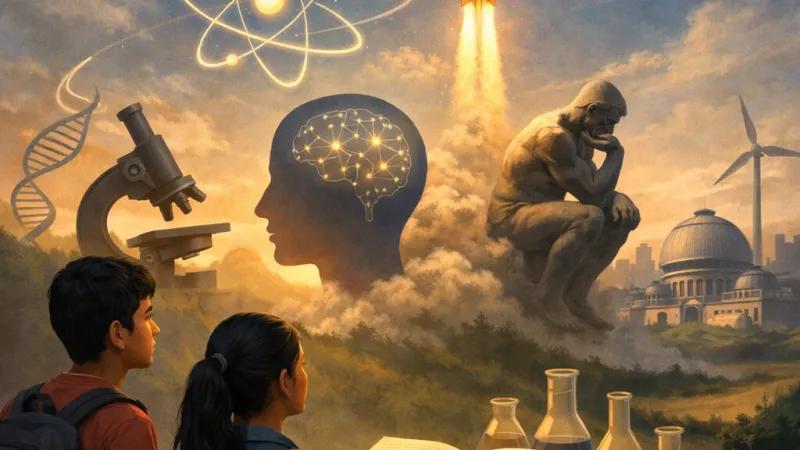
How Science and Reason Together Drive Human Knowledge and Progress
This work has been verified by our teacher: 14.04.2026 at 15:15
Type of homework: Essay Writing
Added: 11.04.2026 at 8:22
Summary:
Explore how science and reason together shape human knowledge and progress, helping students understand their vital roles in society and future advancements.
The Vital Interplay of Science and Reason in Shaping Human Knowledge and Progress
---Introduction
Every step forward that humanity has taken — from learning to light a fire to decoding the human genome — has depended on two powerful tools: science and reason. Science, at its heart, is the disciplined pursuit of knowledge about the world around us, built on observation, experimentation, and evidence. Reason, meanwhile, is the uniquely human capacity for logical thought, sound judgement, and reflective decision-making. In the Indian context, it is common to find a tendency to honour scientific achievement while underemphasising the guiding hand of reason. Yet, history and daily life teach us that scientific understanding alone cannot guide us through the complexities of life; it is the faculty of reason that gives science its true meaning and direction.This essay examines how science and reason, though distinct, work together to shape our society and drive our progress. Science presents facts; reason determines how those facts are interpreted and utilised for the betterment of humanity. Through philosophical discussion, historical and contemporary Indian examples, and an exploration of present and future challenges, I hope to show how the most meaningful advances arise when science and reason go hand in hand.
---
I. Philosophical Foundations: Understanding Science and Reason
The Nature of Science
The essence of science — *vigyan* — is systematic enquiry and the construction of knowledge based on observable phenomena. Whether it is the Vedic seers contemplating astronomical cycles, Sushruta exploring anatomy, or C. V. Raman unveiling the mysteries of light, science has always been about patient observation, meticulous experiment, and the patient uncovering of reliable patterns. Science is not, however, merely a collection of facts: it is a method. The Indian education system, particularly at the secondary and senior secondary levels, encourages students to participate in science fairs and olympiads, cultivating curiosity and investigative skills central to the scientific mindset.The Nature of Reason
Reason — *tarka*, as described in Indian logic — is what moves us from knowledge to wisdom. It is not enough to gather facts; we must reflect, question, and derive deeper understanding. While science might tell us that a certain medicine cures a disease, reason asks whether, when, and for whom it is appropriate. Reason evaluates, prioritises, and sometimes cautions restraint. This insistence on questioning and comparing alternatives has deep roots in Indian philosophy; systems like Nyaya have placed logical reasoning at the centre of intellectual life for millennia.Practical Wisdom: The Balance of Knowledge and Judgement
Aristotle’s notion of *phronesis* — practical wisdom — resonates with India’s own concept of *viveka* (discernment). To act wisely is not just to know, but to judge well. For example, in a modern Indian hospital, a doctor may have access to the latest antibiotics (the fruit of scientific research), yet they must use reason to decide the optimal treatment for a diabetic patient with multiple health complications, factoring in the patient's economic circumstances, social background, and values.Reason’s Role in Ethics
Science can inform us of what can be done, but it cannot tell us what should be done. The recent debate on surrogacy laws in India, for instance, brings up questions that science cannot answer by itself: Is it ethical to commercialise childbirth? Are there limits to what science should do in human reproduction? These are questions of ethics, demanding careful reasoning based on societal norms, cultural values, and philosophical principles.Limits of Science and Subjective Dimensions
It is important to acknowledge that science is bound by what can be measured or observed; it offers no perspective on the rightness or meaning of particular actions. Reason steps in to fill this void, drawing on empathy, cultural understanding, and subjective experience. Indian literature from the *Mahabharata* to contemporary works by R. K. Narayan often explores these themes, showing that the greatest human dilemmas cannot be solved by facts alone.Agency and Free Will
Humanity’s defining trait is not just intelligence, but the ability to make conscious choices. Science describes possibilities — reason chooses between them. This has allowed societies, including India, to shape their destinies consciously, whether in deciding to abolish practices like Sati or in building institutions like IITs that redefine our collective future.---
II. Historical Examples Illustrating the Science-Reason Nexus
The Indian Renaissance
The Bengal Renaissance in the 19th century was not simply a flowering of scientific knowledge but also a resurgence in rational thought. Reformers like Raja Ram Mohan Roy combined scientific awareness (campaigning against superstitions and advocating for modern education) with reasoned argument aiming at social reform — leading, among other things, to the prohibition of Sati and the encouragement of women's education.India’s Space Programme
A more contemporary example is the Indian Space Research Organisation (ISRO). The phenomenal success of Chandrayaan-3 and the Mars Orbiter Mission was not due to raw scientific know-how alone. Bureaucratic challenges, budget constraints, and the need to justify public spending required careful reasoning, prioritisation, and strategic decision-making. The decision to use indigenous technology and incremental innovation echoes the interplay between science (rocketry, physics) and reason (policy, ethics, and social impact).Environmental Policy
India faces acute environmental challenges, from urban air pollution to water scarcity. While scientists track air quality and research renewable energy, the implementation of policies such as the National Clean Air Programme requires reasoning that balances industrial growth, employment needs, and sustainability. Delhi’s famed “odd-even” vehicle scheme is a practical illustration: data suggested vehicular pollution was a major problem, but reasoned analysis led to a scheme with real, if debated, impact on urban life.---
III. Contemporary Applications: Challenges and Opportunities
Artificial Intelligence and Ethics in India
India is rapidly emerging as a hub for AI research and application — from automated chatbots in government services to facial recognition in airports like Hyderabad's. Yet, the ethical conundrums of AI require more than technical expertise. Who is accountable if an AI system in medical diagnostics malfunctions? Can predictive policing unintentionally embed caste or communal bias? Indian policymakers, researchers, and ethicists must use reason to ensure that innovation serves the public good and respects constitutional values.Gene Editing and Bioethics
Gene editing, exemplified by rising interest in CRISPR technologies in Indian laboratories (such as those under the Department of Biotechnology), presents vast opportunities — from resisting plant pests to preventing genetic diseases. However, reason and public discourse must guide the boundaries. Should germ-line editing to cure hereditary diseases be allowed? Is it ethical to introduce designer traits? Only a reasoned, multi-stakeholder approach blending scientific possibility and the values of society will ensure responsible progress.Renewable Energy
India’s commitment to the Paris Agreement and missions like the International Solar Alliance are driven by scientific innovation in solar and wind technology. But scientific advances alone cannot guarantee energy transition; reasoned strategy is vital. Decisions about land use for solar farms in Rajasthan must weigh local livelihoods, biodiversity, and national priorities. Only through public consultation and balanced policy — merging reason and scientific insight — can India achieve sustainable growth.---
IV. Synthesising Science and Reason: Towards a Balanced Future
The Risks of Science Without Reason
History, both in India and worldwide, is full of warnings about blind scientific progress. The Bhopal Gas Tragedy, the consequences of unsustainable Green Revolution practices, and the unchecked rise of electronic surveillance all demonstrate that technical achievement without ethical judgement can lead to catastrophe. Here, the absence of reason in guiding the applications of science can have tragic human consequences.The Limits of Reason Without Science
Conversely, reliance on pure reason or speculation, without empirical grounding, can lead to dogma and stagnation. Unscientific attitudes such as vaccine hesitancy, superstition-fuelled violence, or climate change denial have real-world costs. In India’s fight against COVID-19, scientific data on vaccination was most powerful when paired with campaigns that addressed public concerns through clear, reasoned communication.Integrating Science and Reason
The path forward lies in harmonising both traditions. Education must encourage not only scientific acumen but also critical and ethical reasoning. Curricula, such as those adopted by CBSE schools, increasingly emphasise project-based learning, ethical debates, and perspective-taking alongside laboratory work. Interdisciplinary research, such as at IISc Bangalore or Indian Institutes of Science Education and Research (IISERs), intertwines natural sciences, philosophy, social sciences, and humanities for comprehensive solutions to modern challenges.Governments, academic bodies, and civil society all have a vital role in fostering dialogue between science and reason. Thoughtful, inclusive public debates and transparent policy-making processes ensure that progress does not outpace the social consensus and ethical frameworks necessary for sustainable development.
---
Conclusion
Science and reason, though fundamentally distinct, are inextricably interwoven threads in the fabric of human progress. Science offers us understanding of the physical world, while reason interprets and applies these insights for individual and collective well-being. The philosophical traditions of India, our modern policy imperatives, and the lived experiences of today all show that neither science nor reason, in isolation, can guide us through the complex realities we face.As we move deeper into the 21st century, confronting the challenges posed by climate change, artificial intelligence, and societal inequality, the need for a marriage of scientific knowledge and reasoned judgement has never been greater. Let us strive to nurture both — through education, public dialogue, and personal reflection — so that our journey towards progress is guided not just by what is possible, but always by what is wise, just, and humane. In this lies the true promise of science and reason for India and for the world.
Rate:
Log in to rate the work.
Log in