Top 10 Key Facts About Jammu and Kashmir's Geography and Culture
This work has been verified by our teacher: 11.04.2026 at 14:00
Type of homework: Geography Essay
Added: 10.04.2026 at 10:02
Summary:
Discover the top 10 key facts about Jammu and Kashmir’s geography and culture to enhance your understanding for homework and geography essays effectively.
An In-Depth Exploration of Jammu and Kashmir: Geography, Culture, History, and Contemporary Significance
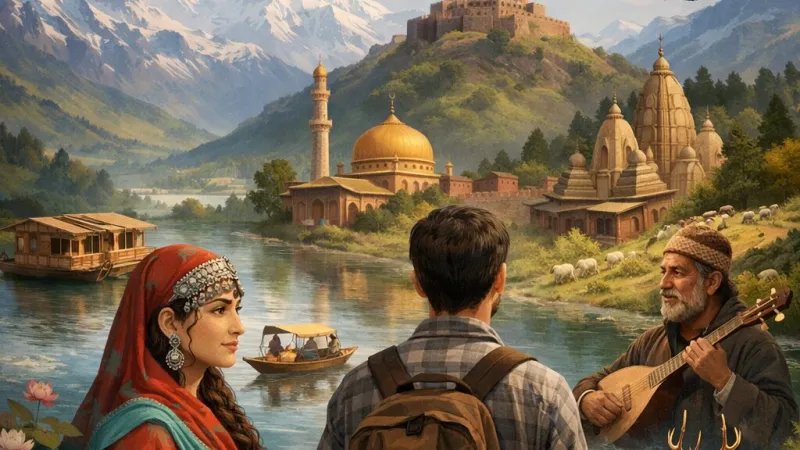
Jammu and Kashmir, perched at the crown of India, is much more than just a land of snowclad peaks and shimmering lakes. This enchanting region, celebrated in ancient literature as paradise on earth, stands out for its breathtaking geography, resplendent culture, and a history woven with both grandeur and turmoil. For Indian students, understanding Jammu and Kashmir is essential—not only because of its scenic beauty, but also for its pivotal place in the country’s unity, diversity, and ongoing transformation. Its towns and villages, valleys and monasteries, echo tales of harmony, strife, resilience, and hope. Truly, Jammu and Kashmir’s unique character springs from the confluence of its geography, the diversity of its people, and its tumultuous yet inspiring story.---
Geographical Features and Administrative Divisions
Jammu and Kashmir occupies a prominent place on India’s map, extending from the subtropical plains of Jammu to the windswept, high-altitude deserts of Ladakh. Bordered by Pakistan to the west and north, and China to the east, this region is defined by formidable landscapes. The mighty Himalayas, including the Pir Panjal and Zanskar ranges, dominate its skyline. The resplendent Kashmir Valley, nestled between the Greater Himalayas and the Pir Panjal, is famed for its lush green meadows, apple orchards, and the famous Dal Lake with its colourful shikaras and houseboats.The administrative story of this region shifted dramatically in August 2019, when the erstwhile state was bifurcated into two Union Territories: Jammu & Kashmir, and Ladakh. This change was much debated, as it involved the abrogation of Articles 370 and 35A that previously gave the region a special status and considerable autonomy. Today, Jammu & Kashmir functions as a Union Territory with its own legislature, while Ladakh, comprising the Leh and Kargil districts, is directly administered by the central government. The region’s unique setup of having Srinagar as the summer capital and Jammu as the winter capital demonstrates not just the climatic diversity, but also the attempt to respect the distinct identities of the two sub-regions.
Language and cultural identity form another beautiful mosaic here. Kashmiri, Dogri, Urdu, and Ladakhi are widely spoken, each lending flavour to local customs and literature. The scripts change—from Persian to Devanagari to Tibetan—reflecting the region’s crossroads position on the old Silk Route.
---
Rich Cultural Tapestry and Demographics
The population of Jammu and Kashmir is a microcosm of India’s broader heterogeneity. In the lush Kashmir Valley, the majority are Muslims, while Jammu is home to significant numbers of Hindus, including Dogras. Ladakh, on the other hand, has sizeable Buddhist and Shia Muslim communities. This mix has historically allowed for festivals, cuisines, and rituals of different faiths to blend together, even though modern events have sometimes put communal harmony to test.Kashmiri literature and language are renowned for their depth and lyrical quality. Lal Ded, the 14th-century mystic poetess, and Habba Khatoon, “the Nightingale of Kashmir”, have enriched Indian literary heritage with their verses of love, longing, and spiritual quest. The region’s Sufi music, the devotional songs of Chhakar and Soz, and the gentle notes of the santoor and rabab, are all testimony to an ingrained tradition of syncretism. Even today, Urdu remains the lingua franca of officialdom, while Kashmiri is spoken in homes and bazaars, and Dogri reverberates in Jammu.
Art, craft, and textiles are embedded in daily life. The unmatched fineness of Pashmina shawls, intricate hand-knotted Kashmiri carpets, lustrous silks, and the golden saffron harvested from Pampore fields, earmark the region on the world map. The traditional papier-mâché artefacts, willow cricket bats from Anantnag, and woodcarvings from Sopore and Baramulla showcase a deep-rooted craftsmanship passed down generations. Sericulture, too, thrives here, giving rise to the famous Kashmir silk. The artistry is not merely an occupation but a celebration of local identity.
---
Historical Context and Political Importance
Jammu and Kashmir’s history is as layered as its landscapes. Once part of the Mauryan and Mughal empires, it later became a princely state under the Dogra dynasty’s Maharaja Hari Singh. With the partition of India in 1947, Maharaja Hari Singh’s decision to accede to India amid Pakistani tribal invasions shaped the modern territorial dispute.For decades, Jammu and Kashmir enjoyed a special position under Article 370, which allowed it autonomy in matters except defence, external affairs, and communications. The abrogation of this article in 2019 changed the relationship between the region and the Indian Union, creating both optimism and apprehension among different segments of its population.
Territorial disputes continue to cast a shadow. Three countries—India, Pakistan, and China—stake claims over various parts of the region, leading to multiple armed conflicts, such as the wars of 1947, 1965, 1971, and the Kargil confrontation in 1999. The Line of Control (LoC) with Pakistan, and the Line of Actual Control (LAC) with China, define the fluid and sensitive boundaries.
Life under such uncertainty has not been easy for residents. Security concerns, militia infiltration, and curfews have affected economic activity and mental health. Yet, amidst these challenges, the spirit of the people—demonstrated in everyday acts of resilience—remains unbroken.
Strategically, Jammu and Kashmir is crucial not only for India’s territorial integrity but also for its water resources as rivers like the Indus, Jhelum, and Chenab originate here. Moreover, the region sits at a geopolitical crossroads influencing South Asian affairs, and is key to India’s Look East and Connect Central Asia policies.
---
Economy and Livelihoods
Despite its extraordinary natural resources, Jammu and Kashmir’s economy faces several constraints. Agriculture, horticulture, and allied activities remain the mainstay. Saffron from Pampore, apples from Shopian, walnuts from Kupwara, and aromatic Basmati rice from Jammu are celebrated across India. The region’s sheep and wool industry, especially Pashmina, is famed worldwide. However, the steep slopes, harsh winters, and political curfews pose challenges to farming communities.Tourism forms another significant pillar. The region’s reputation as “Heaven on Earth” is not exaggerated—the snow-draped slopes of Gulmarg, the emerald meadows of Pahalgam, the tranquil Dal Lake, and the stark beauty of Ladakh’s Pangong Tso attract lakhs of tourists annually. The holy Amarnath cave, Vaishno Devi shrine, Hazratbal mosque, and Hemis monastery highlight religious tourism’s importance. Nevertheless, periodic unrest and security issues occasionally hamper tourist inflow, impacting incomes.
Cottage industries—particularly those producing Pashmina textiles, carpets, papier-mâché artefacts, and carved furniture—are essential to local livelihoods. These crafts not only command high export value but are expressions of cultural pride. Government schemes and NGOs work to preserve these endangered skills and provide employment to thousands, especially women and artisans from rural backgrounds.
---
Contemporary Issues and Opportunities
Modern Jammu and Kashmir is at a crossroads where complex challenges meet new opportunities. Years of discord have left scars. Youth unemployment, mental health issues born of instability, and educational disruptions require urgent attention. Reports have highlighted the migration of Pandits from the Valley, and the shifting demographics in urban centres due to job seekers from other states.However, a new winds are blowing as both private and public sectors strive to bring development. Investment in roadways, hospitals, and higher educational institutions is beginning to improve connectivity and opportunities. Initiatives like the expansion of railway links up to Baramulla and the introduction of 4G internet have already brought parts of modern India closer to this region. The growth of local startups—especially in tourism, e-commerce, and crafts—is gradually giving the youth new hope.
Protecting the region’s fragile Himalayas is a pressing task. Deforestation, pollution of the Dal lake, unchecked urbanisation, and the threats posed by climate change to glaciers and agriculture are being discussed more seriously today. Sustainable development—preserving the beauty while improving livelihoods—is the mantra for the future.
---
Rate:
Log in to rate the work.
Log in