Bhagat Singh: The Life and Legacy of India’s Revolutionary Hero
This work has been verified by our teacher: 11.04.2026 at 13:27
Type of homework: History Essay
Added: 10.04.2026 at 9:04
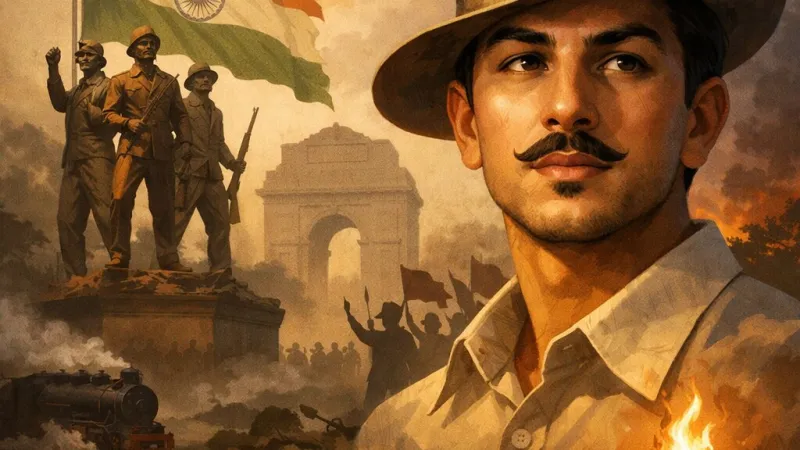
Summary:
Explore Bhagat Singh’s life and legacy to learn how his courage and sacrifice inspired India’s freedom struggle and shaped revolutionary history.
Bhagat Singh: The Eternal Flame of India’s Revolutionary Spirit
Among the pantheon of Indian freedom fighters, certain names shine with an incomparable brilliance. Bhagat Singh’s is one such name, not merely etched in textbooks or celebrated in annual commemorations, but inscribed onto the very psyche of the subcontinent. Often addressed with reverence as “Shaheed-e-Azam” (the supreme martyr), Bhagat Singh stirred the souls of his generation and countless others who followed. Born in the seething cauldron of colonial oppression, his journey from an emotionally scarred child to an ideological firebrand reveals the story of a young man who demanded not just political independence from the British, but a radical transformation of Indian society itself. As one examines the legacy of Bhagat Singh, it becomes imperative to appreciate his life not only as an episode in the freedom struggle, but as a testament to the powers of youth, conviction, and sacrifice.Early Life: The Seed of Revolution
Bhagat Singh was born on 28th September 1907 in Banga village, then part of undivided Punjab, now in Pakistan. Revolution ran in his veins; his family had a storied history of resistance and patriotism, from his father and uncles who endured prison and persecution, to stories of heroism whispered at home. The environment in which Bhagat Singh grew up was packed with the restlessness of a people yearning for freedom from British shackles. The spirit of the Ghadar movement, which had its roots among expatriate Punjabis, and the populist energy of local uprisings, provided a fertile ground for his burgeoning ideals.A pivotal moment in shaping his consciousness was the Jallianwala Bagh massacre of 1919. As a twelve-year-old, Bhagat Singh visited the blood-stained garden in Amritsar, collecting a handful of earth moist with the blood of unarmed Indians gunned down by General Dyer’s men. This act—a child gathering martyr’s soil—became an iconic moment, symbolising his lifelong commitment to the nation's cause. The carnage of Jallianwala Bagh did not merely leave an impression; it sparked a fire for justice and resistance. Stories of such acts percolated into his school days, where, instead of playing with toys, he would playact battles against colonialists or write “Death to the British Raj” on blackboards.
Exposure to revolutionary pamphlets, especially Sajjad Zaheer’s writings and lectures by Lala Lajpat Rai, added an intellectual edge to these emotions. Even as he initially admired Mahatma Gandhi’s call for non-cooperation, Bhagat Singh’s restless mind never ceased to probe deeper into the roots of colonialism, injustice, and the question of what true freedom entailed.
The Path of the Revolutionary: Disillusionment and Ideological Ferment
The early 1920s were a period of seismic change within the freedom movement. The Non-Cooperation Movement, which swept across cities and villages, won many young hearts and minds. Bhagat Singh, drawn to the ideals of swaraj (self-rule), participated in boycott campaigns and swadeshi drives. But the abrupt withdrawal of the movement by Gandhi after the violence at Chauri Chaura in 1922 sowed seeds of doubt in many aspiring revolutionaries.For Bhagat Singh, the retreat appeared as a betrayal of those who had risked everything. His own writings, such as letters and articles in 'Kirti' and 'Matwala', reveal a sharp, analytical mind questioning the adequacy of non-violence in the face of such relentless oppression. He began drawing inspiration from figures like Kartar Singh Sarabha and Ram Prasad Bismil, whose activism advocated more radical methods. By the time he entered the National College in Lahore—a hotbed for youthful debate—Bhagat Singh had started reading Marx, Lenin, and the literature of the Russian Revolution. The dream of ‘Purna Swaraj’ (complete freedom) now expanded for him to encompass not just the end of colonialism, but the annihilation of poverty, casteism, and exploitation, as reflected in his famous essay “Why I am an Atheist”.
Revolutionary Heroics: Deeds That Shook an Empire
Bhagat Singh soon became a key member of the Hindustan Socialist Republican Association (HSRA), an organisation driven by the vision of armed revolution to uproot British rule. The murder of Lala Lajpat Rai in 1928, who died after brutality by the police during a protest against the Simon Commission, became a turning point. In a bid to avenge the national humiliation, Bhagat Singh, with Rajguru and Sukhdev, plotted to kill James A. Scott, the officer responsible for Rai's death, but mistakenly killed John Saunders instead. This act, though tragic in its error, electrified the Indian masses and signalled that the time for radical resistance had dawned.Notably, in 1929, Bhagat Singh along with Batukeshwar Dutt threw non-lethal bombs inside the Central Legislative Assembly in Delhi. Unlike terrorists, their objective was not mass carnage, but what Bhagat Singh so eloquently phrased as “to make the deaf hear”. The smoke and thunder were symbols—an urgent call to the Indian public to rise above fear and inertia. Slogans of “Inquilab Zindabad!” (Long Live the Revolution!) echoed through the corridors of power, stirring a nation’s latent spirit. These acts were never an end in themselves but vehicles to awaken a slumbering populace and assert the rights of workers, peasants, and the downtrodden.
His subsequent arrest and the Lahore Conspiracy Case trial were marked by incredible courage. Enduring solitary confinement, he undertook a historic 116-day hunger strike demanding equal rights for Indian and British prisoners. His writings from jail, letters to friends, and statements before the colonial judges are now preserved as treasures of Indian literature, brimming with logic, satire, and moral clarity.
Martyrdom and the Birth of an Immortal Legend
On 23rd March 1931, at merely 23 years of age, Bhagat Singh, along with Sukhdev and Rajguru, walked to the gallows in Lahore Central Jail, reportedly singing songs of revolution, and with his beloved Marxist and revolutionary literature beside him. The British, fearing public outrage, executed them a day ahead and disposed of their bodies secretly. But news could not be suppressed; India wept, protested, and the echoes of their martyrdom reverberated from academic institutions to akharas, from poetry to political rallies.His death proved to be a rallying cry, energising the youth and adding dynamism to an independence movement often torn between moderate and extremist paths. If Gandhi symbolised India’s soul, Bhagat Singh became its youthful conscience, reminding all that freedom required a willingness for the ultimate sacrifice.
Enduring Legacy: Lessons for Today’s India
Bhagat Singh’s image today is omnipresent: in classrooms, on murals across Delhi University, in scores of film adaptations, and in school textbooks. His life and words have been etched into the pages of Indian literature, from Bhisham Sahni’s plays to ballads sung by street actors. The Chhatra Yuva Sangharsh Samiti at JNU, among many youth groups, continues to invoke his name in student activism.But more importantly, his legacy carries vital lessons. Patriotism for Bhagat Singh was not a mere slogan, but a commitment to social justice, to lift up the oppressed. As he wrote, “Mere political freedom was not enough if it did not include the emancipation of the poorest and most marginalised". His critical thinking, courageous challenge to both colonial might and the complacency within Indian society, serves as an inspiration for students to question, analyse, and act for what is just.
He serves as a beacon for Indian youth, reminding them that age is no barrier to courage and change. Bhagat Singh’s willingness to move beyond rigid dogma and embrace revolutionary ideas, his open-mindedness, and dedication to an egalitarian vision urge modern India to blend patriotism with inclusivity and reason.
Rate:
Log in to rate the work.
Log in