Mastering Flower Drawing: A Step-by-Step Guide for Indian Students
This work has been verified by our teacher: 17.04.2026 at 11:02
Type of homework: Essay Writing
Added: 14.04.2026 at 8:33
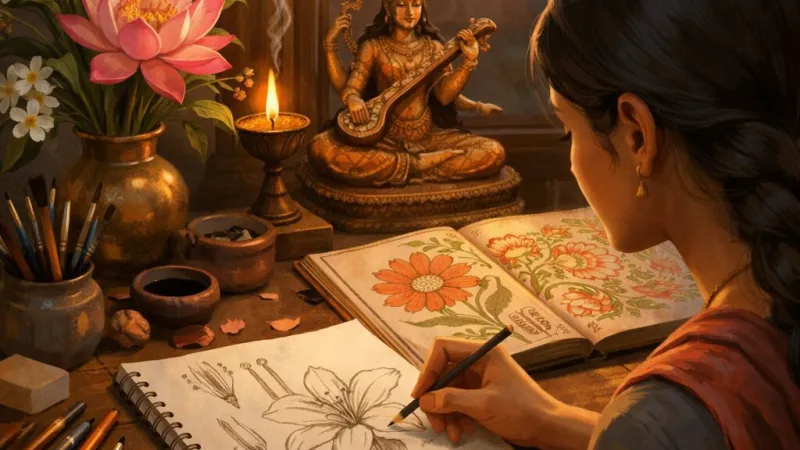
Summary:
Learn step-by-step flower drawing techniques with an Indian perspective. Master floral anatomy, tools, and cultural art to enhance your skills confidently. 🌸
The Art of Flower Drawing: An Indian Perspective
Introduction
“Where flowers bloom, so does hope,” said Jawaharlal Nehru, who revered the rose both as a symbol and a companion. In India and across the world, flowers are much more than natural wonders—they are emblems of celebration, devotion, beauty and even resistance. The urge to replicate their delicate forms and dazzling colours on paper has lured artists from the Mughal miniature painters to modern schoolchildren. Drawing flowers is not only an act of creation, but a bridge between human imagination and the infinite designs crafted by nature. This essay aims to explore the journey of learning flower drawing from an Indian context—from understanding the marvels of floral anatomy, getting accustomed to the best materials, honing step-by-step drawing techniques, to infusing one’s art with our country’s rich cultural vocabulary.Understanding the Basics of Flower Anatomy
Before the first line is drawn, a budding artist must learn to look deeply. A flower is more than its petals—it is a structured masterpiece. In India’s gardens or wild forests, one can observe numerous forms: the symmetrical radiance of a marigold in a temple garland, the soft layered folds of a rose on Republic Day, or the sharp, clean lines of a jasmine strung in hair.The basic structure includes petals (which may show radial symmetry like a daisy or bilateral symmetry seen in orchids), sepals (the leafy base of the bloom), stamens (the pollen-filled filaments), and the pistil (the centre, often with unique shapes in species like the lotus). Keen observation is essential. Set a fresh hibiscus in front of you; notice its five rounded petals, how the central stamen tube sits boldly forward, and the pattern of veins traced upon delicate surfaces. Natural light, filtered through a window, reveals how colours shift or details emerge. Compare this with drawing from a photograph—the static image is convenient, but studying a living flower builds your ability to see.
A few botanical terms can help even young artists: - Corolla: the collective petals - Calyx: all the sepals - Ovary: the central swollen part that might later become fruit - Filament: small stalks holding the anthers (where pollen is found)
With patience, these elements can be translated into the lines that will make your flower come alive.
Essential Drawing Tools and Materials for Flowers
India’s stationary bazaars and growing e-commerce platforms brim with choices suitable for flower drawing. Pencils of various grades are foundational—an HB is good for outlines, while softer 2B, 4B, or 6B pencils are superb for shading and petal depth. Most Indian students will find brands like Nataraj or Apsara sufficient, while art enthusiasts may seek higher-end options like Faber-Castell.The selection of paper is equally important. For detailed line drawings or intricate shading, a smooth, acid-free paper works best (Ivory sheet is a classic choice). Those who prefer textural effects, like in charcoal sketches of hibiscus or lotus leaves, may turn to a lightly textured cartridge paper. Handmade paper, popular in Indian craft, lends unique character for heritage-style drawings.
Beyond pencils and paper, erasers—especially kneadable ones—allow for gentle lifting of highlights from petals. Colouring media open new worlds: - Coloured pencils (e.g., Camlin, DOMS) offer precision; - Watercolours, ideal for washes and the soft blending required for a lotus or marigold, evoke the luminosity seen in Indian miniature paintings - Pastels are perfect for expressive, bold flower portraits
Some modern artists use blending tools like tortillions or stumps for fine gradation, reminiscent of shadows on jasmine buds at dusk. More students are now exploring digital tools—drawing tabs and apps like Autodesk Sketchbook or Procreate India—bridging traditional skills with technological flair.
Step-by-Step Techniques to Draw Flowers
A cautious hand and a methodical mind ensure success. Begin with simple shapes: most flowers can be mapped as an arrangement of ovals or circles (the rose starts with a spiral inside a circle; the marigold, with overlapping ovals radiating outwards). For complex forms like the massive sunflower, break the structure into the centre disk and the ring of petals, drawing in light pencil strokes first.Detailed work follows. Petals do not lie flat: roses curl, lilies twist, lotuses undulate gently. Mimic these natural patterns by carefully observing the direction and curvature of each petal. Depth is created through shading—consider the ancient Indian technique of ‘lafz-e-siyahi’ seen in Mughal manuscripts, where shadow and light interplay to give depth to flora. Use cross-hatching or stippling for rough textures (such as in Chrysanthemum) and smooth blending for softer petals.
Don’t neglect the supporting actors: stems and leaves. Trace the subtle curve of a bougainvillea stem or the pronounced veins on a mango leaf, both ubiquitous in Indian schoolyards. Final touches come at the end: sharpening outlines, adding eraser-derived highlights, and deepening shadowed zones lend the drawing a finished, professional touch.
Exploring Diverse Flower Types and Their Drawing Challenges
India’s natural bounty offers rich inspiration. - Single-petaled flowers: The tulip and lily, though not native to all parts of the country, challenge the artist to maintain symmetry and accurate curve. - Radiant flowers: Sunflowers and daisies, found in Himachal fields or home gardens, test one’s patience for repeating uniform petals and suggesting the golden-flecked central disk. - Layered blooms: Roses, loved by everyone from children to poets like Sahir Ludhianvi, require skill to overlap dozens of petals convincingly. Carnations and marigolds—echoing their use in marriage decorations—have clustered petals demanding intricate, repetitive linework. - Exotic shapes: The hibiscus, a staple in South Indian offerings, boasts broad petals and a prominent stigma; the lotus, which floats serenely atop temple ponds, has petals that must be drawn both above and reflecting on water, demanding a sense of symmetry and fluidity. - Tiny wonders: Jasmine chains and sweet peas, used in hair and festivals, are great practice for delicacy and fine details. Lavender, which is now farmed in Kashmir, brings its own clustered, narrow-petal challenge.For those who love a challenge, the passionflower—unusual and wild—asks for patient symmetry, while begonia and cyclamen require rendering leaves and petals that seem to twirl in conversation with the breeze.
Colour Theory and Application in Flower Drawing
Colour brings soul to a flower drawing. In India, colours of flowers have deep roots—marigold orange for auspiciousness, the red hibiscus for the goddess Kali, and the blue lotus for Vishnu. Understanding natural colour variation is vital. For realistic flower drawing, layer lighter shades first and build up vibrancy—Camlin or Faber-Castell pencils excel at this. Watercolours bestow that semi-transparent glow seen in morning dew on a lotus flower; each wash builds up intensity.Shifting from the science to tradition, note how flowers appear in indigenous arts—Rangoli at the threshold during Diwali, Madhubani paintings from Mithila, and intricate floral motifs in Warli murals. Drawing in these styles gives an understanding of not just form, but symbolic colour use—a peacock feather in a Krishna painting, for example, is a lesson in blending vibrant blues and greens. Observing how the morning light touches a mogra or gwenda bloom, or how evening shadows fall on a hibiscus, teaches you to replicate subtle changes in flower colour.
Creative Practice and Skill Development Strategies
Practice is a constant companion to success. Many artists recommend setting aside time daily to sketch—an early morning jasmine picking can become a moment to draw a quick study from life, while a mobile phone photo of a Gulmohar avenue provides references for later. Trying out different art styles—from the scientific precision of botanical illustration (as seen in Amrita Sher-Gil’s works) to the decorative boldness of Gond art—broadens creativity.Indian students should turn to their immediate surroundings: tulsi or rose bushes in a neighbour’s garden, temple garland makers' baskets, or roadside wildflowers. Engaging with friends in art groups, or entering school competitions (like those conducted by CBSE or local kala melas), brings valuable peer feedback. Today, numerous Indian YouTube art channels and mobile apps offer tutorials tailored for all levels.
Storytelling fosters deeper engagement. A drawing of a kadamba flower might be accompanied by a tale from Krishna's childhood, integrating folklore with visual art.
Practical Applications of Flower Drawing
Flower drawing is not a mere pastime. In Indian textbooks, accurate diagrams are essential in biology—every Class 6 or Class 11 student knows the value of well-labelled botanical illustrations. Beyond this, decorative arts employ floral motifs everywhere: from block-printing textiles in Rajasthan, to mehndi designs for weddings. Mindfulness is another reward—many find the act of drawing petals and leaves meditative, a gentle focus amidst the pressures of school or work.Floriculture is a growing industry. Artists use digital and hand-drawn flower illustrations for greeting card companies, wedding invitation designers, or even for professional event planners creating mandap blueprints. In the therapy space, flower drawing sessions are increasingly part of wellness programmes.
Conclusion
Mastering the art of flower drawing is a journey that offers far more than the skills seen on paper—it opens senses, sharpens focus, and fosters a lifelong appreciation for nature’s intricacies. Through careful observation, wise tool selection, diligent practice, and drawing inspiration from local environments and culture, Indian students can not only become better artists but also mindful individuals connected to their roots. As the poet Gulzar once wrote, “phool khilenge, rang bikherenge”—flowers will bloom, and spread their colours. Let us all take up pencil and brush, and do the same through our art.---
*Appendix:* - Common Indian Flowers: Rose, Marigold, Jasmine, Hibiscus, Lotus, Bougainvillea, Gulmohar, Chrysanthemum. - Recommended Resources: Nandalal Bose’s flower studies, YouTube channels like “Art With Ankita”, and NCERT art education textbooks. - Practice Tip: Fill a sketchbook page every week with flowers you notice in your neighbourhood or at a local market.
With every drawing, you build not only artistic skill but a quiet joy, keeping alive India’s ageless connection with its natural beauty.
Rate:
Log in to rate the work.
Log in