The Ailing Planet: Exploring the Green Movement’s Impact and Importance
This work has been verified by our teacher: 18.04.2026 at 9:51
Type of homework: Essay Writing
Added: 15.04.2026 at 11:00
Summary:
Explore the impact and importance of the Green Movement in India to understand how it fights pollution, deforestation, and protects our ailing planet for the future. 🌍
The Ailing Planet: Understanding the Role and Impact of the Green Movement
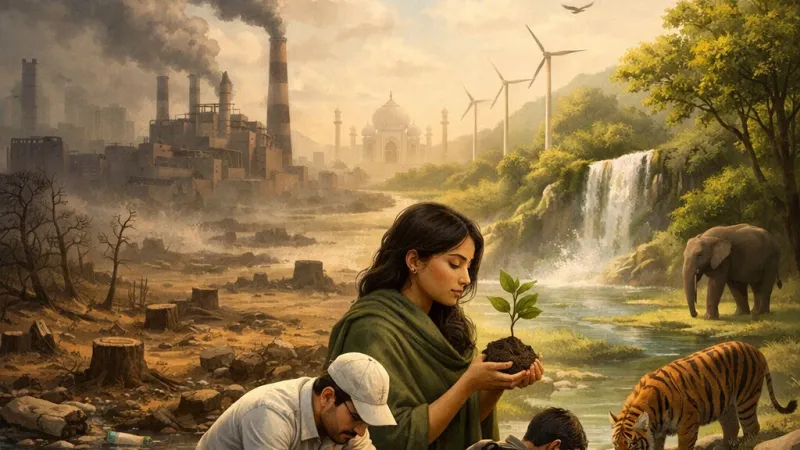
When we refer to our Earth as an “ailing planet,” we do not speak in literal terms but use a powerful metaphor, highlighting the alarming decline of our natural environment. Like the human body suffering from multiple diseases, Earth is now afflicted by deforestation, pollution, species extinction, and climate anomalies. This malaise has not developed overnight; it is the cumulative result of decades—even centuries—of careless industrialisation, greed, and ignorance.
Of late, the warning bells have become impossible to ignore. Delayed monsoons, frequent floods and droughts, vanishing forests, and toxic air are now regular features in India’s news cycle. Against this backdrop, the Green Movement stands out as a crucial collective response aimed at healing our wounded planet. It has evolved from scattered local efforts to a cohesive global movement. For us, as Indian students and responsible citizens, its relevance is immense, especially as we witness environmental degradation that threatens our own safety and future.
In this essay, I seek to explore how the Green Movement originated, developed, and made its mark in India and the world. I aim to illustrate how it seeks solutions, what it asks of governments and citizens, and why it is vital for our era. Ultimately, I hope to underscore the importance of blending ecological preservation with sustainable growth—a vision essential for all humanity.
---
The Ailing Planet: Signs and Causes
Standing amid an Indian city’s morning smog or witnessing a river choked with plastic, one does not need persuasive arguments to believe that Earth is unwell. Across the subcontinent, environmental symptoms are visible: receding Himalayan glaciers, the alarming loss of Western Ghats’ biodiversity, annual air pollution emergencies in Delhi and other metros, and the drying up of rivers that once fuelled civilisations.These symptoms result from multiple, interconnected causes:
- Unrestrained Industrialisation & Urbanisation: As our cities expand, nature is pushed to the margins. Forests are cleared for factories and housing, replacing tree canopies with concrete. - Overpopulation and Overconsumption: India, home to over 1.4 billion people, faces colossal demand for food, water, and fuel. Meeting these needs poses enormous strain on our environment. - Deforestation: Forests are sacrificed for agriculture, timber, or firewood. The Chipko Movement of the 1970s, where rural women hugged trees to prevent their felling, remains a landmark struggle but also a reminder of ongoing threats. - Pollution: Waste from industries and households chokes our air and water. The Yamuna in Delhi is now more a stream of effluents than a river, while soil fertility declines due to relentless chemical use.
If these trends continue unchecked, consequences will be dire: repeated destructive floods and droughts, vanishing wildlife, collapsing crop yields, and rapidly shrinking water tables. The latest heatwaves and unseasonal rains are warnings of an even more uncertain and dangerous future.
---
The Green Movement: Origins and Evolution
The seeds of environmental awareness were sown globally in the late 20th century, particularly after recognitions such as the Stockholm Conference in 1972. Even though global consciousness began to rise, in India, thinkers like Nani Palkhivala made strong cases for viewing environmental stewardship as a necessity, not luxury. Their messages, once considered marginal, found an audience as more people began to connect personal well-being with the state of natural surroundings.Movements and organisations soon emerged: international ones like Greenpeace and WWF set the tone, while Indian movements—be it the aforementioned Chipko or the Clean Ganga campaign—brought ecological activism deeper into public consciousness. The United Nations, through initiatives like the Brundtland Commission, coined “sustainable development” to signify a balance: satisfying present needs while ensuring future generations inherit a habitable planet.
Underlying the Green Movement are key principles:
- Recognising the interdependence of all living systems. - Accepting responsibility—from individuals to corporations—for minimising ecological footprints. - Insisting on long-term thinking rather than sacrificing nature at the altar of short-term gain.
---
Core Pillars of the Green Movement
The Green Movement rests on several foundational agendas:Conservation of Life-Support Systems
Our planet survives on four essential systems: forests, grasslands, fisheries, and croplands. In India, forests like the Sundarbans and the Western Ghats are not just biodiversity hotspots; they prevent floods, maintain climate balance, and support tribal livelihoods. Destruction of these is equivalent to undermining our own future. Various ‘van mahotsavs’ (tree-planting festivals) and afforestation drives show efforts to reverse this decline.Pollution Management
India enacted laws like the Air (Prevention and Control of Pollution) Act, 1981, yet enforcement is inconsistent. Cities like Pune are experimenting with waste segregation, composting, and converting waste into energy. But these must become nationwide movements. Reducing single-use plastics, controlling industrial emissions, and cleaning rivers require both public pressure and robust governance.Sustainable Resource Use
India is both blessed and challenged with resources. Practices such as rainwater harvesting—common in Rajasthan’s traditional stepwells—are now promoted in urban centres. Adoption of renewable energy, seen in the world’s largest solar parks in Gujarat and Rajasthan, illustrates the new pathways the Green Movement nurtures.Population Stabilisation
One cannot separate environmental health from the issue of population growth. Empowering women through education, increasing access to family planning, and awareness have helped Kerala and Tamil Nadu to stabilise their populations, serving as models for the rest of the country.Legal and Policy Frameworks
The Indian Constitution, via Article 48A, mandates the State to “protect and improve the environment,” while Article 51A(g) calls on every citizen to “protect and improve the natural environment.” Laws such as the Wildlife Protection Act have enabled some recovery for endangered species, but law without enforcement will remain ineffective.---
Green Movement’s Achievements and Continuing Challenges
Perhaps the Movement’s greatest success is intangible: a visible increase in awareness. Schoolchildren today discuss climate change and pollution as naturally as previous generations spoke about independence or economic growth. Practices such as waste segregation are now taught early, and the popularity of kitchen gardening or organic shopping reflects a rising eco-friendly consciousness.There are concrete successes as well. The afforestation drive in Tamil Nadu’s Pichavaram mangroves reclaimed lost coastal land while protecting against cyclones. Delhi’s “odd-even” rule temporarily improved air quality. The Narmada Bachao Andolan, though controversial, foregrounded the ecological cost of major dams.
Yet challenges are innumerable. Enforcement gaps persist: illegal sand mining continues in many places, and rivers remain polluted. Many villagers reliant on forests suffer due to conservation restrictions, threatening fair coexistence. Economic disparities mean that for millions, environmental concerns are secondary to survival.
---
Education and Youth: The Vanguard of Change
Including environmental lessons in textbooks, like NCERT’s “The Ailing Planet,” is not just symbolic but necessary. Through MCQs and interactive modules, students learn to see environment as more than a subject—as a lived reality. Quizzes promote quick recall, but field visits foster deep understanding.Youth, the demographic backbone of India, are already taking the lead. Organisations such as Sanctuary Nature Foundation encourage urban youth to volunteer for cleaning lakes, planting saplings, or even documenting biodiversity. Social media, too, offers platforms for campaigns—for instance, #BeatPlasticPollution saw widespread participation in Mumbai.
Many young Indians are now developing water-efficient farming techniques, participating in hackathons to devise renewable energy solutions, and innovating in waste management.
---
Pathways Forward
Building on this momentum, several steps are necessary:- Policy Strengthening: Environmental Impact Assessments must become routine, transparent, and involve local communities. - Community Participation: Ancient Indian traditions often worshipped rivers and groves as sacred, reflecting a ‘living’ relationship with nature. Reviving such respect, alongside scientific knowledge, can bring more effective outcomes. - Course Content Updation: Curricula must not stay static. Incorporating case studies like the 2023 Uttarakhand flash floods or the conservation of Kaziranga’s rhinos can make learning relevant. - Personal Responsibility: Each individual should reduce usage of disposables, save water and energy, and make mindful consumption choices. Incentives for rooftop solar, composting, or cycling to work can nudge wider participation.
---
Conclusion
In summary, acknowledging that our planet is ailing is the first step; acting on that knowledge is the greater challenge. The Green Movement has shown a path—a blend of legal, scientific, and grassroots action—to confront and reverse environmental decay. But laws or activism alone cannot suffice; real change needs every citizen’s commitment.For students, the lesson is clear: build a sound foundation in environmental studies, champion green practices, and engage critically rather than accept information passively. There is urgency—India’s future is tied to the vitality of its rivers, forests, and air.
Only by joining hands—governments, businesses, communities, schools, and individuals—can we hope to restore Earth’s well-being. Our choices today will define the inheritance we leave behind. Let the dream be not just of progress, but of flourishing together, humans and nature, for the ages to come.
---
*Note: To perform well in exams, go beyond memorisation—relate the textbook concepts to local or national examples, update yourself with news, and think about practical actions in your neighbourhood. The ailing planet needs not only awareness, but everyday champions.*
Rate:
Log in to rate the work.
Log in