Detailed Analysis and MCQs of The Tale of Custard the Dragon for Class 10
This work has been verified by our teacher: 21.04.2026 at 17:19
Type of homework: Essay Writing
Added: 20.04.2026 at 14:07
Summary:
Explore a detailed analysis and MCQs of The Tale of Custard the Dragon for Class 10 to master themes, characters, and poetic devices with ease.
The Tale of Custard the Dragon: An In-Depth Analysis for NCERT Class 10 English Poem 9
Introduction
Among the various poems prescribed in the NCERT Class 10 English First Flight textbook, “The Tale of Custard the Dragon” stands apart for its wit, playful tone, and underlying message. Written by Ogden Nash, an iconic figure in light verse, this poem captures students’ imagination with its fanciful characters and humorous treatment of courage and cowardice. Its inclusion in the CBSE curriculum isn’t just to entertain; it also provides young learners an opportunity to reflect on real-life values cleverly disguised in a fun narrative. In this essay, I will dig deep into the story’s plot, the colourful cast, underlying themes, and the poetic devices that not only enrich the text but also appear frequently in exam MCQs—making it essential for CBSE students to master both the poem and its nuances for academic success.Context and Background
Ogden Nash, recognised for his witty and satirical poetry, often introduced ordinary emotions and dilemmas through extraordinary scenarios. “The Tale of Custard the Dragon” is no exception. Instead of heavy, moralistic storytelling, Nash employs a comedic, almost childlike ballad to explore very grown-up concepts like bravery and self-esteem. The setting is deliberately whimsical: a little girl named Belinda shares her house with an odd assortment of pets—a kitten (Ink), a mouse (Blink), a dog (Mustard), and a timid dragon (Custard). The ballad’s tone and rhythm make it instantly memorable, which is precisely why it resonates with young Indian students who are preparing for both textual understanding and competitive exam environments where memory and analysis are key.For learners in India, mastering such poems is not just about literary appreciation. Given the board examination pattern, where objective, short-answer, and analytical questions are all expected, understanding every facet of “The Tale of Custard the Dragon” becomes essential. This is further strengthened by the widespread use of MCQs in the latest CBSE format.
Summary of the Poem
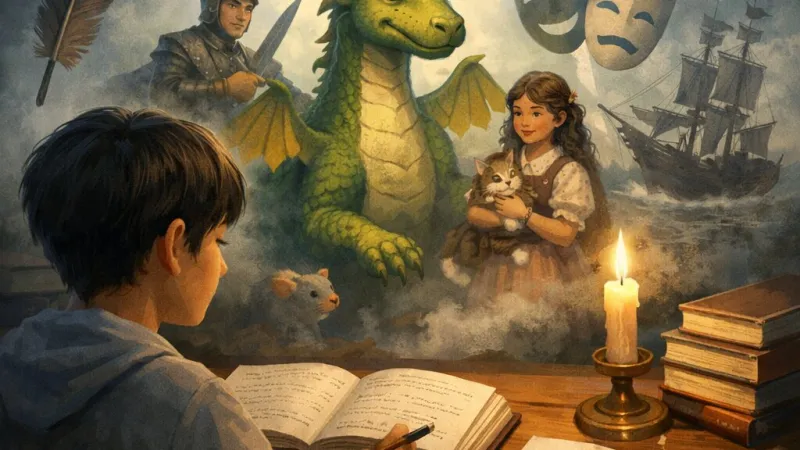
At its core, “The Tale of Custard the Dragon” paints the picture of a unique family. Belinda, the central human character, appears to be the prototypical loving caretaker of her four pets: Ink, the sly and black kitten; Blink, the little grey mouse; Mustard, the fierce yet small yellow dog; and Custard, the most unusual dragon who lives in terror, ironically, within a world that expects him to be fearless.While everyone in Belinda’s house claims to be boldly brave, it is Custard who constantly pleads for a “nice safe cage” due to his fearfulness. The other pets often tease him for what they think is his cowardice. However, when a real threat—an armed pirate—invades, the supposedly brave companions scatter in fright. It is Custard, the so-called coward, who single-handedly confronts and defeats the pirate, ultimately saving the household. Despite his valiant act, the other pets soon revert to their previous behaviour, again belittling Custard while boasting about their own “courage.” The poem closes with Custard’s gentle, forgiving nature and the quiet assertion that real bravery lies in actions, not in showy boasts.
Character Analysis
Belinda
Belinda is depicted as gentle and full of affection, providing the poem’s emotional core. She represents innocence and a nurturing spirit, perhaps mirroring the typical Indian child’s love for animals and their role as caretakers within a household. Her straightforward attachment to her pets, without favouritism, establishes her as the glue binding all personalities together.Custard the Dragon
The protagonist, Custard, defies traditional stereotypes of both dragons and heroes. Dragons, in folklore and Indian mythology alike—think of mythical “sarpa” or the fire-breathing creatures in Amar Chitra Katha—symbolise strength and terror. Yet, Nash turns the trope on its head, making Custard timid and longing for protection. Ultimately, his character arc breaks the expectations set by both his friends and readers, proving that labels don’t define one’s capabilities. Custard, in truth, stands for the often-overlooked, the ones underestimated for their reticence, only to display unexpected courage at crucial moments.The Other Pets: Ink, Blink, and Mustard
These animals serve two key functions. They inject humour with their repeated teasing and provide a foil to Custard. Ink and Blink, tiny in size, and Mustard, despite being “brave,” show the difference between boasting and real action. Their comic cowardice during the pirate attack exposes the hollowness of their bluster, adding to the poem’s irony.The Pirate
The pirate, complete with gun and cutlass, briefly disrupts the peace of Belinda’s home. He represents the classic antagonist, a symbol of fear and adversity. His role, while brief, is critical as it sets the stage for Custard’s transformation and the central display of heroism.Major Themes Explored
Bravery vs. Cowardice
Perhaps the most prominent theme is that appearances can be deceptive. Custard’s size suggests strength, but he’s mocked for seeming weak. Yet, in the moment of truth, he demonstrates genuine bravery, while the others recoil in fear. This parallels other Indian literary classics—like the “Panchatantra” fable of the timid hare whose cleverness saves lives—where wisdom and bravery take unexpected forms.Friendship and Loyalty
Despite their squabbles, there’s an undercurrent of care among all household members. Like the animal tales of Sudha Murthy, where even the smallest creatures play vital roles in togetherness, Belinda’s pets share a unique bond. Their dynamic shows that even flawed relationships can be loving and protective.Humour and Satire
Nash uses playful rhymes and repetitive phrases to lampoon human tendencies to boast or judge others. The light-heartedness keeps the tone from becoming preachy, reminiscent of the everyday humour seen in Harishankar Parsai’s satire or the gentle wit of Ruskin Bond’s writing.The Value of Courage in Adversity
The poem imparts a lesson recognisable to any Indian student: real courage is shown not in idle talk but in times of testing. Just as many folktales and Indian historical stories extol unsung heroes, Custard reminds us that facing fears is the truest form of heroism.Literary Devices and Poetic Techniques
Similes and Metaphors
Nash’s creativity shines in lines like “sharp as Mustard” or “brave as a tiger in a rage.” These comparisons enliven the characters, helping students visualise and relate to them vividly. Indian poetry often uses similar devices, as in Sarojini Naidu's "Palanquin Bearers," creating memorable images through metaphor.Ballad Form
The poem is structured as a ballad—a narrative poem with a sing-song rhythm and repeated refrains. Classic Indian classroom favourites like “Madhushala” by Harivansh Rai Bachchan use rhyme and repetition to aid memory. This form makes the tale easy to recall, an advantage for exam preparations.Rhyme and Rhythm
The recurring rhyme scheme (“house-mouse” or “rage-cage”) gives the poem a musical quality. The rhythm is catchy, almost like a nursery rhyme, encouraging students to recite and internalise the poem’s content.Personification
Each pet has human-like thoughts and emotions—an age-old device evident from ancient Sanskrit lyric to modern Indian stories like Tagore’s “Kabuliwala.”Irony and Humour
Nash’s humour lies in presenting the bold as cowards and the meek as heroes. Indian students, used to the twists in Birbal and Tenali Raman tales, will recognise this irony.Importance for NCERT Class 10 Students and CBSE Exams
Given its inclusion in the “First Flight” syllabus, “The Tale of Custard the Dragon” is essential for mastering poetic devices, interpretation, and thematic analysis. CBSE often tests:* MCQs about character names, traits, and actions * Identification of literary devices (e.g., spotting a simile in a given line) * Comprehension-based questions (what does the poet imply about bravery?) * Analysis for long-answer type questions (summarising the poem or explaining its message)
To ensure success, students should focus on remembering character details, understanding the ballad structure, and being able to explain why certain devices are used. Regular revision with sample MCQs—like those found in Oswaal or Arihant guides—enhances both comprehension and recall.
Sample MCQ Insights and Analysis
Example: 1. Who is Custard? a) A mouse b) A dog c) A dragon d) A kitten Correct answer: c) A dragon2. The poem’s principal theme is: a) Friendship b) Cowardice and courage c) Loyalty d) Humour Correct answer: b) Cowardice and courage
3. What poetic device is “brave as a tiger in a rage”? Answer: Simile—the word “as” directly compares.
Successful MCQ answering requires familiarity with both the poem’s events and the technical terminology often used in CBSE questions. Common pitfalls include mixing up pet names or confusing literary devices; these can be avoided through close reading and regular practice.
Conclusion
Ogden Nash’s “The Tale of Custard the Dragon” delivers more than amusement; it cleverly bundles a lasting moral in layers of laughter and rhyme. Its humour, simple story, and memorable characters ensure students not only prepare well for exams but are subtly guided towards appreciating the complexity behind apparent simplicity. In Indian classrooms, this poem endures because it makes literary analysis approachable, lively, and genuinely enjoyable.To truly reap the poem’s benefits, students should cultivate an analytical as well as creative approach—seeing beyond rote memorisation and nurturing genuine appreciation for poetry.
Additional Study Recommendations for Students
- Read aloud: Recitation helps in grasping the rhyme and makes memorising easier. - Make concept flashcards: List character traits, key themes, and devices to revise efficiently. - Engage in group discussions: Hearing classmates’ interpretations brings new insights. - Write concise summaries and answers: This polishes both articulation and memory. - Practise MCQs and mock tests: NCERT and reference guidebooks, such as Evergreen or Full Marks, offer ample questions matching the CBSE style.Ultimately, “The Tale of Custard the Dragon” is both an asset for board exam success and a gateway to seeing poetry as a living, breathing celebration of life’s small surprises and the unsung hero within us all.
Rate:
Log in to rate the work.
Log in