How Inclusive Growth in India Benefits Everyone Equally
This work has been verified by our teacher: 24.04.2026 at 15:41
Type of homework: Essay Writing
Added: 21.04.2026 at 5:34
Summary:
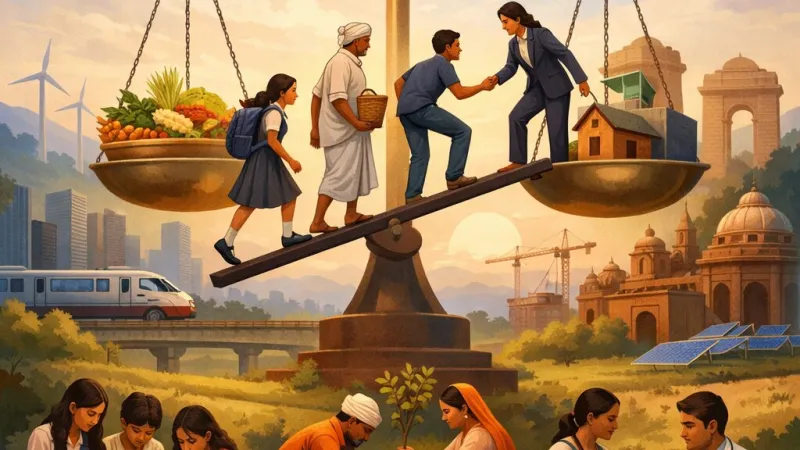
Explore how inclusive growth in India ensures equal benefits for all through fairness and shared progress, helping students grasp social and economic equity.
“A Rising Tide Lifts All Boats” — Lessons for Inclusive Growth in India
The proverb “a rising tide lifts all boats” captures a vision of collective upliftment—when conditions improve for a society at large, every individual is meant to benefit, no matter their social background or starting position. Imagine the imagery of houseboats floating on the Dal Lake in Srinagar: as dawn breaks and the water level gently rises, not just the most elaborate houseboat but even the humblest shikara experiences a lift. Herein lies the central premise of the metaphor: that general progress, be it economic, social or moral, should ideally reach everyone, offering hope and support to each member of society.
However, in a country as diverse and hierarchical as India, the reality of this metaphor is complex. This essay attempts to examine whether economic and social progress naturally uplifts all, or if deliberate intervention is required to ensure no one’s left stranded. We will explore how fairness, equity, and sustainability are indispensable to realising the true spirit behind the phrase. At its core, this essay contends that while collective development holds the promise of shared prosperity, conscious policies and ethical commitments are essential to truly ensure every “boat” is lifted, not just a privileged few.
---
Philosophical and Ethical Foundations of Inclusive Growth
Throughout history, Indian thinkers and global philosophers alike have grappled with the question: should society privilege the individual or the collective? Communitarian ideals, so robustly rooted in India’s own social structure, emphasise that the welfare of the group underpins the well-being of its constituents. As per the Upanishads, “Vasudhaiva Kutumbakam”—the world is one family—reminds us that individual prosperity is ultimately interwoven with broader social welfare. Indian society has, since ancient times, leaned towards systems valuing interconnectedness over isolated achievement.This is further echoed in Aristotle’s vision of an ideal polis, where every citizen’s flourishing arises from communal harmony and shared justice. In practice, if one section of society is submerged in deprivation, the promise of collective progress rings hollow.
Justice finds a central place in the discourse on growth. As philosopher John Rawls asserted, inequalities are only justifiable if they work to the advantage of society’s least advantaged. This principle translates to an ethical responsibility: policies and development agendas should consciously try to shrink rather than widen social and economic gaps. Unbridled pursuit of growth, without moral anchoring, easily perpetuates inequalities and leads to alienation—a danger Mahatma Gandhi cautioned against.
Gandhi’s notion of Sarvodaya, or “the welfare of all”, stood in stark contrast to mere material accumulation. He insisted that “the true measure of any society can be found in how it treats its most vulnerable members.” If growth excludes, or even marginalises, the weakest, it loses its purpose. Dharma—righteousness—must inform economic decisions, advocating for compassion alongside efficiency.
Ultimately, an ethical framework isn’t a luxury but a necessity: it steers policymakers towards choices that consider sustainability and inclusion, ensuring no one is left behind as the “tide rises”.
---
Historical and Socioeconomic Context of Growth and Inequality in India
India’s tryst with growth has been a story of contradictions and complexity. After independence, the country embarked on five-year plans, building public sector enterprises, dams, and educational institutes, all aimed at rapid development. While there were impressive achievements—self-sufficiency in food through the Green Revolution, establishment of IITs and AIIMS—the fruits of progress didn’t reach all uniformly. Some regions, like Punjab and Maharashtra, surged ahead, while others such as Bihar and Odisha lagged. Moreover, deep-seated caste and gender hierarchies meant that Dalits, Adivasis, and women remained largely outside the purview of growth.Social welfare schemes—be it the mid-day meal programmes or reservation policies—were stepping stones towards equity, yet implementation gaps persisted. The urban-rural, caste, and religious divides have often determined who gets to ride the rising tide and who remains mired in poverty.
The wave of economic liberalisation in 1991 opened the Indian market to global trade and investment. This bold move did result in dramatic economic gains: flourishing IT hubs in Bangalore, the rise of a vibrant middle class, and resurgence of entrepreneurship. But the benefits were not evenly distributed. While urban professionals found new opportunities, rural farmers, small artisans, and the unskilled workers sometimes got left behind or even displaced. The digital gulf further accentuated exclusion, demonstrating that globalisation can both raise and sink boats, depending on where one is moored.
Globally, similar trends have played out. During the Industrial Revolution, British mill owners amassed huge fortunes, but their workers suffered until protective labour laws and universal education broadened the base of prosperity. History suggests that unchecked growth often comes at the expense of the vulnerable—unless tempered by reforms and social investments.
The clear lesson: economic expansion, in itself, does not guarantee universal upliftment. Intentional redistribution, legal protections, and visionary governance are necessary to transform growth into shared prosperity.
---
Contemporary Dimensions of Inclusive Growth
India of today offers a fascinating laboratory for policies aimed at inclusivity. The Jan Dhan Yojana, aiming for universal bank accounts, has brought millions from the informal sector—like street vendors and daily wage workers—into the formal economy. Aadhaar, the world’s largest biometric ID system, has enabled targeted subsidies and reduced leakages in welfare delivery. The Mahatma Gandhi National Rural Employment Guarantee Act (MGNREGA) provides financial stability and dignity to the rural poor, especially women, by ensuring at least 100 days of employment annually.However, the real potential for inclusive growth lies in education and healthcare. The Right to Education Act makes schooling a fundamental right, while Sarva Shiksha Abhiyan expands reach to even the most remote village. Schemes like Ayushman Bharat promise affordable healthcare to the poor, reaffirming the centrality of basic human needs in the growth narrative.
Yet, as India races towards Digital India, there are risks of leaving many behind. While urban youth gain access to online jobs, digital payments, and government services, swathes of rural areas still struggle with connectivity and basic digital skills. To avoid creating a new underclass, initiatives for affordable smartphones, vernacular content, and digital literacy are crucial.
Environmental justice is intertwined with the sustainability of growth. As climate change causes more agrarian distress—floods in Assam, droughts in Bundelkhand—the poorest are hit the hardest, threatening the gains made in poverty reduction. The adoption of solar energy in Rajasthan’s villages, water conservation in Maharashtra, and eco-friendly urban planning in cities like Bhubaneswar are steps in the right direction. Sustainable development ensures that the rising tide doesn’t swamp the vulnerable but provides a lasting buoy to all.
---
Critical Analysis and Reflections
It is thus clear that growth, left to market forces or a trickle-down mindset, is rarely inclusive. Globalisation and technological advances can inadvertently concentrate wealth among those already advantaged. The proliferation of luxury apartments in Gurgaon or the stock market booms in Mumbai contrast starkly with the slums of Dharavi and agrarian suicides in Vidarbha.Only honest, ethical governance can guarantee fairness. Transparent policies, robust legal institutions, and prompt redressal mechanisms are essential. Corruption and bureaucratic inefficiency often stymie well-meaning programmes, reducing their ability to reach those most in need, as seen with leakage in the Public Distribution System or slowed disbursement of scholarships.
True growth is not just about GDP numbers; it is about expanding the dignity, agency, and capabilities of all citizens. As Amartya Sen argued, development should be judged by the freedoms people have to live the lives they value. This includes access to education, healthcare, fair work, social security, and a say in public life.
A truly rising tide thus requires a multi-pronged approach: social justice, legal rights, participatory governance, and continuous investment in human potential. The stories of successful self-help groups in Kerala or the rise of women entrepreneurs in Gujarat are testament to what is possible when opportunity is democratised.
---
Conclusion
The metaphor of “a rising tide lifts all boats” is a powerful ideal, but its realisation in India—or anywhere—depends on where we channel our collective energies. Historical evidence and contemporary realities both assert that equitable, just, and sustainable frameworks—rather than blind faith in growth—alone can transform collective progress into universal upliftment.As Gandhi emphasised, “the best test of a civilisation is in the way it treats its weakest members.” It is our duty, as students, citizens, and future policymakers, to strive for a society where progress is not measured solely by averages but by the well-being of every individual—rich and poor, urban and rural, privileged and marginalised.
May we always endeavour to create a rising tide that lifts every boat, big or small, new or battered, ensuring not just material prosperity but also dignity and hope for all.
Rate:
Log in to rate the work.
Log in