Swachh Bharat Abhiyan: A Key Initiative for a Cleaner India
This work has been verified by our teacher: 24.04.2026 at 12:35
Type of homework: Essay Writing
Added: 22.04.2026 at 7:32
Summary:
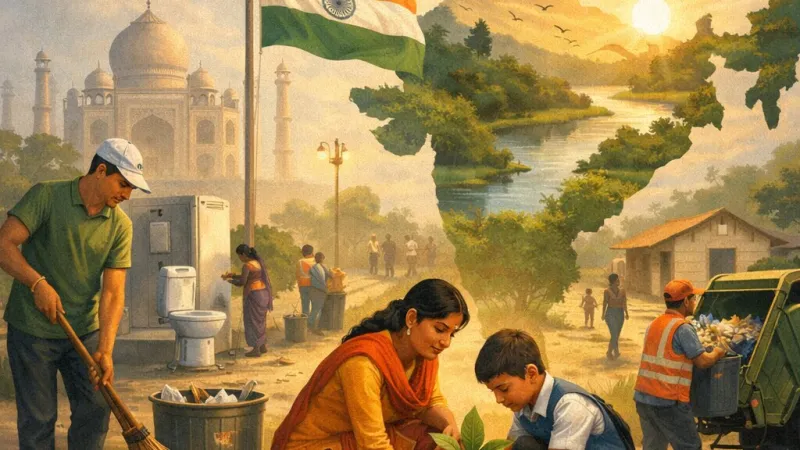
Explore the Swachh Bharat Abhiyan's goals and impact to understand how this key initiative promotes cleanliness and a healthier India.
Paragraph on Swachh Bharat Abhiyan
“Cleanliness is next to godliness”—this age-old proverb is deeply rooted in Indian tradition. From the earliest days, Indian scriptures and teachings, like those found in the Manusmriti and Charaka Samhita, have emphasised the significance of swachhata (cleanliness) not only for health but also as a symbol of social progress and self-respect. Clean surroundings are the bedrock of a healthy community, contributing to both physical well-being and the dignity of its people. However, despite such a rich heritage, modern India had, for many years, struggled with challenges like open defecation, unmanaged waste, and poor sanitation. In response to these persistent issues, Swachh Bharat Abhiyan was launched as a national mission to transform our nation into a cleaner, healthier, and more dignified society. This essay delves into the genesis, objectives, achievements, challenges, and the future vision of Swachh Bharat Abhiyan, a campaign with the potential to redefine not just India’s physical landscape, but also its mindset.
Historical Background and Genesis of Swachh Bharat Abhiyan
Cleanliness is not a new concept to the Indian subcontinent. Traces of well-planned drainage systems from the Indus Valley Civilization at sites like Mohenjo-Daro and Harappa reflect an ancient understanding of public hygiene. Ayurveda, the age-old science of health and longevity, has also always linked cleanliness with good health. No figure in Indian history, however, epitomises the concept of swachhata as powerfully as Mahatma Gandhi, who believed that “Sanitation is more important than independence.” He often cleaned toilets himself to break the stigma attached to sanitation work and to send a powerful message about dignity of labour.Despite these foundations, post-independence India struggled to provide universal access to toilets and sanitation. The government launched the Nirmal Bharat Abhiyan, but its efforts, though sincere, achieved success on a limited scale. Recognising the urgency and magnitude of the sanitation crisis, Prime Minister Narendra Modi launched the Swachh Bharat Abhiyan on Gandhi Jayanti, 2nd October 2014, from Rajghat—thus linking the mission symbolically with the spirit and teachings of the Mahatma. Two ministries—the Ministry of Drinking Water and Sanitation for rural, and the Ministry of Housing and Urban Affairs for urban areas—were entrusted with implementing this ambitious campaign, backed by a substantial government budget and a spirit of mass mobilisation.
Objectives and Importance of Swachh Bharat Abhiyan
The Swachh Bharat Abhiyan, meaning ‘Clean India Mission’, was envisioned to systematically address major shortcomings in public health and hygiene. Its core objective was to eliminate open defecation and make India ‘Open Defecation Free’ (ODF), a task involving the construction of millions of new toilets in the remotest villages and bustling cities alike. Other crucial aims included promoting solid and liquid waste management, increasing awareness about personal and community hygiene, and changing entrenched habits that perpetuate unhygienic practices.The deeper significance of this mission is most felt in the areas of health and social equality. Lack of sanitation infrastructure has historically been a leading cause of diseases such as diarrhoea, malaria, cholera, and even severe undernutrition among children. Providing toilets also empowers women and girls—offering them privacy and safety, and reducing the risk of harassment and exploitation, which in turn improves school attendance among girl students. At a broader level, Swachh Bharat has also played a role in restoring dignity to people previously forced to defecate in the open or work in demeaning conditions.
From an environmental perspective, the mission has facilitated a reduction in the level of soil and water pollution by minimising untreated human waste in the environment. Clean streets and public places have improved the look and feel of our cities and villages, promoting not just health, but also tourism and economic activity.
Structure and Components of the Mission
Swachh Bharat Abhiyan was designed as a two-pronged mission: Swachh Bharat Gramin focused on rural cleanliness, and Swachh Bharat Urban targeted urban sanitation and waste management. Under the rural segment, crores of toilets were built in households, schools, and community spaces across thousands of gram panchayats. In the cities, the construction of public and community toilets became a key focus, along with systematic garbage collection and processing.A distinctive feature of the campaign was its emphasis on mass awareness and citizens’ participation. Rallies in villages, cleanliness pledges in schools, and “Shramdan” (voluntary cleaning work) brought together people from all walks of life. Media campaigns, Bollywood actors, and even cricketers like Sachin Tendulkar lent their voices, while various competitions and “Swachhata Pakhwada” initiatives on campuses deepened its reach. Use of technology—for example, mobile apps for reporting unclean areas—helped increase transparency and real-time monitoring.
Community participation proved to be the backbone of the mission. From local panchayats organising cleanliness drives to corporates investing in sanitation infrastructure under CSR (Corporate Social Responsibility), every stratum of society was called upon to participate. Swachh Bharat became not merely a government scheme, but a people’s movement.
Achievements and Impact So Far
In numerical terms, the accomplishments of Swachh Bharat Abhiyan are truly remarkable. By October 2019, more than 110 million toilets had been constructed in rural India, leading to the declaration of over 600 districts as ODF. States like Kerala, Sikkim, and Haryana emerged as trailblazers, achieving near-total ODF status well ahead of deadlines. On the urban front, lakhs of public and community toilets, as well as robust waste collection systems, were set up in many municipalities.One of the most transformative impacts has been seen in girl child education—attendance in schools has noticeably risen with the provision of clean and functional toilets, addressing a long-standing barrier for adolescent girls. The tourism sector too witnessed brighter prospects: clean ghats in Varanasi and beaches in Goa attracted more visitors, while the Swachh Survekshan surveys fostered healthy competition among cities for cleanliness rankings.
Additionally, the scheme has opened avenues for rural and urban employment, from toilet construction to roles in waste processing and sanitation management. Internationally, Swachh Bharat has been hailed as one of the world’s largest sanitation drives; the United Nations noted its significant contribution towards Sustainable Development Goal 6 (Clean Water and Sanitation).
Challenges and Criticisms Faced
However, no large-scale movement is without hurdles. Swachh Bharat Abhiyan, despite its achievements, has faced several challenges. Deep-rooted behavioural patterns are one of the toughest blocks to shake—many households, especially in rural parts, continued open defecation due to social taboos or lack of awareness, even after receiving toilets.The quality of infrastructure built also remained a concern. Instances of incomplete or poorly constructed toilets, lack of water supply, or neglect of maintenance threatened the campaign’s sustainability. Unrealistic reporting—such as premature ‘ODF’ declarations—sometimes belied on-the-ground realities, creating gaps between official statistics and actual progress.
Financial constraints and administrative delays caused bottlenecks, while densely populated urban areas continued to grapple with unsegregated waste and overburdened garbage collection systems. Despite massive awareness campaigns, changing mindsets proved to be a long-term task, not a one-time effort.
Future Vision and Way Forward
Recognising these challenges, Swachh Bharat entered its second phase post-2019, aiming to focus as much on sustainability as on coverage. The new approach stresses on solid and liquid waste management, eliminating single-use plastics, and ensuring that toilets built are actually used and maintained. There’s an increasing drive towards encouraging citizens, especially students, to become ambassadors of cleanliness in their own homes and communities.Technology is expected to play a greater role: smart bins, GPS-enabled tracking of garbage trucks, and real-time cleanliness monitoring are being piloted in various cities. Linking sanitation with other government initiatives, like Jal Jeevan Mission for clean water access, has been proposed to create a holistic approach.
A truly sustainable Swachh Bharat requires that every citizen feel ownership over public spaces. This means integrating cleanliness drives into school timetables, recognising local heroes of sanitation, and incentivising Panchayats, RWAs (Resident Welfare Associations), and even individual households for upholding cleanliness standards. India may also benefit from adopting best practices from countries like Singapore or Japan, where cleanliness is a part of national identity, albeit adapted to suit our unique scale and diversity.
Conclusion
Swachh Bharat Abhiyan signifies much more than the building of toilets or the cleaning of streets. It is a social revolution, aiming to change mindsets as much as our environment. The journey so far has propelled India towards a cleaner, safer, and more inclusive society, but much remains to be done. The mission’s baton must now be passed on to every citizen, making swachhata a way of life rather than merely a government-driven initiative.In honouring the principles dear to Mahatma Gandhi, Swachh Bharat is not just about achieving targets—it is about dignity, respect, and national pride. The promise of a clean India rewards not only our generation but paves the way for healthier, happier futures. As the slogan goes—“Na gandagi karenge, na karne denge” (I will not indulge in dirt, nor let others do so). Only with this collective resolve can the dream of a truly Swachh Bharat be realised, making our ancient land glorious not only in history, but also in hygiene and humanity.
Rate:
Log in to rate the work.
Log in