Sunita Williams: The Inspiring Journey of an Indian-American Astronaut
This work has been verified by our teacher: 23.04.2026 at 14:30
Type of homework: Essay Writing
Added: 21.04.2026 at 13:33
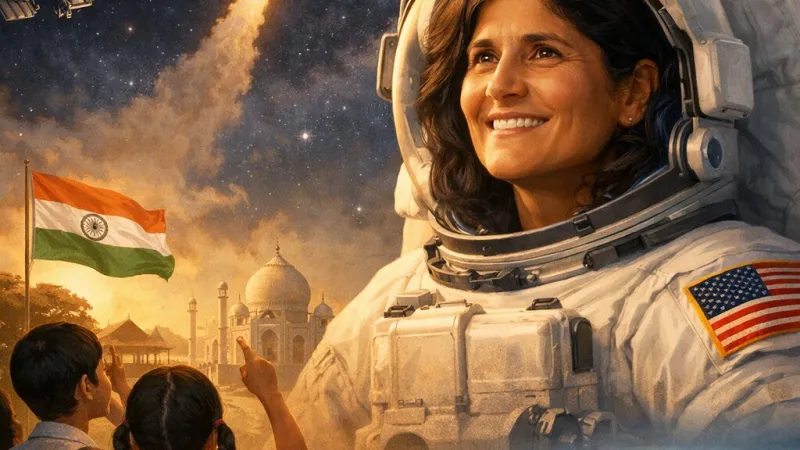
Summary:
Explore the inspiring journey of Sunita Williams, the Indian-American astronaut who overcame challenges to excel in space and inspire students in India 🚀
An Inspiring Journey of Sunita Williams: The Indian-American Astronaut Who Conquered Space
There are few individuals whose journeys transcend borders and ignite the spark of curiosity in millions, particularly in the field of science and space exploration. For students in India, especially young women aspiring to break the glass ceiling, Sunita Williams stands as a shining example. Her life story seamlessly weaves together the fabric of two cultures—Indian and American—and exemplifies dedication, courage, and the relentless pursuit of dreams. This essay delves into the life and accomplishments of Sunita Williams, highlighting how she inspires countless students and fosters a sense of pride within the Indian diaspora.
Early Life and Background
Sunita Williams was born in Euclid, Ohio, in the United States on September 19, 1965. Her roots trace back to India, as her father, Dr. Deepak Pandya, hails from Gujarat and migrated to the United States in pursuit of further education and career prospects. Her mother, Bonnie Pandya, was an American of Slovenian descent, and from this union, Sunita received a unique cultural inheritance. Growing up as the youngest among her siblings, she was exposed to a vibrant blend of traditions, values, and aspirations at home.Her upbringing beautifully reflected the Indian samskara of respecting elders, seeking knowledge, and maintaining humility, coupled with the American ethos of independence and self-expression. Festivals like Diwali and Holi were celebrated at home alongside Thanksgiving, creating a well-rounded personality that could embrace both worlds. This dual background not only enriched her personal life but also instilled in her a sense of confidence and adaptability that would later define her professional path.
Education has always been considered a gateway to advancement in Indian culture, a value upholding by Sunita’s family. She attended Needham High School in Massachusetts, where her natural curiosity led her to shine in academics, with a particular inclination towards science and sports. Her interest in understanding how the world works, combined with the encouragement from her teachers and family, positioned her to take up Physical Science at the United States Naval Academy.
Higher education took her further; she pursued a master's degree in Engineering Management from the Florida Institute of Technology. In reflection, it was this unwavering focus on learning, a trait so cherished in Indian households, that gave Sunita the mental and technical framework required for her adventures beyond Earth.
Early Career in the US Navy
Sunita’s decision to embark on a career with the United States Navy was driven by a thirst for adventure and a deep love for flying, which she developed during her university days. The armed forces, both in India and abroad, are seen as symbols of discipline, dedication, and patriotism—her choice resonated with values passed on from both cultures. Upon joining, she broke conventions, as female aviators were, and still are, a rarity in many parts of the world.Her training at the Naval Air Training Command was demanding, requiring not only academic brilliance but also immense physical stamina. Sunita quickly stood out for her unmatched work ethic and adaptability, flying over 30 different types of aircraft during her service. Her contributions extended from serving as a helicopter pilot on active missions to participating in crucial rescue operations.
These experiences polished her leadership abilities and honed her skills in teamwork, strategy, and resilience—qualities fundamental to both soldiers and astronauts. The ability to remain calm under pressure, solve complex problems, and work efficiently within a team are priorities in the armed forces; these very qualities were her passport to the next phase in her journey—space.
Journey to Becoming a NASA Astronaut
In 1998, Sunita Williams was selected as an astronaut candidate by NASA, the United States space agency renowned for sending humans beyond the boundaries of our planet. The selection process was extremely rigorous, with thousands of highly qualified individuals competing from various backgrounds, including scientists, engineers, and pilots. Sunita’s technical expertise, extensive flying record, and demonstrated leadership set her apart, marking her entry into a prestigious club.Once at NASA’s Johnson Space Center in Houston, Texas, she underwent an intensive training programme. This included simulations replicating space conditions, underwater exercises to prepare for spacewalks (known as Extra-Vehicular Activities or EVAs), survival drills in remote environments, and detailed studies of spacecraft systems. Such training tests both body and mind, much like the ancient Indian practice of tapasya, where strength, patience, and focus are honed through rigorous methods.
Many trainees find the adaptation to space environment challenging—weeks of training for weightlessness, dealing with claustrophobia, and maintaining physical fitness to counteract the weakening effects of microgravity. Sunita’s previous experience in the Navy, along with her inner resolve, made her one of the top performers in these trials.
Space Missions and Achievements
Sunita Williams' space journey began in December 2006, when she launched aboard Space Shuttle Discovery as part of Expedition 14/15. She spent over 195 days continuously in space—a record for women at the time—and later accumulated a total of more than 321 days in orbit over two missions. Her tasks on the International Space Station (ISS) were many: conducting scientific experiments, operating and maintaining complex space equipment, and leading several spacewalks.Of particular note are her spacewalk achievements. Sunita completed seven EVAs, spending more than 50 hours working outside the spacecraft—a global record for women until recently. Such spacewalks are crucial for repair, installation, and research far outside the comfort of the ISS’s walls.
What made Sunita’s missions more relatable to Indians was her gesture of carrying sacred items—she brought a copy of the Bhagavad Gita, an idol of Lord Ganesha, and a small figurine of Hanumanji aboard the ISS. These items not only reminded her of her Indian heritage but also signalled to millions back home that cultural roots can be celebrated even in the most modern of professions.
Sunita's spirit went beyond her duties; she even ran the Boston marathon from a treadmill on the ISS, synchronizing with the event on Earth. This unique feat showcased the boundless possibilities of the human mind and body.
Recognition and Awards
Sunita Williams has received wide recognition across the globe. In India, she was honoured with the Padma Bhushan, a prestigious civilian award conferred for exceptional service. The Gujarat government has recognised her achievements by welcoming her with public celebrations on her return. Additionally, she received the Sardar Vallabhbhai Patel Vishwa Pratibha Award—honouring those of Indian origin who have excelled internationally.Her contributions are not confined to national borders. The Russian government awarded her the Medal for ‘Merit in Space Exploration’, acknowledging her work in joint missions involving Russian cosmonauts. Such recognition highlights her role as an ambassador for global cooperation in space, bridging divides that often separate nations on Earth.
Sunita's membership in numerous professional organisations, such as the Society of Experimental Test Pilots and the American Helicopter Society, reflects her continuing commitment to the advancement of science and education.
Personal Life and Values
Sunita's personal life is a testament to her grounded nature. She is married to Michael J. Williams, a federal police officer, and has often expressed how the support and understanding of family members is crucial for anyone in demanding professions. Choosing not to have children, she has focused her energies on her career without compromising on her values.Her humility, courage, and sense of devotion stand out—even in interviews and public appearances, she often credits her achievements to her roots and her relentless pursuit of learning. Her respect for Indian customs is evident from the way she celebrated festivals with colleagues at NASA and carried symbols of faith to space.
Impact and Legacy
What makes Sunita Williams a role model, particularly in the Indian context, is her ability to break barriers. At a time when science and technology are still sometimes perceived as male-dominated domains in India, her journey sends a powerful message to young girls: no goal is unattainable. Her achievements are regularly cited at science fairs, classroom discussions, and popular motivational talks across schools and colleges.By inspiring students to pursue careers in STEM (Science, Technology, Engineering, Mathematics), she encourages a generation to dream beyond conventional careers. Her life proves that one can carry their culture with pride, embrace challenges, and collaborate on the global stage.
Sunita also symbolizes the unity possible through scientific exploration. Her missions, involving astronauts from Russia, America, Europe, and other nations, remind us that space knows no borders. In today’s world, where cultural and political rifts are common, her example becomes even more relevant.
Challenges and Lessons Learned
Space missions are fraught with risks—physical exhaustion, isolation, prolonged separation from loved ones, and the psychological toll of living in a confined environment. Williams often speaks candidly about the difficulties she endured: missing home, adapting to weightlessness, and the constant vigilance required to tackle unforeseen technical glitches.As an Indian-American, she had to carve out an identity, repeatedly proving herself both in a foreign land and a demanding profession. Her journey teaches us not just about chasing ambitions, but about perseverance through failures. In her interviews, Sunita often tells young aspirants: “Mistakes are part of learning; it’s the journey that counts.”
Conclusion
Sunita Williams’ life, from a curious child in the United States with Indian roots to a celebrated astronaut, embodies the spirit of boundless possibility. She has become a source of inspiration to students, especially girls across India, by demonstrating that persistence, open-mindedness, and cultural pride can pave the way for extraordinary accomplishments.Her legacy is captured best in her own words: “If you have a dream and you believe in it, you can achieve anything.” Through her example, Sunita Williams remains a beacon, guiding countless Indian youth to reach for the stars—showing them that the path of knowledge and courage holds no limits.
Rate:
Log in to rate the work.
Log in