Comprehensive Analysis and Summary of Mrs. Packletide’s Tiger for Class 10
This work has been verified by our teacher: 25.04.2026 at 11:46
Type of homework: Essay Writing
Added: 22.04.2026 at 10:55
Summary:
Explore a detailed analysis of Mrs. Packletide’s Tiger for Class 10 students, covering themes, characters, and social satire to enhance your essay skills.
A Critical Study of “Mrs. Packletide’s Tiger” by Hector Hugh Munro: Themes, Characters, and Social Commentary
Among the many gems of the Class 10 English curriculum, “Mrs. Packletide’s Tiger” by Hector Hugh Munro—better known by his pen name Saki—stands out as a masterful satire. Saki, whose works are renowned for their sparkling wit and biting critique of Edwardian society, brings his unique literary style to this short story. The narrative, set in colonial India, draws readers into the peculiar world of English aristocrats, their social games, and absurd pretensions.
This story is not merely a humorous episode involving a rather pitiful tiger and a very ambitious lady, but a mirror held up to certain universal human flaws—vanity, competition, and the ever-present desire to surpass one’s peers. For young Indian students, the piece provides both entertainment and a window into the intertwined issues of colonial attitudes and personal ambition. Through this essay, I aim to examine the story’s context, plot, and characterisation, analyse its themes, and reflect on its continued relevance in our society.
---
Context and Setting
Geographical and Cultural Landscape
“Mrs. Packletide’s Tiger” is set against the backdrop of British colonial India, a period when the upper echelons of society often found elaborate ways to show off their power and wealth. Hunting tigers in India was considered an ultimate sign of bravery and prestige among the British elite—an activity often celebrated in British clubs and society columns back home. Saki’s depiction of this environment brings out the dichotomy between the wildness of the Indian jungle and the artificiality imposed upon it by colonial customs.The story also subtly reflects the social scenario of the time—it was not uncommon for Indian villagers to become participants in the amusements arranged by the powerful, motivated more by financial rewards than any attachment to the colonial culture. In other words, the story is about more than just Mrs. Packletide or a tiger—it is an accurate snapshot of the times, where appearances mattered more than authenticity, and nature itself was turned into a stage for social display.
Historical and Social Perspective
During the colonial period, the activities and interests of high-society British women were relatively constrained. “Achievements” often revolved around social one-upmanship—being seen as more daring, more fashionable, or more influential than one’s peers. The story’s central conflict arises from precisely this competition: Mrs. Packletide’s envy of Loona Bimberton’s aerial adventure triggers a chain of events laced with satire and irony.In Indian literature and history, we come across multiple instances of similar social contests, not just among colonisers but within the Indian royal class as well. Even today, remnants of these values can sometimes be seen during lavish weddings or social gatherings, where displays of wealth and adventure serve as markers of status.
---
Plot Analysis
Summary of Key Events
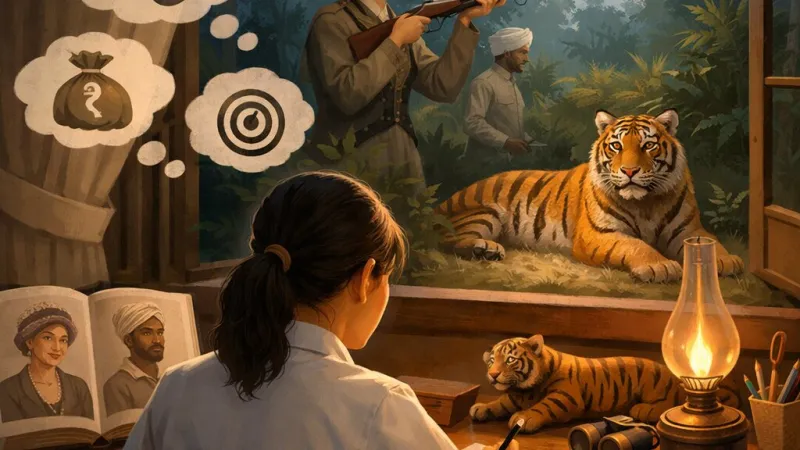
The narrative begins with Mrs. Packletide’s growing irritation at her friend-rival Loona Bimberton, who has managed to capture the attention of society with her feat of shooting a tiger from a hot air balloon in Africa. Stung by jealousy, Mrs. Packletide resolves to outdo her rival and get herself photographed with a tiger she herself has hunted, hoping thereby to become the centre of social attention.For the right price, a group of Indian villagers agrees to help her arrange a convenient—and risk-free—hunt. They have just the solution: an old, feeble tiger that barely strays beyond the edge of the jungle and is too weak to hunt food by itself. With bait procured and every precaution in place (including a goat tied as lure and armed villagers nearby), Mrs. Packletide is assured of a safe victory.
On the big night, accompanied by her paid companion Miss Mebbin, Mrs. Packletide fires her rifle but misses the tiger—her bullet instead kills the poor goat. However, the tired old tiger dies of shock, presumably from the gunshot sound. Despite not firing the fatal shot, Mrs. Packletide claims the kill. The event is publicised, she hosts a grand luncheon for Loona Bimberton (though her rival refuses to eat tiger meat), and enjoys her moment of fame.
But Miss Mebbin—who had observed everything with sharp eyes and a sharper mind—blackmails Mrs. Packletide. She threatens to reveal the truth unless rewarded with a cottage of her own, which Mrs. Packletide is forced to grant. The story ends with Mrs. Packletide swearing never to shoot again—all because of the costs associated with “moral retribution”.
Narrative Techniques
Saki’s brilliance, apart from the plot’s comic absurdity, lies in his use of irony. The entire premise is filled with understated humour—the idea that a hunt could be so carefully orchestrated that even the tiger’s death is by accident, and the “huntress” ends up outwitted by her own companion.Characterisation is subtle but pointed. Miss Mebbin’s sly opportunism, Mrs. Packletide’s vanity, and even the villagers’ cooperative greed are painted in crisp strokes, making them immediately relatable and real.
---
Character Study
Mrs. Packletide
Mrs. Packletide epitomises vanity and envy—her desire to hunt a tiger emanates not from any love for adventure, but from a burning need to upstage Loona Bimberton. Her actions throughout are shallow and transactional: she pays for a “hunt”, arranges publicity, and seeks only to bask in reflected glory. Saki presents her as a deeply flawed, yet recognisably human, character—her weaknesses are easy to laugh at but also provoke some inward reflection.Loona Bimberton
Though Loona does not actually appear in the story, her influence is ever-present. She represents the social ideal to which Mrs. Packletide aspires, and her feat—a genuine, if somewhat absurd, accomplishment—serves as the catalyst for the entire episode. Many Indian students may relate this to the ever-present competition within classrooms, where comparison with peers can often overshadow personal satisfaction.Miss Mebbin
Miss Mebbin, Mrs. Packletide’s paid companion, is sharp-witted and unashamedly materialistic. Her tendency to look after “her own interests” (protecting the goat, for example) and her ultimate blackmail of Mrs. Packletide show her as clever and opportunistic. She becomes a central figure in the story’s climax, demonstrating that greed and cunning are not limited to the upper class, but pervade all social strata.The Villagers
The villagers’ role is pragmatic—they are willing partners, motivated more by the reward money than any thrill for the hunt. Their willingness to enable the fiction of Mrs. Packletide’s hunt—by luring the tiger and arranging every detail—reflects both social inequality and economic reality. In many parts of rural India, this readiness to collude for financial gain is a reflection of the hardship faced by villagers for survival.---
Themes and Messages
Vanity and Social Competition
Saki mocks the endless game of social competition. Mrs. Packletide’s efforts are driven by pure ego and comparison, rather than genuine achievement. Like many societal contests in India (and across the globe), this episode reveals how vanity can push individuals to absurd lengths.Deception and False Pride
The “hunt” is a manufactured event—there is nothing authentic about it. Yet, Mrs. Packletide is only too eager to project herself as a courageous hunter, embodying the theme of false pride. The story invites readers to question such hollow accomplishments and reflects the importance of honesty and integrity over mere appearances.Irony and Satire on Colonial Leisure
Saki’s story is full of satirical jibes at the colonial obsession with animal trophies and game hunting. In India, hunting tigers was a source of pride among the British and Indian ruling classes alike. The story exposes the hollowness and artificiality of this pursuit.Human Greed and Opportunism
Miss Mebbin and the villagers both represent shades of human greed. While Miss Mebbin’s blackmail is a critical turning point, the villagers’ willingness to “arrange” the event for payment highlights the transactional nature of the entire episode.Role of Media and Perception
Much is made of newspaper reports, photographs, and public recognition. This obsession with societal validation is not very different from today’s world, where social status and self-worth are often measured by others’ approval, whether in print or online.---
Language and Style
Satire and Humour
Saki’s tone is light, yet scathing. His narration is laced with wit—a hallmark of his writing. For instance, he refers to Mrs. Packletide’s “morbid dread of censure” and Loona Bimberton’s “reluctant consent” to attend the luncheon, which beautifully captures the artificiality and hypocrisy of the characters.Descriptions and Imagery
Descriptions of the jungle and the tiger are vivid, yet often undercut by humour. The contrast between the wildness of nature and the tameness of the actual event is stark: the tiger is old, infirm, and the hunt is more farcical than heroic.Vocabulary and Expressions
Class 10 students might find words like “prodigality”, “nonchalant”, or “morbid” challenging, but Saki’s language is precise and greatly enhances the mood. These words are worth learning, as they capture subtleties of class, attitude, and emotional nuance.---
Moral and Lessons for Students
Vanity and its Futility
The story warns us against running after achievements purely to outshine others. Mrs. Packletide’s experience shows how attempts at shallow recognition can backfire, leading to embarrassment and unintended consequences.Deceit and its Price
Dishonesty may yield temporary advantages, but genuine achievements require integrity. Mrs. Packletide pays dearly—not just in money, but in loss of peace.Social Status and Values
Young readers should reflect on the difference between genuine worth and societal validation. The story encourages questioning prevalent values around fame, success, and materialism, which are deeply relevant in an age dominated by social media.---
Relevance in Contemporary Times
Social Media and Vanity
Today’s world, obsessed with likes, shares, and virtual approval, mirrors Mrs. Packletide’s hunger for social recognition. Many people go to great lengths for online validation, often resorting to trickery similar to the staged tiger hunt.Environmental and Ethical Dimensions
While hunting was once a mark of distinction, today society values wildlife conservation. The story prompts students to consider the ethical implications of using animals for sport or social display and to question traditions that lack empathy for nature.Universal Human Traits
Jealousy, greed, and pretence remain as present now as in Mrs. Packletide’s era. Literature, like this story, can help us develop empathy and cultivate a more reflective, ethical outlook.---
Conclusion
“Mrs. Packletide’s Tiger” is a clever, humorous story that delves into the depths of human folly—not just of one woman, but of an entire social order obsessed with appearance. Saki’s satire remains timeless, exposing vanity, opportunism, and the superficiality of social competitions. For students in India and elsewhere, reading such pieces is more than an academic exercise; it is a lesson in self-awareness, critical thinking, and ethical living.Through Mrs. Packletide’s farcical adventure, Saki not only entertains, but educates—and as students, we must learn to look beyond the laughter to the wisdom that underlies great literature.
---
Additional Tips for Class 10 Students
- Understand each character’s motivations—write practice character sketches. - Note key events in your own words; make brief summaries to revise quickly. - List out difficult words, learn their meanings, and try using them in your own sentences. - In exams, be precise, support your points with examples from the text, and always highlight the story’s underlying message. - Practice answering old question papers under timed conditions to improve confidence and performance.In the end, may your study of literature not just fetch marks, but foster wisdom and insight!
Rate:
Log in to rate the work.
Log in