10 Key Points Explaining the Meaning and Importance of the Indian National Flag
This work has been verified by our teacher: 25.04.2026 at 10:00
Type of homework: Essay Writing
Added: 22.04.2026 at 12:14
Summary:
Discover 10 key points explaining the meaning and importance of the Indian National Flag and learn its symbolism and significance in Indian history. 🇮🇳
An In-Depth Exploration of the Indian National Flag: Symbolism, Significance, and Respect
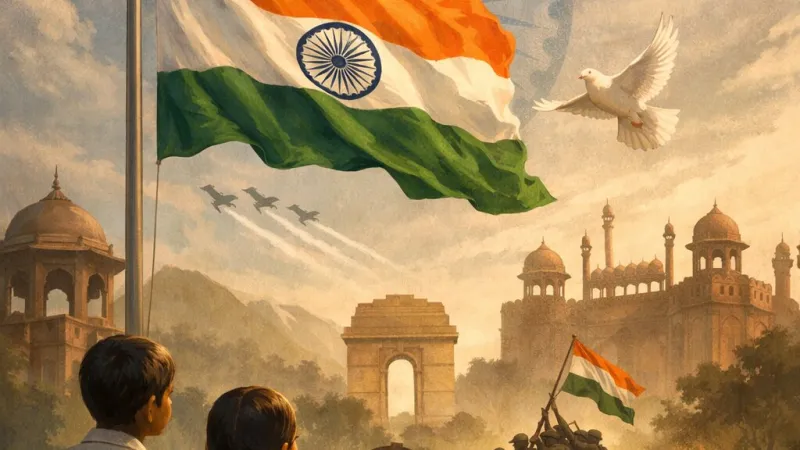
Every nation in the world identifies itself through emblems and symbols that connect its citizens with a shared sense of purpose and unity. Among these, the National Flag stands out as a most powerful representation of a country’s identity, aspirations, and struggles. For Indians, the Tricolour or Tiranga is not merely a piece of fabric fluttering in the wind; it embodies the dreams, sacrifices, and unyielding spirit of an entire subcontinent. The National Flag stands tall over government institutions, in schools, and even in the hands of children during national celebrations, epitomising the collective heartbeat of millions. This essay seeks to explore the Indian National Flag in depth—its design, underlying symbolism, historical journey, protocols, and above all, the special place it holds in the Indian ethos, from the days of the freedom struggle to modern times.
---
Historical Background of the Indian National Flag
India’s journey to freedom was long and arduous, and the National Flag’s evolution is tightly interwoven with this history. During the struggle for independence, several different flags were used as rallying points for the masses. The first collective expression came in 1906, when the “Calcutta Flag” was unfurled by the leaders, with bands of green, yellow, and red, denoting unity and religious harmony. Later, Madam Bhikaji Cama, a remarkable figure in the expatriate community, raised an early version of the flag at an international socialist conference in Stuttgart in 1907, capturing the world’s attention to India’s quest for independence.The Indian National Congress, which was central to the freedom movement, played a crucial role in galvanising support and revising the flag’s design. It was in 1921 that Mahatma Gandhi asked Pingali Venkayya, a visionary and freedom fighter from Andhra Pradesh, to design a flag that would resonate with all Indians. After several iterations, the current form was officially adopted by the Constituent Assembly on 22 July 1947, just days before Independence. The chosen design beautifully reflected India’s pluralism, rich culture, and high ideals—the very soul of the nation as envisioned by its founding leaders.
---
Design Elements of the National Flag
The Indian National Flag is distinctive for its elegant simplicity and deep symbolism. It comprises three horizontal stripes of equal width. The upper most is deep saffron (Kesari), representing courage, sacrifice, and renunciation—characteristics seen in the saints, soldiers, and countless martyrs who shaped the nation’s destiny. The middle band is pristine white, signifying peace, purity, and honesty; its presence calls every citizen to uphold the truth and seek harmony. The bottom most band is rich green, indicative of faith, fertility, and the land’s prosperity—a tribute to the country’s agricultural roots, so vital in a land where the majority are cultivators and nature lovers.At the centre of the white stripe lies the Ashoka Chakra, a navy blue wheel with 24 spokes, inspired by the Lion Capital of Ashoka at Sarnath. This ancient symbol stands for eternal progress, righteousness (Dharma), and relentless motion. Unlike static emblems, the Chakra embodies dynamism, reminding the nation to advance continuously towards justice and moral duty, as enshrined in the ethos of Emperor Ashoka.
The precise proportions of the flag, as laid down by the Flag Code of India, reflect both mathematics and aesthetics: the ratio of its length to its width is 3:2, and the Chakra is perfectly centred and sized to fit harmoniously within the design. Such attention to detail underlines the respect attached to the national emblem.
---
Symbolic Meanings Embedded in the Flag
The Tiranga is not a mere arrangement of colours. Each stripe and the wheel collectively encapsulate India’s values and constitutional vision. The colours seek to unite a vast mosaic of languages, faiths, and communities, symbolising brotherhood within diversity. The saffron at the top encourages us to act selflessly, rising above personal interests, while the white stripe is an ever-present conscience, bidding citizens to forge unity through truth and peace.The Ashoka Chakra, in particular, resonates with profound significance. Its 24 spokes signify virtues like love, courage, patience, and justice, values central to India’s ancient dharmic philosophy. The green below assures us that regeneration and progress are possible when we remain rooted to our land and values. Together, the flag visualises the hope that India will remain committed to justice, freedom, and growth, irrespective of the challenges, reflecting the spirit of the Constitution and the values endorsed by Dr. B.R. Ambedkar and other architects of modern India.
---
Protocols and Rules Governing the Indian National Flag
Because of its sacred place in national consciousness, the Indian Flag is protected by strict laws and codes. The Prevention of Insults to National Honour Act, 1971, expressly forbids any disrespect, mutilation, or improper use of the flag. The Flag Code of India elaborates in detail how and when the flag can be hoisted, displayed, and stored.The flag must always be flown with dignity—hoisted briskly and lowered slowly, as a mark of respect. It must never touch the ground or be dipped in salute to any person or thing; it should not be draped as clothing or as a decoration, nor used for commercial purposes such as advertising. During national events like Independence Day and Republic Day, the Tiranga is unfurled with great ceremony while the national anthem is sung, fostering a deep collective pride.
Any violation of these protocols is treated seriously under Indian law, with penalties prescribed for wilful disrespect or misuse. These rules are not merely legal strictures—they are reminders to every citizen that honouring the flag is respecting the nation itself.
---
The National Flag and Its Role in India’s Freedom Movement
During the colonial era, the National Flag grew into a symbol of hope, resistance, and unity. It served as a rallying point for revolutionaries and commoners alike. When leaders like Pandit Jawaharlal Nehru, Sardar Vallabhbhai Patel, and Netaji Subhas Chandra Bose addressed vast crowds, the Tricolour fluttered above, infusing courage into those striving for independence.Many freedom fighters made unimaginable sacrifices, carrying the flag into protests, risking arrest, and even their lives. One such poignant episode was the Jallianwala Bagh massacre in 1919, where protestors—some with homemade versions of the future flag—stood undaunted before imperial guns. After the Dandi March, the image of the Tricolour became synonymous with the call for ‘Swaraj’ (self-rule). Even after independence, the flag continues to remind us of the sweat, tears, and dreams of those who struggled for the birth of a free India.
---
The Flag’s Contemporary Significance and Emotional Resonance
Today, the National Flag is more than just a historic artefact—it is a vibrant presence in everyday India. On important national holidays, it is hoisted in schools, government buildings, and residential colonies. Schoolchildren, dressed in neat uniforms, gather around the flagpole and sing ‘Jana Gana Mana’, feeling a surge of patriotic pride. During international sporting events, athletes drape the Tricolour around their shoulders on victory podiums, uniting millions across the country in joy and celebration.In times of conflict or national challenges, the flag becomes a beacon of hope and solidarity. Whether during disaster relief or when Indian armed forces engage in peacekeeping, the unfurling of the National Flag reaffirms faith in the unity and resilience of the people. Internationally, the flag is the face of India, representing the country’s diversity, integrity, and growing stature.
---
Common Misconceptions and Importance of Awareness
Despite the sacred status of the Tiranga, there are many misconceptions about its colours and proper use. Some believe, wrongly, that the saffron stands only for Hinduism or the green only for Islam, when in truth, the colours are meant to reflect broader virtues and ideals, not religious affiliations. Commercial misuse, such as printing the flag on disposable items or using it casually in advertisements, remains a concern.To address these issues, awareness campaigns led by both the government and NGOs strive to educate citizens on the Flag Code and the importance of respect. Educational institutions are being encouraged to teach students the correct way to handle and display the flag, so that the coming generations uphold the traditions and pride associated with the Tricolour.
---
Rate:
Log in to rate the work.
Log in