Celebrating Teacher’s Day: Honouring the Pillars of Education in India
This work has been verified by our teacher: 26.04.2026 at 11:08
Type of homework: Essay Writing
Added: 25.04.2026 at 9:16
Summary:
Explore the significance of Teacher’s Day in India and learn how it honors educators who shape minds and inspire generations every September 5th. 📚
Teacher’s Day: A Homage to Our Torchbearers
Every society stands upon pillars of knowledge, values, and character, and few contribute more enduringly to the construction of these pillars than teachers. Throughout history and literature, teachers have been likened to divine architects, quietly moulding minds and shaping spirits. In India, a country with a profound reverence for education, we dedicate one day annually—5th September—entirely to the celebration of teachers. Observed as Teacher’s Day, this occasion is both a commemoration and a heartfelt gesture of respect, affection, and gratitude toward our educators. Far from being a mere formal celebration, Teacher’s Day symbolises our collective recognition of the invaluable role teachers play in the progress of individuals and the nation as a whole. This essay endeavours to explore the origins, traditions, significance, and evolving nature of Teacher’s Day in India, while reflecting on the timeless importance of the Guru-Shishya relationship in our cultural fabric.
---
Historical Background of Teacher’s Day in India
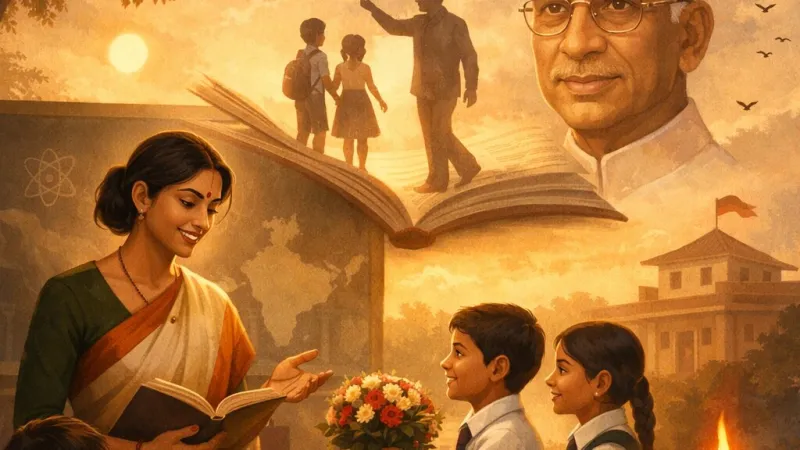
Teacher’s Day in India is celebrated on 5th September, marking the birth anniversary of Dr. Sarvepalli Radhakrishnan. Widely regarded as one of India’s foremost intellectuals, Dr. Radhakrishnan’s life and ideals hold a special place in the heart of every Indian student and teacher.Born in 1888 in a modest Brahmin family in Thiruttani, Tamil Nadu, Dr. Radhakrishnan’s journey from a humble background to the highest constitutional office in the country is remarkable. He excelled in academics, earning distinctions at Madras Christian College. Later, he served as a member of faculty at several reputed institutions—Madras Presidency College, University of Mysore, and University of Calcutta. As a teacher, Dr. Radhakrishnan was known for his exceptional ability to explain complex philosophical ideas with simplicity and grace. He championed the Upanishadic spirit of inquiry and stressed that the purpose of education was not merely to fill minds with information, but to kindle critical thinking, ethical reasoning, and compassion.
It is said that when his students and well-wishers wanted to celebrate his birthday, Dr. Radhakrishnan humbly requested them to dedicate the day to all teachers instead. This humble gesture sowed the seeds for a nationwide celebration of teachers, a tradition that took root in 1962, during his tenure as India’s second President. His vision was clear: to elevate and honour the noble teaching profession, making every educator feel valued.
---
Significance of Teacher’s Day in Contemporary India
The celebration of Teacher’s Day goes well beyond showy events or customary greetings. In the Indian context, the teacher is often venerated as a Guru—one who dispels the darkness of ignorance. Literature and mythology are replete with instances highlighting the importance of the Guru, from the Mahabharata’s Dronacharya-Drupada episode to the tales of Chanakya and Chandragupta Maurya. The phrase “Acharya Devo Bhava” (The teacher is like God) captures this sentiment.But what makes this day truly significant in modern India? A teacher today is not only an academic guide but also a moral compass, a mentor, and sometimes a second parent. In a fast-changing society grappling with technological advancements and moral dilemmas, teachers provide much-needed direction and stability. Teacher-student relationships shape not just what we know but also how we think, feel, and act. Celebrating Teacher’s Day serves as a reminder for both students and society to reaffirm our commitment to respect, empathy, discipline, and the joys of lifelong learning.
Moreover, by dedicating a special day to teachers, we underscore the centrality of knowledge and wisdom in Indian society—a society that aspires to move towards “Jnana yoga” (the path of knowledge) and places education at the heart of its socio-economic progress.
---
Ways Teacher’s Day is Celebrated Across India
The beauty of Teacher’s Day in India lies in its diversity of celebrations, echoing the colourful mosaic of our nation.Schools and Colleges
Perhaps the most vibrant celebrations happen in schools and colleges. On this day, students come together to decorate classrooms with flowers, rangolis, and hand-made posters conveying their love and regards. The morning assembly often features speeches, poems, and sometimes even songs dedicated to teachers. In my school, for instance, students prepare a cultural programme consisting of skits, traditional dances, and mimicry acts, all lovingly tailored to entertain and honour the teachers.One of the most cherished rituals is the “role reversal”, where senior students step into the shoes of teachers for a few periods. This playful activity not only brings laughter but also instils in students a deep appreciation for the responsibilities teachers shoulder every day. Teachers, meanwhile, get to sit back and enjoy the festivities, receiving cards, chocolates, and thoughtful handmade gifts from their students, expressing personal gratitude.
Community and Public Observances
Beyond the formal educational institutions, many communities and public bodies organise felicitation ceremonies for outstanding teachers, presenting them with mementoes or certificates. Statues and portraits of Dr. Radhakrishnan in schools, libraries, or community halls are adorned with garlands as a token of collective respect.Alumni associations often use the occasion to invite former teachers for nostalgic reunions, where they recount past anecdotes and celebrate enduring bonds. These reunions can be emotional affairs, with students sharing how their teachers have shaped their life trajectories. The contributions of teachers in rural India, who often serve as beacons in resource-poor environments, are especially remembered.
The Online Era: Adapting Celebrations
In recent years, especially post-pandemic, the canvas of Teacher’s Day celebrations has expanded to the digital realm. Students send video messages, create digital cards, and participate in webinars. Social media platforms are flooded with hashtags and tributes, making it possible for even those separated by distance to send their heartfelt thanks. This evolution demonstrates the resilience and adaptability of both students and teachers in keeping the tradition alive.---
Objectives and Deeper Purposes of Celebrating Teacher’s Day
While celebrations add charm and colour, the true objectives of Teacher’s Day run much deeper.Honouring Unseen Efforts
First and foremost, the day is about recognising the quiet labour and sacrifices teachers make, often working beyond their official hours—evaluating papers into the night, counselling troubled students, or even contributing their own resources for classroom needs. By acknowledging these efforts, society validates their pivotal role.Cultivating Respect and Gratitude
Young students, frequently quick to take teachers for granted, learn through Teacher’s Day the priceless value of guidance, encouragement, and discipline. The event becomes a way of teaching by example, reinforcing moral values and the Indian tradition of regarding teachers as “second parents”.Reinforcing the Value of Education
At a time when India aspires to build a knowledge society, celebrating Teacher’s Day is a public reaffirmation of education as a national priority. It is a message from the grassroot level upwards—education is everyone’s business; teachers are everyone’s pride.Motivating Teachers
When teachers feel respected and celebrated, it motivates them to persevere in their noble mission, even when faced with inadequate infrastructure or societal apathy. Such encouragement is vital for the health of the education ecosystem.Perpetuating Dr. Radhakrishnan’s Ideals
Every Teacher’s Day celebration, whether grand or simple, is a living tribute to Dr. Radhakrishnan—his vision of enlightened teaching, and his philosophy that real education fosters inquiry, tolerance, and compassion.---
Challenges and The Path Forward
Even as we celebrate, it would be unwise to ignore the pressing challenges troubling Indian teachers today. Many, particularly in rural or economically weaker regions, grapple with large classrooms, poor facilities, and low salaries. There are stories of teachers travelling kilometers daily, working without basic amenities, and yet giving their best. In some cases, the societal status of teachers has declined in comparison to older times.To make Teacher’s Day more meaningful, we must look beyond ceremonies. There is a burgeoning need for active involvement of policymakers, NGOs, and communities in supporting teachers—be it through continuous professional development, better remuneration, or conducive work environments. Incorporating teacher training workshops, seminars on innovative teaching methods, and sessions on mental health can make Teacher’s Day a driver for real change.
The march of technology has altered teaching dramatically. Platforms like DIKSHA and e-Pathshala have empowered teachers, but also present new challenges in digital literacy and engagement. Teacher’s Day should now spotlight the need for digital upskilling, supporting teachers with new tools for the digital age.
Most importantly, let us strive to foster a culture where respect for teachers is perennial, not confined to a single calendar day. Let every student, every parent, and every citizen recognise the value of teachers in all spheres of life.
---
Conclusion
In sum, Teacher’s Day in India is a unique confluence of reverence, joy, reflection, and collective promise. Its origins in Dr. Radhakrishnan’s legacy serve as a beacon, inspiring us to value knowledge and those who impart it. The day is marked by lively celebrations in schools and touching public tributes, but its heartbeat lies in the gestures—large or small—that express gratitude, reinforce respect, and strengthen the teacher-student bond.As we remember the words of Kabir, “Guru Gobind dou khade, kaake lagoon paay; Balihari Guru aapne, Govind diyo batay,” we are reminded that teachers are the true pathfinders, illuminating our journey through life. Let us celebrate them with sincerity—not just on 5th September, but each and every day—by upholding their values, supporting their work, and carrying forward the torch of learning. To all teachers, past and present: thank you for being the guiding lights of our society.
Rate:
Log in to rate the work.
Log in