Building a Just Society Through Intergenerational Responsibility and Altruism
This work has been verified by our teacher: 3.05.2026 at 18:30
Type of homework: Essay Writing
Added: 30.04.2026 at 7:30
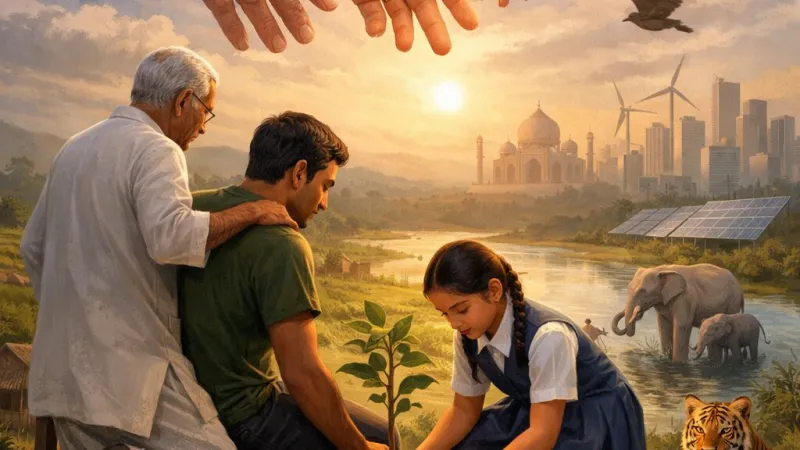
Summary:
Explore how intergenerational responsibility and altruism build a just society, ensuring ethical choices that protect India's future generations and environment.
Intergenerational Responsibility and Ethical Altruism: Foundations for a Just and Sustainable Society
Our world faces grave challenges that do not end with us, but instead ripple ahead into the lives of those yet to come. Climate change—reflected in the parched fields of Maharashtra, receding Himalayan glaciers, and choking Delhi smog—reminds us that our decisions today cast a long shadow on tomorrow. Equally, the depletion of groundwater, steady urbanisation swallowing agricultural land, and the vanishing of indigenous languages point to a larger question: do our ethical commitments extend beyond our immediate circle and our own timespan? Traditionally, moral thought in India has journeyed from the emphasis on individual dharma to broader concerns for samaj (society), and now, increasingly, towards a conscious care for future generations. This essay argues that the fusion of intergenerational responsibility and ethical altruism is vital to constructing a just, enduring, and equitable society. We will explore their philosophical roots, implications, challenges, and relevance through Indian cultural and contemporary frames, and propose a way forward for individuals and institutions alike.
Understanding Intergenerational Responsibility
Definition and Scope
Intergenerational responsibility can be understood as an ethical commitment to protect the well-being, rights, and opportunities of those who come after us, despite the fact that we may never meet them. It goes beyond mere stewardship of resources—it is about preserving the possibility for future generations to live well, to flourish, and to inherit a world not diminished by our negligence. This responsibility has both a temporal and moral dimension: it stretches our circle of concern to embrace unborn citizens whose lives are shaped by our current choices.Why Intergenerational Responsibility Matters
In the Indian context, such responsibility becomes palpable in problems like water shortages, air pollution, the destruction of forests in the Western Ghats, the drowning of mangroves near Mumbai, and the staggering burden of national debt accumulated with little foresight. These are not only environmental crises but also ethical failures. When urban expansion swallows agricultural communities, or ancient monuments decay from neglect, it is not only present well-being that is at risk, but also the rights of those who have no voice yet: the people of tomorrow. As moral agents, it is incumbent upon us to maintain not just the resources but the rich variety of choices, cultures, and connections that form the foundation of a meaningful life.Historical Perspective
Indian philosophical traditions have long embedded such responsibility. The concept of *dharma*—elucidated in the Bhagavad Gita—asks not only for individual righteousness but also for collective harmony (*lokasamgraha*). Kautilya's Arthashastra, though often considered a pragmatic treatise, insists that rulers act as trustees not for personal gain but for the enduring welfare of their subjects and posterity. These notions bear an eerie resonance with intergenerational ethics, which although more prominent in today's global policy debates, are deeply seeded in our cultural past. Unlike some utilitarian traditions, which have debated the tangible obligations owed to future persons, Indian dharma has often been unequivocal: the chain of life is unbroken, and we are its temporary bearers.Ethical Altruism as a Moral Framework
Definition of Ethical Altruism
Ethical altruism is the principle of acting selflessly for the betterment of others, placing their well-being on a par with, or above, one's own interests. It goes beyond the narrow confines of reciprocity—doing good because one may benefit later. Genuine altruism may entail personal sacrifice without any expectation of return or recognition.Philosophical Foundations
Philosophical schools across ages have wrestled with altruism. In Indian thought, the practice of *daan* (charity) and the Buddhist principle of *karuna* (compassion) both elevate the ideal of selfless action. Modern frameworks reinforce this: Kant’s categorical imperative enjoins us to act in ways that could become a universal law, leaving no room for selfish exception. John Rawls, though a Western philosopher, offered an instructive method—imagining moral choices from behind a 'veil of ignorance', ignorant of our own time and circumstances, pushing us to build systems fair not only to ourselves but to any possible future person.Altruism Extended to Future Generations
The difficulty—and necessity—of stretching altruism to encompass future lives is clear. Can we imagine the suffering or joy of children born a century hence? Moral philosophers like Amartya Sen have emphasised capabilities and justice for the many, not just the few or present. Hindu traditions, too, embed this extension: the notion of *pitru rin* (debt to ancestors) and *rishi rin* (debt to sages) demands repayment not just to the past, but as forward-giving, so that society continues to thrive. Thus, treating the future with care is both a logical and cultural progression of altruism.Interconnection between Ethical Altruism and Intergenerational Responsibility
Mutual Reinforcement of Concepts
These two themes—altruism and intergenerational responsibility—are not merely parallel; they are deeply intertwined. Altruism widens our imagination, helping us act for those unseen and unknown. Intergenerational responsibility, in turn, gives altruism a temporal scope. Consider sustainable agriculture in Andhra Pradesh, where cooperative water management is practiced not only for current yields but to preserve soil fertility for later generations. Or look at local communities in Himachal Pradesh, who maintain *dev ban* (sacred groves) for the benefit of descendants. Such acts are altruistic, for they benefit others without palpable reward, and intergenerational, for they keep the chain of well-being unbroken.Moral Challenges Addressed
Short-termism, observable in political electioneering, corporate quarterly targets, and our own consumption habits, erodes both ethical pillars. Driven by selfishness, we too often choose profit now over sustainability later. The collapse of lakes in Bengaluru, or the deforestation for rapid urban sprawl, are not just policy failures—they are moral lapses. By rooting our outlook in ethical altruism and a sense of duty towards posterity, we resist these temptations.Philosophical and Ethical Debates
There are thinkers who argue that the needs of current people should take absolute priority, or doubt our capability to anticipate future requirements. Uncertainty about technological progress, changing demographics, or even the identity of 'future persons' complicates the account. However, as Sunil Khilnani observes in "The Idea of India," the project of nation-building itself is intergenerational, requiring faith, forethought, and an ethical investment in the unknown. While some reinterpret altruism as 'enlightened self-interest'—protecting the future because our own peace depends on it—Indian ethical tradition frequently locates virtue in simple, self-sacrificing care for all life.Practical Implications and Applications
Policy Making
In recent years, Indian policy has increasingly gestured towards intergenerational ethics, though practice often lags behind. The National Action Plan on Climate Change, sustainable urban planning initiatives in cities like Pune, or recent efforts to rejuvenate the Ganga river are all attempts—imperfect yet significant—to embed long-term thinking in governance. The presence of children’s parliaments (baal sansad) in schools symbolises a cultural recognition that today's policies must allow future citizens to thrive.Corporate Social Responsibility
Indian corporations have been mandated, through the Companies Act, to dedicate a portion of profits to community welfare, an attempt to translate ethical stewardship into law. Companies like Tata and Infosys have made sustainability—be it through green campuses or village upliftment—a pillar of their legacy. The challenge is persistent: profit must never override ethical custodianship.Individual and Community Level Actions
At the grassroots, countless examples abound. Rainwater harvesting, organic farming, community recycling, and solar initiatives by rural cooperatives demonstrate that ethical altruism applied locally can have far-reaching, intergenerational effects. A village that restores its tank (pond) ensures clean water not just for today but for decades.Education and Cultural Shift
If society is to change, so must its curriculum. Discussions on environmental ethics, Gandhian trusteeship, and case studies on the Chipko movement or Bishnoi community conservation efforts should pepper our textbooks. Parents and elders, as keepers of oral wisdom, can narrate stories of sacrifice and care, so that these virtues become second nature.Challenges in Practicing Intergenerational Responsibility and Ethical Altruism
Psychological Barriers
Humans, by nature, struggle to respond emotionally to abstract, distant others. The pull of instant gratification—consumerism, consumption, and convenience—often overpowers a sense of future justice.Political and Economic Challenges
Short-term political gains frequently eclipse the necessity for long-term planning. Economic policies champion growth today, sometimes sacrificing sustainability tomorrow. The tension between immediate employment needs and conservation, evident in debates on coal mining versus renewable energy, exemplifies this conflict.Ethical Complexity
We must grapple with difficult questions: how much should the living sacrifice for the yet unborn? If resources are finite, what allocation is truly fair? And how do we prepare for a future full of unknowns?Strategies to Overcome Challenges
Encouraging ethical leadership—with models like Sunderlal Bahuguna or Medha Patkar—can inspire broader shifts. Awareness campaigns, social audits, and mechanisms for participatory governance encourage long-term thinking. Above all, collective, values-driven decision-making, not just economic expediency, is crucial.Case Studies and Examples
India-Specific Examples
Communities in Rajasthan revive ancient stepwells (baoris), providing water security across decades. The Chipko movement, led by rural women, halted rampant tree felling—not for immediate profit, but to secure ecological health for their children. Sacred groves protected by tribals in the Western Ghats, and the reverence for the Ganga as both physical and spiritual lifeline, are testament to indigenous intergenerational stewardship.The National Green Tribunal and the “Clean India Mission” (Swachh Bharat Abhiyan) demonstrate policy attempts to enforce responsibility, with mixed success.
Global Examples
Internationally, India is a signatory to the Paris Agreement, committing to reduce emissions not just for domestic benefit, but as a duty to global posterity. The experiment with solar energy in villages like Dharnai, Bihar, showcases how innovation and ethical vision combine for sustainable transformation.Lessons Drawn
These stories teach us that intergenerational justice requires community mobilisation, effective laws, and transparent, inclusive governance. Ethical commitment is not automatic: it must be cultivated, protected, and made resilient against the tides of expediency.Conclusion
The intertwined forces of ethical altruism and intergenerational responsibility stand at the heart of the quest for a just and sustainable society. Our philosophical traditions, from the Gita to Gandhi, urge us to move beyond self and present, anchoring our choices in a concern for all—and for time itself. The practical benefits are clear: only by thinking of future generations can we preserve the bounty and beauty of India for centuries to come. The path is strewn with psychological, economic, and ethical hurdles, yet, as our past shows, these can be overcome when values are embedded at every level—from family to panchayat, from corporation to Parliament.As citizens, leaders, educators, or youth, we are called upon to imagine the world through the eyes of those yet unborn, and to act now in their best interests. What legacy will we leave—the desolation of ravaged forests and parched rivers, or the inheritance of wisdom, prosperity, and harmony? The answer lies in the ethics we choose to live by, and in the unbroken thread of responsibility we pass forward, binding one generation to another in hope and justice.
Rate:
Log in to rate the work.
Log in