Silk Road MCQs with Answers for NCERT Class 11 English Lesson 6
This work has been verified by our teacher: 15.05.2026 at 12:47
Type of homework: Essay Writing
Added: 14.05.2026 at 7:53
Summary:
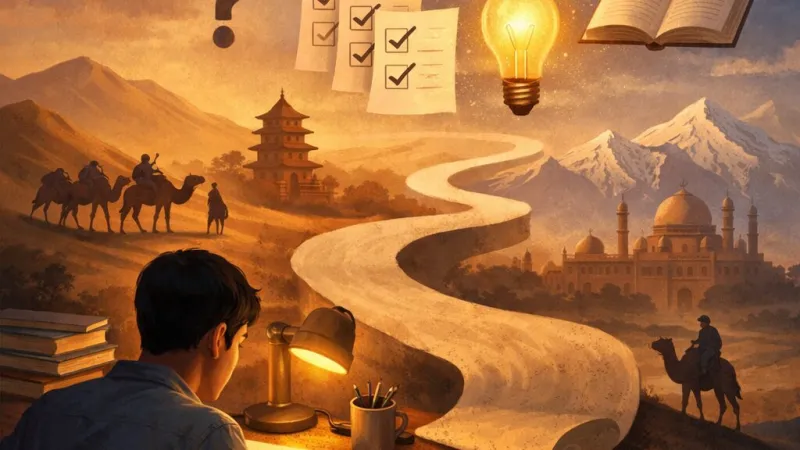
Explore Silk Road MCQs with answers for NCERT Class 11 English Lesson 6 to boost understanding, enhance exam prep, and grasp key concepts confidently.
Silk Road MCQs with Answers NCERT Class 11 English Lesson 6: A Critical and Comprehensive Exploration
The Silk Road, featured as Lesson 6 in the NCERT Class 11 English Hornbill book, holds a unique position in the curriculum, offering more than just language enrichment. It is a captivating travelogue written by Nick Middleton, who recounts his arduous journey through Tibet toward Mount Kailash, weaving together threads of adventure, cultural insight, and reflection.
Unlike traditional stories, “Silk Road” acts as a window through which students can glimpse not only the geographical peculiarities of the Tibetan plateau but also the customs, beliefs, and daily lives of its people. Placed thoughtfully in the Class 11 English syllabus, the lesson adds a layer of complexity and exposure that aligns with the CBSE’s holistic approach to language education—one that encourages both critical thinking and empathetic engagement with the world. By focusing on the study of MCQs related to this lesson, students can deepen their comprehension, prepare effectively for examinations, and gain an appreciation for the narrative’s many layers.
Background and Setting of ‘Silk Road’
Historical and Geographical Context
The Silk Road refers not only to ancient mercantile passages stretching from China to the Mediterranean but also to a living metaphor for the movement of ideas, spiritual values, and multicultural exchanges. In this narrative, the author’s journey is set in the awe-inspiring, wind-battered landscapes of Tibet, renowned for their spiritual significance and geographical harshness. Locations such as Lhasa, the Changtang plateau, and the sacred Mount Kailash form the crux of the backdrop.Historically, these regions have witnessed the flow of traders, monks, and adventurers, each leaving indelible marks on the communities they touched. The varied topography—icy passes, vast grasslands, and treacherous rivers—does not just test the traveller physically but also presents a backdrop against which internal journeys unfold.
to Key Characters
The protagonist, Nick Middleton himself, adopts the role of both narrator and explorer, setting out with the purpose of circumambulating Mount Kailash, a pilgrimage site holding enormous spiritual weight for Buddhists and Hindus alike. His companions, Daniel—a knowledgeable guide—and Tsetan—a resourceful and stoic driver—anchor and guide him through the myriad difficulties of Himalayan travel.Along the way, the author interacts with local people: Lhamo, a warm-hearted Tibetan woman who gifts him a long sheepskin coat as a token of concern, and various nomads known as Drokbas. Each encounter, whether with nomadic herdsmen or fierce Tibetan Mastiffs, is an opportunity to observe traditions and resilience honed by centuries of living in harsh climates.
Narrative Elements and Structure
Plot Progression and Journey Overview
The narrative follows a chronological pattern, beginning with the assembly of travel gear and culminating in the author’s arrival at Darchen, the base for pilgrims of Mount Kailash. Every waypoint—be it the bustling market at Hor or the remote valleys inhabited by Drokbas—brings its own challenges and lessons.Significant events infuse the story with life: freezing river fordings, sudden snowfalls, and the shrill barks of guard mastiffs. Each episode is a vignette illuminating the realities of travel in one of the world’s most daunting terrains.
Use of Descriptive Language and Imagery
Middleton’s prose is laced with evocative imagery. Thick, churning clouds above the pass signal looming blizzards. The biting cold turns the author’s breath into mist, while jagged white mountains stand as silent sentinels over “endless stretches of plateau.” Such descriptions do more than paint a picture—they immerse the reader in the sensory world of the traveller. The challenges of adjusting to thin air, the taste of yak-butter tea, and the jangle of prayer wheels collectively add richness and authenticity.Narrative Style and Tone
The travelogue employs a first-person voice, imparting immediacy and subjectivity. The tone shifts seamlessly—from initial excitement and energy to palpable exhaustion, moments of anxiety, and finally, reflective awe. By blending observation with personal response, Middleton crafts an account that is both factual and deeply emotional, balancing the journalistic with the poetic—much like Raghubir Singh’s photographic essays or Satyajit Ray’s travel sketches, which are cherished in Indian literary and artistic circles.Themes and Ideas in ‘Silk Road’
Exploration and Discovery
At its core, “Silk Road” is a story of curiosity and the age-old human urge to move beyond familiar boundaries. The author’s struggles—be it headaches caused by altitude or fear in the face of howling mastiffs—mirror the psychological journey of pushing against limitations. Every new interaction, be it with a nomad or the environment, sparks an evolution in his understanding of the world and himself.Cultural Diversity and Interaction
Middleton’s observations capture the cultural richness of Tibet—Drokbas with traditional robes, tents dotted across the plains, and unique rituals like Kora (the act of circumambulating a sacred site). The exchange of gifts (such as the sheepskin coat from Lhamo) and hospitality reveal how in isolated lands, warmth and generosity can bridge gaps created by geography and language—a message that resonates with the Indian ethos of “Atithi Devo Bhava”.Challenges of High Altitude and Environment
Middleton’s narrative repeatedly returns to the harsh realities of Himalayan travel—persistent cold, thinning oxygen, and unpredictable snow. These physical challenges underline the necessity of both mental strength and adaptability, echoing the experiences of Indian climber Bachendri Pal’s Everest expedition, or Arunima Sinha’s journey as the first female amputee to scale the world’s highest mountain.Significance of Natural Elements and Spiritual Overtones
The narrative’s spiritual thread ties back to the reverence for Mount Kailash. The Kora ritual, practiced by devout pilgrims, becomes not just a journey around a physical mountain but also a metaphor for inner cleansing and humility. As the author reflects on the “vast emptiness” of the plains, it paves the way for meditative introspection—a motif akin to Rabindranath Tagore’s communion with nature as seen in his Shantiniketan days.Role and Importance of Multiple Choice Questions (MCQs) in Learning
Why MCQs Are Effective for Class 11 Students
MCQs transform reading from passive to active, compelling students to engage closely with facts, details, and subtle thematic hints. Aligning with CBSE examination patterns, they make students comfortable with time-bound, objective assessment methods, reinforcing factual retention and comprehension.Types of Questions Typically Asked
MCQs related to ‘Silk Road’ usually belong to the following categories:- Factual recall (names of places, people, events) - Contextual vocabulary (meanings of “Kora,” “Drokbas,” etc.) - Analytical understanding (why a character acts in a certain way, or what a particular incident symbolizes)
Developing Higher Order Thinking
Well-crafted MCQs require inference and not mere rote memorisation. For example, a question might ask why the author’s experience in Darchen seemed anticlimactic, pushing students to explore the narrative’s deeper emotional currents.Detailed Analysis of Selected MCQs
Understanding Cultural Terms: Questions probing the meaning and significance of “Kora” or “Drokbas” ensure that students do not just parrot definitions but connect them to cultural settings. For example, understanding “Kora” is essential to appreciate why pilgrims brave treacherous conditions for spiritual fulfilment.Geographic and Environmental Knowledge: MCQs asking about the features of the Changtang plateau or the effects of high altitude highlight the relationship between humans and geography, an intersection familiar from NCERT’s own social studies texts.
Character and Event-Based Questions: Questions like “What does Lhamo’s gift signify?” nudge students to read situational context and cultural subtleties, echoing examiners’ emphasis on understanding over memorisation.
Practical Tips for Students Preparing for ‘Silk Road’ MCQs
Active Reading Techniques
1. Annotate: Mark central ideas, descriptions, and explanations within the text. 2. Visualisation: Sketch a route map or timeline for the author’s journey. 3. Glossary: Maintain a list of unfamiliar terms with their meanings culled from context.Strategies for Accurate Answers
1. Carefully parse MCQs to ensure you understand what is being asked. 2. Use elimination—rule out incorrect options to increase the chances of selecting the right answer. 3. Revisit the text for contextual clues, especially in questions hinged on cultural practices or nuanced events. 4. Practice: Use NCERT’s back-exercises and supplementary sample papers to accustom yourself to the question pattern.Using Supplementary Resources
Utilise the NCERT glossary, watch documentaries on Tibet (for example, those narrated by Indian National Geography hosts), and participate in group study discussions for diverse viewpoints.Conclusion
In summary, “Silk Road” is more than a language lesson; it is a multidimensional exposure to geography, culture, and the human spirit. The thoughtful combination of narrative structure, evocative description, and spiritual undertones deepens students’ understanding of the world beyond textbooks.Practicing MCQs not only sharpens examination skills but also hones the capacity to perceive connections between text, context, and broader human themes—a hallmark of holistic learning promoted by the CBSE.
I encourage every student to journey beyond the literal Silk Road: explore maps, read up on Tibet and Kailash’s religious significance for Indians, and reflect on the traveler’s mindset—curious, humble, and ever ready to learn. In doing so, you transform the exercise of answering MCQs into an exciting expedition of your own.
---
Glossary: - Kora: The act of walking around a sacred site, a Tibetan spiritual practice. - Drokbas: Tibetan nomads known for herding sheep and yaks. - Changtang: High-altitude plateau in northern Tibet. - Mount Kailash: A mountain venerated in Hinduism, Buddhism, Jainism, and Bon.
With attentive reading, cultural curiosity, and a strategic approach to MCQs, “Silk Road” becomes an opportunity not merely for academic achievement, but for personal growth, mirroring the very journey described in the lesson itself.
Rate:
Log in to rate the work.
Log in