A Short Essay on Dr Bhimrao Ambedkar’s Life and Legacy
This work has been verified by our teacher: 3.05.2026 at 9:43
Type of homework: Essay Writing
Added: 1.05.2026 at 14:20
Summary:
Explore Dr Bhimrao Ambedkar’s life and legacy to learn about his role as a scholar, reformer, and architect of India’s Constitution and social justice movement.
Paragraph on Bhimrao Ambedkar
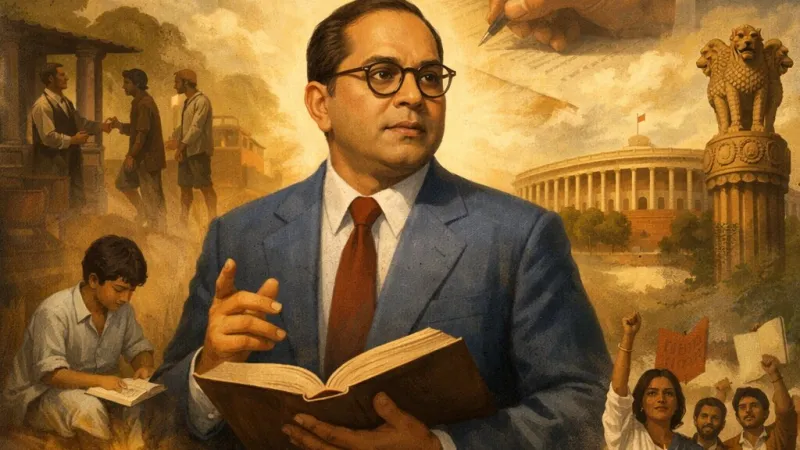
Bhimrao Ramji Ambedkar stands as one of India’s most towering and revered figures, whose vision continues to illuminate the nation’s ideals of justice, liberty, and equality. Far more than just a political leader, Dr Ambedkar’s multifaceted life—as a scholar, legal expert, social reformer, and above all, as the principal architect of the Indian Constitution—remains emblematic of resilience and purposeful progress. He emerged during a time when India was bound by the chains of a deep-rooted and rigid caste system, which dictated one's very destiny from birth. In such a stifling social context, Ambedkar did not simply fight for his own rights but for the dignity and upliftment of millions. To truly understand India’s ongoing journey towards social justice, it is essential to study Dr Ambedkar’s life, his multitude of contributions, and the lessons he left for future generations.
Early Life and Background
Dr Ambedkar was born on 14th April 1891 in the cantonment town of Mhow, currently in Madhya Pradesh, to the Sakpal family belonging to the Mahar community. His father, Ramji Maloji Sakpal, was a Subedar in the British Indian Army, while his mother, Bhimabai, was a homemaker who nurtured her son with much care. The Mahar caste, to which Ambedkar belonged, was branded as ‘untouchable’ in the ruthless ladder of Indian caste hierarchy. This status meant being shunned from common resources and social life, often facing overt humiliation and deprivation of basic rights. Unlike most of his contemporaries, young Bhimrao experienced discrimination firsthand—from being made to sit separately in school, denied entry into temples, and being refused water from public sources. These hard realities might have broken a weak spirit, but for Ambedkar, they strengthened his resolve. Despite all odds, his brilliance shone through, and he topped his class at Elphinstone High School in Bombay, an achievement that would set the stage for his lifelong quest for learning and justice.Academic Journey and Overseas Education
Education would be both Ambedkar’s armour and sword in his war against social inequalities. The rare privilege of schooling for someone from his community was possible because of his father’s earnings and the support of reform-minded patrons like Maharaja Sayajirao Gaekwad of Baroda. After excelling in his matriculation, Ambedkar completed his Bachelor’s degree in Economics and Political Science from Bombay University, standing out for both academic brilliance and intellectual curiosity. His journey soon took a historic turn when he was awarded a scholarship by the Baroda State to pursue further studies abroad—an unimaginable aspiration for most Indians of that era, let alone someone stamped as ‘untouchable’.At Columbia University in New York, Ambedkar completed his M.A., writing a thesis on 'Ancient Indian Commerce', and was deeply influenced by the works of social philosophers like John Dewey. His academic pursuit continued at the London School of Economics, where he earned his Doctorate in Economics, and he also qualified as a barrister from Gray’s Inn. Exposure to the rational and democratic values of the West helped shape his ideas of justice, equality, and human rights, giving him a unique perspective on India’s social problems. His scholarly achievements were not just individual triumphs but collective victories for every oppressed person in India who longed for a life of dignity.
Social Reform and Fight Against Caste Discrimination
Returning to India, Dr Ambedkar was painfully reminded of the harsh realities of untouchability. Instead of succumbing to them, he launched a courageous public campaign to fight for the rights of the downtrodden. He founded periodicals like ‘Mooknayak’ (Leader of the Voiceless) and ‘Bahishkrit Bharat’, using his intellect as a weapon to question orthodox practices that perpetuated injustice. Ambedkar led landmark social agitations, most notably the Mahad Satyagraha in 1927, where he and thousands of Dalits drank water from the Chavdar tank, asserting their right to equal access to public water sources. Similarly, his struggle for temple entry rights in Nashik challenged centuries-old barriers.Ambedkar’s seminal work, “Annihilation of Caste,” remains a fierce critique of caste-based discrimination. In it, he argued that true freedom and democracy were impossible without the eradication of caste. He believed real empowerment could only come through education and stressed that learning and self-awareness would break the shackles of social bondage. Moreover, his advocacy was not limited to one section—he championed women’s rights, demanding their access to education and participation in public affairs, decades before such discussions became mainstream in Indian society.
Role in Nation Building and Political Career
After India attained independence, Dr Ambedkar’s stature as both a legal luminary and a tireless advocate of justice found recognition. He was appointed as the first Law Minister of independent India—a position fraught with responsibility, given the need to lay the legal foundations of a diverse and fragmented nation. Above all, his crowning achievement would be his role as the chairman of the drafting committee for the Constitution of India.Ambedkar approached this monumental task with both idealism and pragmatism. Drawing from his studies and experiences worldwide, he ensured the Constitution’s framework promoted not just political democracy but also social and economic justice. The document enshrined fundamental rights—such as equality before law (Article 14) and the abolition of untouchability (Article 17)—that were radical in their vision and scope. He introduced provisions for reservations in education and government jobs for Scheduled Castes and Scheduled Tribes, ensuring that those historically denied their rights would finally have a place at the table.
Politically too, Ambedkar formed the Independent Labour Party and later the Scheduled Castes Federation, giving representation and voice to the neglected. He worked with princely rulers like Chhatrapati Shahu Maharaj of Kolhapur, who supported efforts for Dalit upliftment. His battles ranged from securing access to public utilities for all to pressing for the Hindu Code Bill, which aimed to grant equal rights to women within the family structure. Although some of his progressive proposals faced setbacks and political opposition, their very articulation laid the seeds for future reforms.
Legacy and Impact on Modern India
Decades after his passing in 1956, Dr Ambedkar’s influence can still be felt in every corner of Indian society. The values he institutionalised through the Constitution—equality, dignity, affirmative action—remain relevant in contemporary debates, from campus discussions to legislative assemblies. Policies of reservation and social justice are still defended or critiqued, but no one questions their origins in Ambedkar’s vision of an inclusive nation.For millions of Dalits, tribals, and other marginalized communities, Ambedkar is not just a historical figure but a living inspiration—a beacon that assures them their struggle is rooted in a proud legacy. His birthday, celebrated as Ambedkar Jayanti on 14th April, brings together people from all walks of life to honour his memory and renew their commitment to justice. University campuses, statues across cities, and the presence of Ambedkar as a central figure in popular culture all reflect his iconic status.
Yet, Ambedkar’s legacy is also a call to introspection. India continues to grapple with discrimination, gender bias, and new forms of inequality. Critics may argue about the effectiveness or limits of his methods, particularly regarding reservation policies, but the fact remains that his pursuit of a just society sparked a silent revolution that still shapes India’s moral conscience.
Conclusion
Dr Bhimrao Ambedkar’s journey from an oppressed child in Mhow to the chief framer of the Indian Constitution is not just a personal story but a lesson in courage, humanity, and the transformative power of education and resolve. With every challenge he faced and overcame, Ambedkar taught India the value of questioning unjust traditions, of dreaming big despite harsh realities, and of serving humanity above self. His life is a guiding light for all students and citizens: to study hard, think independently, fight discrimination in all its forms, and strive toward building a nation where justice truly triumphs over prejudice.No summary of modern India is ever complete without mentioning Ambedkar. His ideas and action continue to shape our laws, influence our debates, and spark hope among those who seek equality. As custodians of his legacy, it is our duty to honour his memory not just in words but also through deeds—by fostering empathy, upholding constitutional values, and working for a society where every individual’s dignity is cherished equally.
Rate:
Log in to rate the work.
Log in