10 Interesting Facts About Ostriches for Secondary School Students
This work has been verified by our teacher: 21.05.2026 at 9:03
Type of homework: Essay Writing
Added: 19.05.2026 at 7:59
Summary:
Discover 10 interesting facts about ostriches for secondary school students, covering their size, habits, habitat, and unique adaptations in nature’s giant bird.
10 Lines on Ostrich – Nature’s Giant Bird
Ostriches are among the world’s most fascinating creatures, well-known not just for their staggering size but also their extraordinary adaptations to life on the open plains. Despite never taking to the skies, these remarkable birds have earned a legendary status in nature’s hierarchy. Below, let us embark on an in-depth exploration of the ostrich, delving into its appearance, habits, and role within its native environment—all tailored to intrigue the Indian school student and bring nature’s marvel closer to our own understanding of the world.---
1. Introduction: The Magnificent Ostrich
When we think of big birds, none can match the grandeur of the ostrich. Known as *Struthio camelus* in science, it proudly claims the title of largest living bird. Unlike our very own peacock, the ostrich cannot fly, but what it loses in flight, it more than makes up for in speed and stamina. Impressive in size and equally unique in its way of life, the ostrich stands as a living testament to evolution’s creativity. In this essay, we shall explore the ostrich’s distinct physical features, behaviour, habitat, diet, reproduction and interactions with humans.---
2. Physical Characteristics of the Ostrich
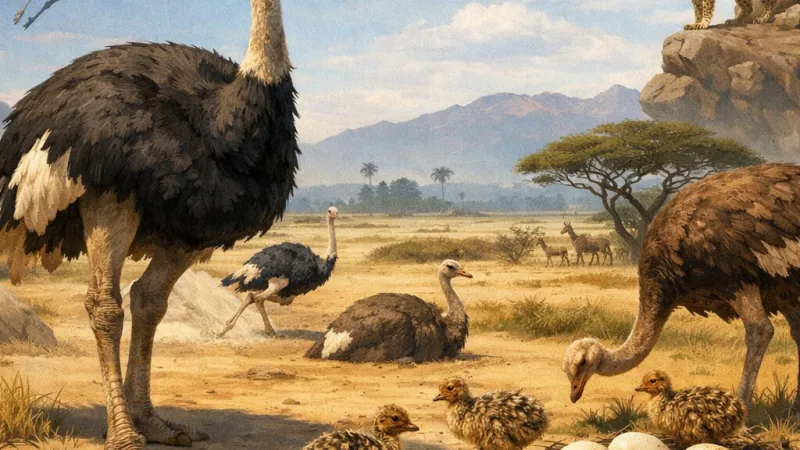
Imagine an animal taller than most adults and heavier than two grown men put together—that is the ostrich, often reaching up to 9 feet (about the height of a modest room wall) and weighing between 120 and 160 kilograms. The males sport striking black plumage with dazzling white wing tips and tail feathers, reminiscent of an aristocrat’s robe, while females blend into sandy landscapes with their subtle brownish-grey feathers. These colours are not accidental, but a clever camouflage—females, who spend more time on the nest, merge perfectly with the dry grasslands, keeping eggs and chicks hidden from prying predators.Their necks are extraordinarily long and gracefully curved, supporting a small head equipped with a flat, broad beak. But the most remarkable feature is perhaps their large, expressive eyes—the biggest among all land animals! With eyes nearly the size of a billiard ball, the ostrich can spot threats from vast distances, a crucial survival trait on the wide, open savannah. Even their legs command attention—robust and muscular, each ending in two large toes, unlike our desi chickens or peahens with three or four toes per foot. This unusual foot design helps them run fast (a point we’ll soon see is of life-saving importance).
---
3. Habitats and Where Ostriches Live
Ostriches are native to the grasslands and savannahs of Africa. Picture the vast, golden plains of the Serengeti with scattered acacia trees—this is the world where ostriches feel at home. These open lands give the ostrich space to spot danger and run unhindered, making dense forests or marshes unsuitable for them.There are a handful of subspecies adapted to different regions—North African ostriches have flourished near the Sahara, the Masai ostrich in east Africa, and the South African variety in the grass-rich south. Interestingly, Arabian ostriches once roamed the Arabian Peninsula, but have sadly disappeared in the wild. These days, ostriches can also be seen in wildlife parks and zoos across the world, including India—most famously at the National Zoological Park in Delhi, where school trips let us marvel at these giants up close.
---
4. Behaviour and Social Life
Despite being flightless, ostriches have mastered the art of survival. Their powerful legs allow them to sprint as fast as 70 km per hour—imagine a scooter zipping down the road—and they can maintain this speed over big distances, much longer than our local stray dogs or even leopards. This is far faster than any other bird, and helps them make a hasty escape from lions, hyenas, or cheetahs on the hunt.Ostriches typically live in groups, known as herds or flocks, ranging from just a handful to several dozen. Within these groups, one can observe a lively social structure. There is often a dominant male who leads, while others follow; this system helps with keeping a lookout—one ostrich can alert the group to danger with a low booming call or a hiss. For children, it’s surprising to know ostriches sometimes choose to lie low and flatten themselves against the earth, blending in brilliantly and avoiding the gaze of prowling predators.
When threatened, their best defense is their sheer speed. If cornered, ostriches defend themselves with a forward kick from their mighty legs—strong enough to break bones! In popular Indian folktales, animals like the tiger are considered very dangerous, but in Africa, even such big cats think twice before tangling with an angry ostrich.
---
5. Diet and How Ostriches Feed
Unlike many birds that peck delicately at their food, ostriches are bold but not greedy. Their primary diet consists of grass, seeds, shrubs, and even flowers. However, being opportunistic feeders, they will not ignore a juicy locust, beetle, or even a small lizard when the moment arises. In this way, ostriches resemble our Indian mynahs or crows, adapting their eating habits according to the season.Since ostriches lack teeth, they have a fascinating trick to aid digestion: swallowing small stones, called gastroliths. These stones grind up food in their muscular stomachs—a bit like the grinding stones our grandmothers used for spices! This adaptation makes it possible for them to thrive even on coarse, tough plants.
---
6. How Ostriches Reproduce and Grow
Ostrich courtship is a sight to behold. The dominant male—sometimes called the “rooster”—performs elaborate dances: spreading his wings, dropping his body to the ground, and swaying rhythmically, like a performer at a folk dance festival. Female ostriches—called “hens”—watch closely before selecting their partners.Nesting time sees another remarkable behaviour. Instead of building high nests like pigeons do, ostriches scrape shallow pits directly into the sandy earth. Multiple females often lay eggs in a communal nest, but the dominant pair care for the majority. An ostrich egg is an absolute giant, weighing almost 1.5 kilograms and as large as twenty hen’s eggs put together. These eggs are creamy white, tough-shelled, and can withstand accidental trampling.
Incubation is shared: the drab-coloured female sits on the eggs during the day, while the black-feathered male takes over at night, ensuring constant protection. Once hatched, the chicks quickly find their feet—within days, they can run fast enough to keep up with the adults. Yet, dangers abound; only a fraction survive to adulthood, as predators often target the young.
An ostrich in the wild may live up to 40 years, but those cared for in reserves or farms sometimes survive even longer, making them some of the longest-lived birds around.
---
7. Ostriches and People
In African cultures, and now even in countries like India where farming and eco-tourism are growing, ostriches have notable importance. Their meat is lean, healthy and increasingly popular among health-conscious people, much like emu meat in parts of southern India. Ostrich leather, known for its dotted, unique pattern, is prized for making wallets, belts, and handbags. Their majestic feathers have long been used as decoration, even finding their way into costumes for dance and drama—for instance, in ancient Egyptian and African processions.But ostriches have faced threats—unregulated hunting and habitat loss have shrunk their numbers. International and local conservation programmes, like those seen at Bharatpur Bird Sanctuary, echo the importance of protecting not just birds native to India but also creatures like the ostrich elsewhere, safeguarding global biodiversity.
---
8. Curious Facts: Did You Know?
- Ostriches have a special gland that allows them to save water, letting them withstand days without drinking—a trick well suited to desert environments, not unlike how the camel survives the Thar Desert. - Their thick eyelashes provide a shield from swirling sand and sunlight, much needed in open plains. - Despite old myths, ostriches do not bury their heads in the sand; they merely lower them to the ground to blend in, which can look like head-burying from afar. - By eating fruits and dispersing seeds, ostriches play a vital part in their ecosystem, helping new plants to grow.---
9. Conclusion: Lessons from the Ostrich
In sum, the ostrich stands tall not only in a physical sense but as a symbol of adaptation and endurance. Its powerful legs, keen eyes, and unique survival skills teach us the value of using what we have to our advantage—even if it means running instead of flying. For students in India, learning about the ostrich is a window into the extraordinary variety of the natural world and a reminder of our responsibility to cherish and protect these marvels for generations to come.Whether as a subject of science, a character in stories, or a lesson in biology classes, the ostrich inspires awe and curiosity—a true giant of the bird kingdom and a marvel of nature’s genius.
Rate:
Log in to rate the work.
Log in