Short and Simple Lines About the Giraffe for School Essays
This work has been verified by our teacher: 27.03.2026 at 16:44
Type of homework: Essay Writing
Added: 24.03.2026 at 10:27
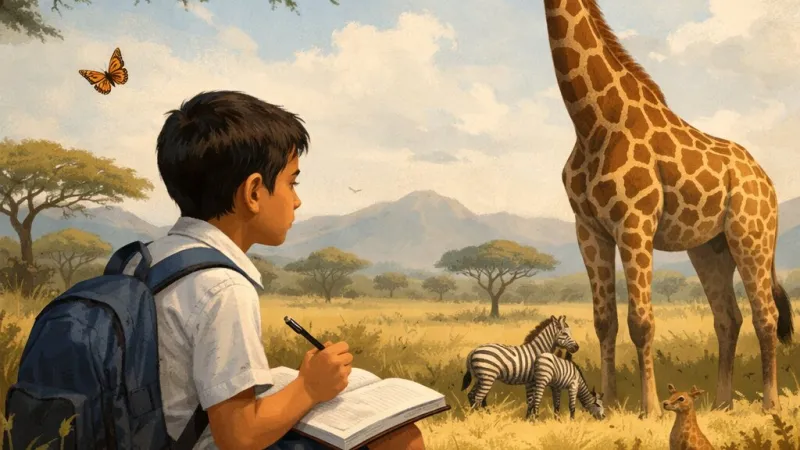
Summary:
Discover short and simple lines about the giraffe for school essays. Learn key facts, biology, and unique traits ideal for junior students. 🦒
The Giraffe – Nature’s Towering Marvel
Among all the wild animals that capture the human imagination, the giraffe stands tallest – quite literally. With its graceful stride and remarkable height, the giraffe commands awe and wonder, both for its striking appearance and for the gentle, calm demeanour that belies its immense size. In Indian schools, we learn about many animals of our forests, such as the Bengal tiger, the Asian elephant, and the Indian peafowl. Yet, the giraffe, although native to faraway Africa, finds its way into our textbooks and stories, its silhouette instantly recognisable even to those who have never visited the savannah. Why does this animal fascinate us so? Perhaps it is the giraffe’s uniqueness—its long, sinuous neck, beautiful patchwork skin, and towering legs—that makes it seem almost magical, a living totem of nature’s creativity.
Learning about the giraffe is not merely an exercise in animal study. It reminds us of the diversity present in the animal kingdom and how each species, no matter how distant geographically, plays a vital part in the global web of life. This essay will explore the biology, natural home, habits, and survival strategies of the giraffe, as well as the important conservation efforts being made to protect this gentle giant. Ultimately, understanding the giraffe allows us to reflect on the delicate balance of our ecosystems and our shared responsibility toward all living beings.
Biological Characteristics of the Giraffe
The giraffe is unmatched in height among all land mammals, with adults reaching up to six metres—more than twice the height of an adult human and about as tall as two autorickshaws stacked one above the other. Their weight, ranging from 700 to 800 kilograms, is distributed across long, slender legs that can cover great distances with every step. But the giraffe’s most striking feature is, of course, its neck, which can itself stretch up to 2.5 metres. Although it seems as if this neck should have dozens of vertebrae, in reality, the giraffe’s neck contains only seven, just like ours. Each vertebra is, however, greatly elongated, an extraordinary adaptation found among few animals.The giraffe’s coat features lovely irregular brown patches edged with lighter highlights, which help it blend with the dappled sunlight on the savannah. This pattern is unique to each giraffe, much like fingerprints are to humans. One remarkable adaptation is the giraffe’s tongue: long, dark, and prehensile, it can measure up to 50 centimetres and helps them pluck leaves from thorny branches. The dark colour protects it from sunburn as they browse daily under harsh African suns.
Internally, the giraffe is a marvel of nature’s engineering. Its heart, weighing about ten kilograms, must pump blood against gravity to the top of the neck, a feat accomplished by specially adapted blood vessels that prevent fainting when the animal stoops to drink. The wide-set eyes provide a panoramic field of view, allowing the giraffe to spot predators from far away—a vital survival tool.
Reproductive habits are equally fascinating. A female giraffe carries her calf for more than a year (about 15 months) before a single baby, or occasionally twins, is born. Within just an hour, the newborn can stand on its wobbly legs—a vital skill in the wild. Usually, giraffes live for 25 to 30 years if undisturbed by predators.
Habitat and Distribution
Naturally, giraffes are children of the African wild. They graze and browse mainly in open savannahs and woodlands dotted with their favourite food—acacia, mimosa, and wild apricot trees. One may spot them across various African regions such as Kenya, Tanzania, Botswana, and even in the semi-dry Sahel. Their habitat is always close to patches of shrubs and tall trees that allow them to feed well above the reach of other herbivores like zebras or wildebeest.Interestingly, not all giraffes are the same. There are several recognised species and subspecies, such as the Northern giraffe, Southern giraffe, Reticulated giraffe (with its beautiful lattice-like patterns), and Masai giraffe. Each is adapted to local terrain and vegetation, showing the endless adaptability of animals to their surroundings.
Behaviour and Social Structure
Contrary to the solitary image some might imagine, giraffes are quite social animals. They may be spotted in loose groups, called towers or herds, with adults and calves mingling freely and changing groups as they roam. This flexibility benefits them in the wild, allowing for shared vigilance and stronger protection from lurking predators, much like the chital deer herds in our Indian forests.Communication for giraffes is subtle. While generally silent, they can produce snorts, coughs, and grunts, and young calves sometimes let out plaintive bleats when in distress. Neck rubbing, gentle nudges, or even intense bouts of head-swinging (“necking”) serve as communication tools among them.
Feeding habits are highly specialised: giraffes reach vegetation most animals cannot. Their favourite food includes the leaves, flowers, and pods of acacia trees. Thanks to their long tongues and flexible necks, they delicately avoid thorns as they munch. It is believed that they require around thirty kilograms of food per day! Most of their water comes from moisture-rich leaves, meaning they can go days without actually drinking, which is a handy adaptation for drought-prone habitats.
Even their sleep routine is unusual—they tend to rest standing up and sleep only a few minutes at a time, rarely lying down for fear of predators. This behaviour is not so different from the Indian nilgai, which remains wary during rest in the open fields.
Unique Adaptations and Survival Mechanisms
Perhaps the most remarkable behaviour is the “necking” contest among male giraffes. In these ritual combats, males swing their necks and deliver powerful blows with their heads to one another, a display reminiscent of the rutting competitions seen in Indian blackbucks and sambars. The winner of such encounters earns mating rights and higher social standing.The giraffe’s defences against predators are equally ingenious. Lions, hyenas, and leopards might be tempted by calves or the old, but an adult giraffe is not an easy meal. A well-aimed kick from those powerful legs can seriously injure or even kill a predator. Their sharp eyesight and preference for open landscapes mean they are often among the first to spot danger and alert others.
From an evolutionary viewpoint, giraffes provide a living study in adaptation and survival. Their long necks, once believed to be purely for browsing high branches, also serve as tools in battles for dominance and for keeping a lookout.
Conservation Status and Challenges
Sadly, the giraffe’s very existence hangs in the balance in some parts of Africa. Habitat loss due to expanding human settlement, agriculture, and deforestation is the main threat. Illegal hunting for bushmeat and hide has also claimed many. Today, conservation groups classify certain giraffe sub-species as endangered.Reserves and national parks across Africa strive to offer protection, much like India’s own Project Tiger aimed to save our tigers. International cooperation, education campaigns, and involvement of local communities are helping giraffe populations recover in some regions. The giraffe, by maintaining the balance of trees and shrubs, is a vital cog in the ecosystem, much as elephants are in our forests.
Cultural Importance and Human Interaction
From ancient cave drawings in Africa to contemporary cartoons, giraffes have always been part of human culture. For example, in Indian children’s storybooks like “Panchatantra,” animals often take on symbolic meanings. The giraffe, too, is represented in tales and toy shops, often as a symbol of gentleness and grace.Giraffes are a big draw for tourists in Africa, just as tigers or rhinoceroses attract nature lovers to Indian reserves. Their presence supports local economies and inspires both adults and youngsters to value and respect the wild. Nature documentaries, wildlife parks, and zoos play a huge role in education, connecting children from cities like Mumbai, Delhi, or Chennai with faraway creatures.
Rate:
Log in to rate the work.
Log in