Top 10 Key Facts About the Mekong River for Secondary School Students
This work has been verified by our teacher: 17.04.2026 at 13:38
Type of homework: Geography Essay
Added: 15.04.2026 at 16:17
Summary:
Discover the top 10 key facts about the Mekong River and learn its geography, ecology, and cultural importance for secondary school students in India 🌏
10 Lines on Mekong River: A Comprehensive Indian Perspective
In the realm of geography and world rivers, the Mekong River stands as an extraordinary lifeline of Southeast Asia, weaving through landscapes, societies, and history much as the Ganga or Brahmaputra do in India. For Indian learners acquainted with the interdependence of rivers and civilisation—from the ancient Harappan settlements on the banks of the Indus to Farmer’s societies thriving along the Godavari and Krishna rivers—the study of the Mekong River offers a fascinating look into nature's power, human adaptability, and the challenges of sustainable development. This essay presents a deep, nuanced picture of the Mekong River, exploring its origin, journey, ecological role, sociocultural connections, and the concerns that surround its future.
---
Geographical Overview of the Mekong River
The Mekong River’s birthplace is nestled amid the icy heights of the Tibetan Plateau, akin to how our own Brahmaputra finds its source in the Himalayas. The river begins its journey from the Lasagongma spring and soon picks up pace, meandering through China (where it is called “Lancang”), before making its way through Myanmar, Laos, Thailand, Cambodia, and finally Vietnam, where it empties into the South China Sea. This journey spans approximately 4,350 kilometres, making it one of Asia’s longest rivers—though not quite matching the Ganga’s cultural centrality in the Indian context.As the Mekong carves its descent from altitudes exceeding 5,000 metres down to the deltaic plains, it encompasses a drainage basin of about 795,000 square kilometres. Along this route, countless tributaries join it, such as the Nam Khan and Nam Ou, reminiscent of how the Yamuna meets the Ganga, each blending waters, histories, and ecosystems. Seasonal changes dominate the Mekong, shaped by monsoonal rains and Himalayan snowmelt, with dramatic fluctuations in water flow—reminding us of the annual flooding in the plains of Assam and Bihar in India.
---
Unique Physical Features and the Delta
The Mekong’s route is not uniform— far from it. High up in Laos, the river confronts Khone Falls, a sprawling set of waterfalls and rapids, which historically have hindered navigation and commerce, much as the Barrage at Tehri affects the Ganga's course in northern India. These natural obstacles are not merely obstructions but also vital for river health, fish migration, and the formation of unique microhabitats.Arguably the most fertile and vibrant section is the Mekong Delta in southern Vietnam. Covering an area similar to the Sundarbans Delta at the Ganges’ mouth, the Mekong Delta supports vast agricultural fields, primarily rice paddies, which feed millions. Cities like Phnom Penh and Ho Chi Minh City have developed along the riverbanks, harnessing the river’s gifts for transport, trade, and sustenance. These urban centres recall Indian cities like Varanasi and Kolkata—each drawing spiritual, economic, and ecological sustenance from their riverine location.
---
Ecological Richness and Biodiversity
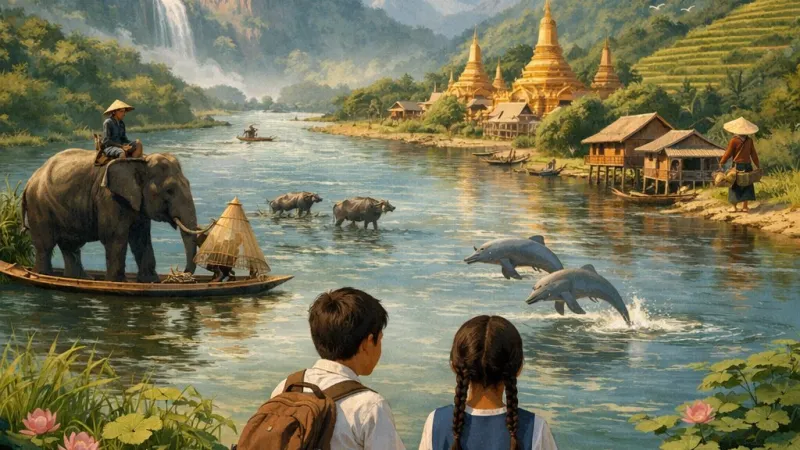
The Mekong is not just a geographical or economic entity; it is also a hub of biodiversity, a fact often echoed in the biodiversity hotspots of the Western Ghats or the rich riverine ecosystems of Sundarbans. With over 1,200 species of fish—some, like the giant catfish, growing to legendary sizes— the Mekong stands as the world’s second most diverse river, just behind the Amazon.The river is home to endangered creatures such as the Irrawaddy dolphin and the Siamese crocodile, along with countless birds, amphibians, and riverine flora. Each year, monsoonal floods transform the landscape, much like in the Indian Northeast, dispersing nutrients and allowing for breeding of fish and regeneration of forested wetlands. The river’s health, therefore, is intimately tied to the rhythm of seasonal cycles, and any disruption in this pattern affects millions of lives—including many who practise traditional fishing or farming along its banks.
---
The Human Connect: Socio-Economic Importance
The Mekong’s nurturing role resembles that of the Indian rivers supporting the rural economy. Over sixty million people depend directly on the river for their daily livelihoods—chiefly in fishing and agriculture. The river’s fertile plains produce rice, vegetables, and fruits, while its waters provide abundant fish. Sometimes referred to as the “rice bowl of Asia,” the Mekong Delta is the primary source of food for much of Vietnam and export markets beyond.Trade and transport have always flourished along the Mekong. Even today, wooden boats packed with goods ply its waters, bridging remote communities and city markets, as seen in the bustling floating markets of Can Tho. These scenes bring to mind the riverine trade once flourishing on the Ghats of Patna or the boat-markets along Kerala’s backwaters.
Yet, as in India, modern pressures have altered traditional pathways. Hydroelectric projects and dams, such as those at Manwan and Xiaowan, supply energy to developing economies but also bring tension over water resources and displacement—echoing long-standing debates around the Sardar Sarovar Dam on the Narmada or the Tehri Dam in Uttarakhand.
---
International Dimensions and Issues of Governance
Unlike many Indian rivers, the Mekong is truly international, a lifeline shared across six nations. This gives rise to both opportunities for cooperation and risks of conflict. The Mekong River Commission (MRC), much like India’s National Ganga River Basin Authority, seeks to ensure harmonious, efficient management. Yet, varying interests—especially between China (upstream) constructing large dams and downstream countries like Cambodia and Vietnam—lead to disputes over falling water levels, fish populations, and sediment transport. Such conflicts parallel the India-Bangladesh water-sharing discussions on the Ganga and Teesta rivers.Shared rivers often become bridges for cultural exchange and unity, carrying stories, festivals, and livelihoods across borders. The Mekong, with its river festivals and shared culinary traditions, is a potent symbol of Southeast Asian unity—as essential to regional identity as the Yamuna is in Indian mythology and festivals like Chhath Puja.
---
Environmental Concerns and Future Prospects
Despite its enduring vitality, the Mekong faces a slew of environmental challenges. Climate change has led to unpredictable rainfall, threatening established agricultural patterns and fisheries. Pollution from factories and excess use of fertilisers upstream mirrors the situation faced by Indian rivers like the Yamuna or the Sabarmati, where unchecked industrialisation has eroded water quality and ecosystem health.The growth of hydroelectric dams has come at a steep price. Fish migration routes are interrupted, villages relocate, and ancient forests sink beneath artificial reservoirs. With these changes, the river’s ability to nourish communities and wildlife stands imperilled.
Still, there is hope. Integrated water resource management, ecologically sensitive dam planning, and joint scientific research have gained ground, much like the Namami Gange project in India. Grassroots organisations and international donors are now working towards preserving the river’s integrity, restoring wetlands, and protecting endangered species. The lessons learned here are just as relevant for Indian students championing the cause of river conservation.
---
Conclusion
The story of the Mekong River is, in many ways, a reflection of the relationship that Indian society has with its own mighty rivers. In tracing the river’s origin in the Tibetan Plateau through turbulent falls, bustling cities, and a vibrant delta, one realises that rivers are more than just physical markers or borders—they are threads weaving together nature, culture, and economy. The Mekong River’s journey highlights the brilliance and vulnerability of nature’s design, reminding us of our shared responsibility to nurture and protect these lifelines.For students in India, understanding the Mekong offers not just knowledge of a distant land but valuable insights into our own riverine challenges and the importance of trans-boundary collaboration, ecological respect, and sustainable progress. It stands as a powerful testament that rivers, wherever they flow, are universal symbols of civilisation, resilience, and hope.
Rate:
Log in to rate the work.
Log in