Key Facts About the Congo River for Secondary School Students
This work has been verified by our teacher: 25.04.2026 at 16:53
Type of homework: Geography Essay
Added: 23.04.2026 at 8:50
Summary:
Explore key facts about the Congo River for secondary school students in India and learn its unique geography, depth, and ecological importance. 🌍
10 Lines on Congo River: An Indian Student’s Perspective
Introduction
From the green lands of Assam by the Brahmaputra to the grand banks of the Ganga, rivers have shaped the Indian imagination deeply. Similarly, the Congo River flows at the heart of Africa, holding immense influence over the land, ecology, and history of the continent. While our text books in India often focus on the Nile or the Amazon, the Congo River is a natural marvel worth exploring for its unique characteristics and vital role in Africa’s development. This essay seeks to cast detailed light on the Congo River, examining its origin, physical features, ecological richness, cultural significance, and ongoing challenges—drawing parallels to Indian contexts as appropriate.Geographical Features of the Congo River
One of the most fascinating aspects of the Congo River is its extraordinary journey. It has its source in the highlands of Central Africa. More precisely, it begins near the border of Zambia, close to Lake Tanganyika and Lake Mweru—places unfamiliar to most Indian students, but analogous in their life-giving role to the Western Ghats and the Himalayas for several Indian rivers. Tracing its path, the Congo crosses several countries: Democratic Republic of Congo (DRC), Republic of Congo, Angola, and the Central African Republic, among others. Remarkably, the river twice crosses the equator in its meandering route—something no major Indian river does, and a geographical curiosity on the world stage. Such a journey traversing equatorial rainforests gives rise to the Congo Basin, which is second only to the Amazon in size and richness.Stretching roughly 4,700 kilometers, the Congo River is the second-longest on the African continent, surpassed only by the Nile. Its drainage basin—covering approximately 4 million square kilometers—collects water from several major tributaries like the Kasai, Ubangi, and Lomami. For comparison, imagine the Ganga and Brahmaputra basins combined, yet even greater in scale. These tributaries play a crucial role in feeding the Congo, supporting both the river’s might and the communities living on its shores.
Physical Characteristics and Hydrology
Perhaps the Congo River’s most impressive physical attribute is its depth. It holds the world record for the deepest river, with some points plunging deeper than 220 metres. For Indian students, who might have travelled on the mighty Brahmaputra or Ganga, this is a staggering fact—by comparison, our largest rivers rarely exceed a depth of 120 metres. This extraordinary depth enables navigation by large cargo vessels in certain stretches, fostering trade and transport even deep within Africa’s forests.In terms of volume, the Congo River is equaled only by the Amazon. Its average annual discharge is about 40,000 cubic metres per second, making it not just a river, but a lifeline for an entire region—the kind of role the Indus or Godavari plays in subcontinental contexts. The current is swift in many regions, with several rapids, especially the notorious Livingstone Falls downstream near Kinshasa, forming powerful natural barriers and making navigation dangerous. If one considers the many ghats and waterfalls of India, such as the Jog Falls on Sharavathi or the steep descent of the Subansiri in Arunachal, the Congo’s rapids are even more extreme, designed by nature as a testing ground for human ingenuity.
Ecological and Environmental Significance
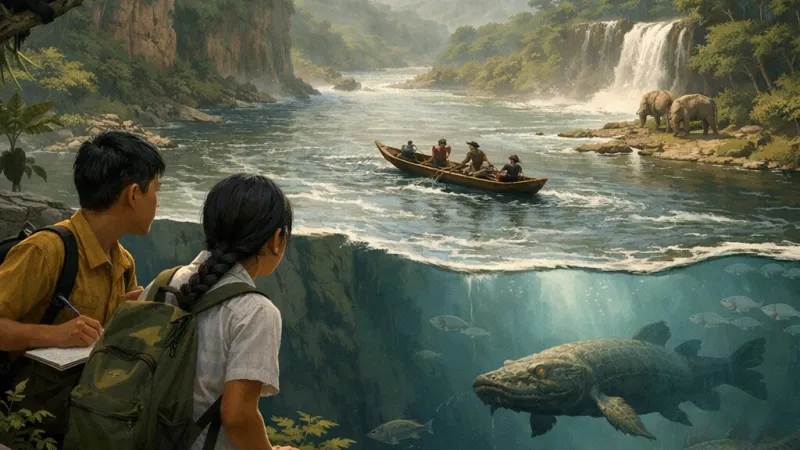
The Congo Basin hosts the world’s second largest rainforest, after the Amazon. Its expanse supports a breathtaking array of life: from more than a thousand species of fish—many found nowhere else—to forest elephants, bonobos (a kind of great ape), and okapis. In the Indian context, one might compare this biological richness to the Western Ghats, which UNESCO recognised as a global biodiversity hotspot. Just as our sacred rivers like the Yamuna are home to dolphins and turtles, the Congo’s waters teem with unique fauna, many yet to be fully studied.The river’s banks are lined with dense evergreen forests. The region experiences substantial rainfall, leading to a humid, tropical climate. Much like the Sundarbans in West Bengal or the forests flanking the lower Brahmaputra, these wetlands and forests depend on the river’s cycles of flood and drought. The Congo’s ecosystem is delicately balanced, and disruptions to the river threaten thousands of plant and animal species.
Historical and Cultural Context
Historically, the Congo River is named after the ancient Kingdom of Kongo, a formidable polity of the African interior, much as the Ganga region was once dotted with states like Magadha and Kashi. The river is also known as the Zaire—a reminder of the many changes in political power the region has seen. The French call it ‘Fleuve Congo’, a term heard around the former French Equatorial Africa.European explorers only reached the river’s mouth in the late 15th century. The Portuguese navigator Diogo Cão was the first known outsider to encounter the Congo, in 1482. Later, in the colonial era, the British explorer Henry Morton Stanley’s expeditions mapped much of its course, echoing the pioneering surveys done by William Lambton and George Everest in mapping India. The river’s name and stories remain alive in the heritage, economy, literature, and music of the region.
Socio-Economic Importance
For the people residing along its vast banks, the Congo River is a primary artery of transport and commerce—comparable to how the Ganga, Yamuna, or Brahmaputra foster communication and trade across the vast Indian plains. The river allows movement of people and goods in regions where roads are few and forests thick. However, its many dangerous rapids and waterfalls, especially between Kinshasa and Matadi, create significant navigation challenges, reminiscent of the ghats of the Western Himalayas.Besides transport, the river’s waters sustain fishing, small-scale agriculture, and even irrigation in many parts. Traditional communities rely on the river, much like Indian villagers have depended on the Narmada or Godavari for centuries. Major exports like palm oil, timber, and copper have passed down its stream, shaping the region’s economic history.
A notable aspect of the Congo’s potential lies in hydro-electric power. The Inga Dams, built on the river, have the capability to generate some of the world’s largest quantities of electricity. Though plagued by political and technical challenges, planned expansions of these hydro-projects could, in theory, supply power to much of Africa, much as the Bhakra Nangal Dam has energized North India. However, large projects always raise concerns over displaced communities and environmental cost.
Environmental Challenges and Conservation
Like all great rivers, the Congo faces threats from human activity. Rapid deforestation for timber and agriculture, pollution by mining industries, and indiscriminate hunting have placed tremendous strain on the river’s ecosystem. Similar issues haunt many Indian rivers, from the Yamuna’s pollution to the reckless sand mining scarring the Kaveri’s banks. Climate change also threatens to upset the delicate rainfall patterns feeding the Congo, further endangering species and livelihoods.International bodies like UNESCO, along with local governments and NGOs, are working to safeguard the river and its forests. Their projects range from creating reserves for endangered gorillas to campaigns against illegal logging. This mirrors Indian efforts like Project Tiger and Ganga Action Plan—complex, ongoing ventures requiring both scientific knowledge and political will.
Conclusion
To summarise, the Congo River is one of the planet’s greatest waterways—remarkable for its length, depth, biodiversity, and the vitality it offers to Central Africa. It has inspired legends, bridged communities, and provided sustenance for countless people and creatures for thousands of years. For Indian students, seeing the Congo through the lens of our own river-rich heritage helps make distant lands familiar and new knowledge more accessible. Understanding and protecting such rivers is essential, not just for local prosperity, but for the ecological health of our planet.As we move into the future, learning from river management and conservation around the world should inspire us to research, preserve, and cherish rivers—both in Africa and India—building a sustainable legacy for generations yet to come.
Rate:
Log in to rate the work.
Log in