Battle of Khanwa 1527: Ten Short Lines on the Historic Clash
This work has been verified by our teacher: 22.01.2026 at 10:54
Type of homework: History Essay
Added: 17.01.2026 at 19:06
Summary:
Learn key facts on the Battle of Khanwa 1527: ten concise lines covering date, leaders, tactics, outcome and why it shaped Mughal dominance in North India.
10 Lines on the Battle of Khanwa
The Battle of Khanwa is one of the defining events of Indian medieval history, fought at a time when the destiny of North India hung in balance between two powerful contenders. It was on the plains near the village of Khanwa, close to the city of Bharatpur in present-day Rajasthan, that on 16 March 1527, the forces led by Babur, founder of the Mughal dynasty, met those of Rana Sanga of Mewar, who was at the head of a formidable Rajput confederacy. This clash was not just a test of armies, but a decisive moment that would shape the political landscape of Hindustan for generations to come.
Why the Battle of Khanwa Matters
In a single sentence: The Battle of Khanwa sealed the emergence of the Mughal empire as a dominant power in northern India, displacing the established Rajput alliances and introducing new military techniques to the subcontinent.---
Ten Lines on the Battle of Khanwa
1. The Battle of Khanwa was fought on 16 March 1527 near Khanwa, a village close to present-day Bharatpur in Rajasthan. 2. The conflict was between Babur, the newly established Mughal ruler, and Rana Sanga, the powerful Rajput king of Mewar. 3. The battle occurred because both leaders aspired to rule northern India after Babur’s earlier conquest at Panipat in 1526. 4. Rana Sanga allied numerous Rajput states and Afghan chiefs, creating a vast army outnumbering Babur’s relatively smaller force. 5. Babur, however, introduced effective field artillery and gunpowder to Indian warfare, strengthening his defensive position. 6. The Mughals built protective barricades and used matchlock guns, which blunted repeated Rajput cavalry attacks. 7. During the fierce battle, several key Rajput allies deserted or lost heart, and Rana Sanga was seriously wounded, swinging the momentum. 8. Babur’s forces won decisively, gaining control over the Delhi-Agra heartland and establishing Mughal supremacy in North India. 9. The defeat shattered the Rajput confederacy and ended Rana Sanga’s dream of restoring indigenous rule in Hindustan. 10. The Battle of Khanwa is remembered as a turning point that ensured the Mughal dynasty’s rule for centuries over large parts of India.---
The Battle of Khanwa: Background and Context
Centuries of political rivalry shaped the background to the Battle of Khanwa. After Babur’s emphatic victory against Ibrahim Lodi at the First Battle of Panipat in 1526, he became master of Delhi and Agra, awaking ambitions among the old Indian powers to retake control. Rana Sanga of Mewar, often celebrated in Rajasthani folk tales and bardic traditions for his bravery and sense of honour, emerged as the foremost challenger. He rallied princes from Rajasthan, Malwa, Gujarat, and even Afghan chiefs, uniting them with the promise of expelling foreign rule and reviving Rajput dominance. The thread that linked the opponents was ambition—for Babur, to consolidate a new dynasty; for the Rajputs, to revive the old order.---
Armies, Leaders, and Military Preparations
Babur, though victorious at Panipat, knew his position was precarious. His Timurid roots gave the Mughals a tradition of disciplined cavalry and use of gunpowder but numerical strength was not their advantage. His camp was a mix of Central Asian warriors, local recruits, and he was famed for strict discipline and tactical innovation. The Rajput side, led by Rana Sanga (whose real name was Maharana Sangram Singh), was a symbol of Rajput martial valour—commanding over 80,000 men, hundreds of elephants, and cavalry units drawn from almost every Rajput state.What set the two apart was, above all, the Mughal use of field artillery and matchlock muskets—technologies new to Indian battlefields. Indian armies of the era, as recorded in the historical accounts such as Baburnama, relied heavily on shock tactics, armoured elephants, and heroic charges. Babur fortified his camp using “tulughma” (a tactic of dividing forces to encircle the enemy) and “araba” (defensive carts lashed together), a strategy borrowed from earlier Central Asian battles.
---
The Course of the Battle: Key Tactics and Turning Points
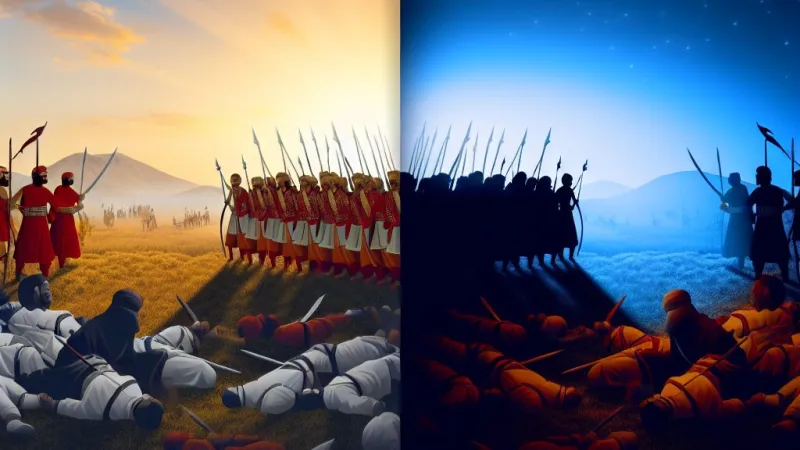
As early morning dust rose over the sands of Khanwa, the Rajput cavalry charges thundered against Mughal ranks, but the defensive barricades and salvos of gunfire inflicted heavy losses on their attackers. The weathered lines of both armies clashed repeatedly. The Rajputs, though courageous and numerous, faced confusion in coordination as differing chiefs led their own contingents, unlike Babur’s unity of command.Midway through the battle, fortune began to favour the Mughals. Historical legends speak of certain Afghan allies switching sides or withdrawing support—the betrayal cutting into the Rajput resolve. Moreover, Rana Sanga himself was struck by an arrow (by some accounts even poisoned), leading to collapse of morale. The Mughals, reading the signs, launched a final attack, enveloping the Rajput army and sealing victory as evening approached.
---
Reasons for Outcome: Why Did Babur Win?
Several factors can be discerned for the Mughal triumph. Firstly, technological superiority—Babur’s use of artillery and firearms—meant Rajput charges were costly and ineffective. Secondly, Mughal battlefield discipline—precise formations, quick adaptability, and unity under a single command—contrasted with the Rajputs’ valorous yet poorly coordinated advances. Lastly, the weakening of the Rajput alliance—whether from disagreements, betrayal by Afghan nobles such as Hasan Khan Mewati, or injuries to Rana Sanga himself—sapped their collective will and effectiveness.---
Aftermath and Historical Significance
The immediate effect of the battle was a dramatic consolidation of Mughal authority across northern India. Babur distributed lands, claimed the title of "Ghazi" (holy warrior), and his court chroniclers celebrated Khanwa as a divinely approved victory. For the Rajputs and their allies, the loss at Khanwa marked the end of a united resistance against foreign rule for many decades. In the long run, Mughal military success, symbolised by the innovative use of gunpowder, compelled Indian kingdoms to adapt or face similar defeat.Culturally, the epic stories of Rana Sanga’s bravery lived on—sung by bards and recorded in historical texts. Yet, politically, the battle signified the passing of an old order and the firm arrival of one of India’s most enduring imperial dynasties.
---
Conclusion
The Battle of Khanwa was not only a fierce clash of arms but a turning point that echoed across Indian history. It exemplifies the dynamic between tradition and innovation—Rana Sanga’s valour facing Babur’s modern tactics. It paved the way for the Mughal Empire’s glory days, highlighted by figures like Akbar and Shah Jahan, and remains a lesson on how both courage and change shape the fate of empires. As students, remembering its facts and significance helps us appreciate the complex tapestry of India’s past, and the legacies that live on in our collective memory.---
Exam Writing Tips:
- Always note the date (16 March 1527), place (Khanwa, Rajasthan), and the two main leaders (Babur and Rana Sanga). - For the 10 lines, keep each point crisp and factual—avoid stacking several facts into one sentence. - If asked for a paragraph answer, group related facts logically: first set the context, then describe the battle, and finally state its importance. - Revise using flashcards (date, leaders, location, tactics, consequence), and if possible, explain it aloud to someone else which reinforces your memory.---
Further Reading
Students interested in deeper details can consult chapters on Mughal history in the *NCERT History* textbooks for Classes VII and XII. Memoirs like the *Baburnama*, though originally in Persian and later translated, offer fascinating insights, but always verify your facts with standard school books for exams.---
Rate:
Log in to rate the work.
Log in