Martyrs Day in India: Remembering Our Courageous Freedom Fighters
This work has been verified by our teacher: 3.04.2026 at 16:24
Type of homework: Essay Writing
Added: 1.04.2026 at 13:34
Summary:
Explore the significance of Martyrs Day in India and learn about the courageous freedom fighters who sacrificed their lives for the nation's independence and unity.
Martyrs Day: Honouring the Brave Hearts Who Shaped Our Nation
Throughout India’s vast and eventful history, the idea of self-sacrifice for the greater good has been revered as one of the highest virtues. Few occasions bring this sentiment into sharper focus than Martyrs Day, known in Hindi as Shaheed Diwas. This commemorative day is not just a ritualistic reminder, but a deep, soul-stirring recognition of the courageous men and women who gave their lives for the country’s freedom, dignity, and progress. Generations rise and fall, but the memory of these martyrs continues to galvanise our collective conscience, urging each citizen to value the hard-won liberty and unity of our motherland.---
Understanding Martyrs Day: Meaning and Importance in the Indian Context
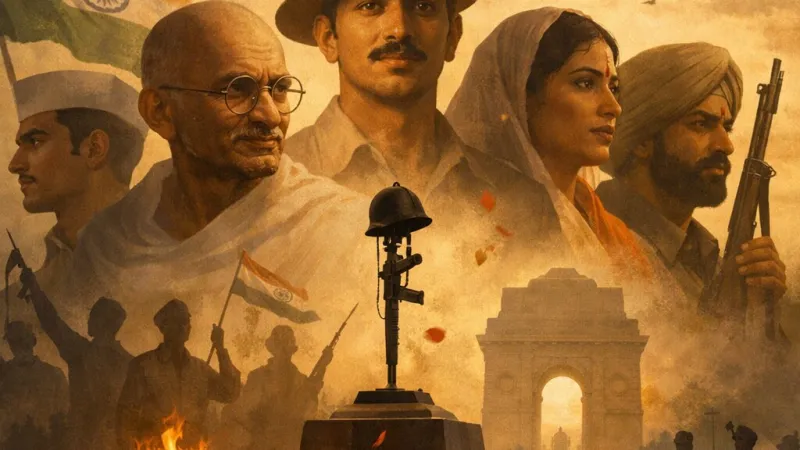
Martyrs Day is a solemn occasion dedicated to the remembrance of those who laid down their lives for India. The word 'martyr' itself finds resonance in the annals of Indian culture—be it the Rajput queens’ jauhar, Guru Tegh Bahadur’s supreme sacrifice to protect religious freedom, or the countless unsung heroes of the 1857 Uprising. A martyr in India is a symbol of ultimate courage—someone who places the welfare of the nation above personal ambitions, comforts, and even life itself.India marks Martyrs Day on two main dates: 30th January and 23rd March. Both have powerful historical connections. The 30th of January is observed as the death anniversary of Mahatma Gandhi, lovingly called Bapu and remembered as the Father of the Nation. 23rd March is etched in the consciousness of Indians as the day when Bhagat Singh, Sukhdev Thapar, and Shivaram Rajguru—young revolutionaries, were executed for daring to dream of free India. On these dates, the nation unites in a rare moment of collective remembrance, gratitude, and reflection.
---
Tracing the Legacy: Historical Background of Martyrs Day
Martyrdom of Mahatma Gandhi (30th January)
Mahatma Gandhi, born Mohandas Karamchand Gandhi, emerged as the most transformative figure in India’s fight against colonial rule. He gifted the world with the principle of non-violent resistance—Satyagraha—which became the backbone of movements like the Non-Cooperation Movement, Civil Disobedience, and the Call for Swadeshi. Gandhi challenged the mighty British Empire not with arms, but with a firm belief in truth and peace, mobilising millions across villages and towns, from Sabarmati to Champaran.Tragically, on the evening of 30th January 1948, as Gandhi led prayers at Birla House in Delhi, he fell victim to an assassin’s bullet. Nathuram Godse, the assailant, nursed political animosity, blaming Gandhi’s approach and tolerance for the Partition’s violence and hardships. The entire nation plunged into mourning; people wept openly as if losing a beloved family member. In memory of that great soul’s sacrifice and ideals, 30th January was declared Martyrs Day—a pledge to keep alive Gandhi’s vision of truth, communal harmony, and non-violence.
Martyrdom of Bhagat Singh, Sukhdev, and Rajguru (23rd March)
Across the spectrum of India’s freedom movement, another narrative—one of fiery resistance and courageous rebellion—was woven by young men like Bhagat Singh, Sukhdev, and Rajguru. Bhagat Singh, a gifted thinker and passionate patriot from Punjab, was joined by Sukhdev and Rajguru in challenging colonial injustice through direct action. Triggered by the brutal assault on Lala Lajpat Rai and his death at the hands of British police, the trio plotted and executed the killing of officer John Saunders—mistaken for James Scott, the perpetrator.Unrepentant and fearless, they later threw harmless bombs in the Central Legislative Assembly to “make the deaf hear”, as they proclaimed in court. Their unwavering conviction during the trial, refusal to seek clemency, and courageous acceptance of the death sentence earned them deep respect across India. On 23rd March 1931, all three were hanged in Lahore Jail, but their sacrifice inflamed the imagination of millions and infused youth-led activism with vigour across the country.
Though Gandhi and the revolutionaries had contrasting paths—Gandhi’s non-violence versus Bhagat Singh’s radicalism—both streams were united by love for the motherland and a willingness to forsake everything for its liberation.
---
Why Martyrs Day Matters: Lessons for Today’s India
Martyrs Day is not simply a day of rituals—it is a school of patriotism. It compels us to look back and draw inspiration from sacrifices, whether from the humble salt satyagrahis or the lionhearted youth of Lahore. It reinforces a sense of unity that is desperately needed in our diverse subcontinent, reminding us that the fruits of freedom enjoyed today were earned by rivers of sweat, and sometimes, blood.The stories of the martyrs kindle a sense of responsibility among the young. When students read about Gandhi forgiving his oppressors, or about Bhagat Singh embracing the noose with a smile and singing ‘Mera Rang De Basanti Chola’, they absorb vital values—courage, selflessness, and a higher ideal of service. Educational institutions across the nation mark Martyrs Day with competitions, plays, speeches, and documentary screenings. Teachers discuss with students how, at their age, Bhagat Singh dreamt not of a private fortune, but of a liberated, just India.
Schools also instil the importance of non-violence and peaceful protest, as taught by Gandhi. Not every fight need be waged with arms; a pen, a voice, a vote—these too are mighty weapons. In times fraught with communal tension or political unrest, this is a lesson of critical importance. As Jawaharlal Nehru poignantly said, “The martyr’s blood is the seed of freedom's tree.”
---
How India Remembers: Observances and Activities
National Tributes
On 30th January, the nation bows its head in silence as the Prime Minister, President, and other leaders pay floral tributes at Raj Ghat, Gandhi’s memorial in Delhi. The haunting notes of bugles, a solemn Guard of Honour, and the Maun Prarthna (two minutes silence) envelop the country in a rare moment of shared grief and pride. Similar tributes are paid at Hussainiwala on 23rd March, the memorial site of the three martyrs.Schools and Colleges
Educational institutions play a pivotal role in perpetuating the legacy of our martyrs. Special assemblies recount the importance of the day, students perform skits reenacting historic moments, and essay contests drive youngsters to research and reflect. The powerful last letters written by Bhagat Singh or Gandhi’s inspiring speeches have often found a place in school textbooks, prompting lively debates on ethics, methods of resistance, and nation-building.Cultural and Community Programs
Cultural groups, local institutions, and even neighbourhood committees organise poetry readings, patriotic song competitions, and candlelight marches. Community members visit museums and libraries, rediscovering the tales of local heroes who may not find mention in textbooks. Newspapers and TV channels air documentaries, interviews with descendants of freedom fighters, and expert panels discussing how to carry the martyrs’ ideals forward in modern times. Social media buzzes with artistic tributes—paintings, stories, and digital posters—all evoking sacrifice and unity.---
Martyrs Day: An Enduring Beacon for the Future
While remembering the past, Martyrs Day offers profound guidance for the present. In a nation rife with diversity—of language, religion, and customs—the martyrs teach us unity of purpose. They rose above parochial differences and fought, side by side, for justice and dignity. Their sacrifice reminds us to keep working for an inclusive, tolerant India.The legacy is also a charge to today’s youth. Patriotism is not proven on the battlefield alone; it lives in honest work, social activism, standing up for the weak, voting responsibly, or even picking up litter in the mohalla. The courage to battle corruption, discrimination, or ignorance is, in its own way, a continuation of the freedom movement. As Gandhi famously said, “The best way to find yourself is to lose yourself in the service of others.”
Martyrs Day further urges us to appreciate the many methods of seeking justice. Gandhi’s non-violent path and Bhagat Singh’s radical activism may have differed in form, but both demand a strong sense of purpose, discipline, and a refusal to accept injustice—qualities as relevant in today’s democracy as they were under colonial rule.
---
Conclusion: Let Us Not Forget
The observance of Martyrs Day is not just a tribute to lives lost, but a vow to cherish what was won because of them. It is a day to renew our commitment to democracy, peace, and progress, conscious that each right and liberty comes with the responsibility to uphold it. Today, as we stand amidst free air and the fluttering tricolour, let us always remember the sacrifices that made it possible. Let us teach our children about those who chose the gallows and the bullet, not out of hate, but out of burning love for Bharat Mata.Martyrs Day is, at its heart, a call to action—not just in deeds of grandeur, but in everyday acts of citizenship, unity, and service. It inspires us to live with courage, work with honesty, and dream of an even brighter tomorrow. By remembering those who gave their all, we ensure that their light continues to guide India into the future.
Rate:
Log in to rate the work.
Log in