Key Facts and Significance of India’s Republic Day Explained
This work has been verified by our teacher: 29.03.2026 at 10:35
Type of homework: Essay Writing
Added: 26.03.2026 at 8:14
Summary:
Explore key facts and significance of India’s Republic Day to understand its history, constitutional importance, and the values that unite the nation 🇮🇳
A Comprehensive Exploration of Republic Day of India
The 26th of January, known to every Indian as Republic Day, stands tall as a cornerstone in our nation’s diary of pride and unity. More than merely a public holiday, it marks the day when India, after a long and arduous struggle, adopted its own Constitution, setting forth on the path of a sovereign and democratic Republic. This annual observance is not only a moment to reflect on the sacrifices and vision that shaped modern India but also a celebration of the values that guide us as a diverse yet united nation. As the tricolour unfurls across the country—from city schools to the grandeur of Rajpath in New Delhi—Republic Day becomes a living testament to our collective identity and constitutional ideals. This essay aims to offer a detailed exploration of the historical background, constitutional significance, grand celebrations, and the deeply-embedded values that make Republic Day a national festival dear to every Indian.
Historical Context of Republic Day
To understand the gravity of Republic Day, one must look back at the long path India trod towards self-governance and dignity. The quest for independence saw countless leaders and ordinary citizens alike striving to break the shackles of colonial domination. A particularly significant moment predating 1950 is the Purna Swaraj declaration made by the Indian National Congress on 26th January 1930, at the Lahore session, when leaders like Jawaharlal Nehru hoisted the tricolour and pledged complete independence. By commemorating Republic Day on this very date, we acknowledge the historical continuum from colonial subjugation to true nationhood.After achieving independence on 15th August 1947, the newly liberated people of India faced the monumental challenge of laying the foundations for a just and inclusive society. The Constituent Assembly, first convened in December 1946, embarked on the formidable task of shaping the Constitution that would capture the aspirations of the nation’s diverse populace. Spearheaded by Dr. B. R. Ambedkar as the Chairman of the Drafting Committee, and ably supported by luminaries like Sardar Vallabhbhai Patel, Maulana Azad, and Sarojini Naidu, the Assembly debated and deliberated over nearly three years. On 26th November 1949, the Constitution was adopted, but it was ceremoniously enforced on 26th January 1950—a day that thus marks both the birth of the Republic and the enduring spirit of democratic nationhood.
The Indian Constitution: Foundation of the Republic
A constitution may be likened to the ‘manusmirti’ of a modern state—a living document that governs, guides, and guarantees the rights and responsibilities of its citizens. The Indian Constitution, the longest written constitution in the world, is the supreme law that established the Republic on principles of sovereignty, democracy, secularism, and justice. It provided, for the first time, a legal framework that promised liberty, equality, and fraternity, irrespective of caste, religion, or gender.Distinctive features of our Constitution include federalism, a parliamentary system, an independent judiciary, and a detailed catalogue of fundamental rights and duties. Concepts like social justice, gender equality, and individual liberty echo throughout its articles—proof of the far-reaching vision of the architects who drafted the document.
Dr. B. R. Ambedkar’s profound influence as the chief architect is reflected in the Constitution’s unwavering commitment to social reform and equity. His voice for the underprivileged and his focus on eliminating untouchability and social oppression have shaped our national ethos. Moreover, by establishing India as a republic, the Constitution enshrined the idea of a head of state elected by the people, symbolising the ushering in of true self-rule—“of the people, by the people, for the people.”
Significance of Republic Day in Contemporary India
Republic Day is far more than a formal commemoration of a document. It is the annual reaffirmation of India’s unity in diversity, a vibrant display of the national mosaic where every community, language, and region finds representation. In a country of immense pluralism—where students may read Premchand in Hindi, Rabindranath Tagore in Bengali, or study Jnanpith awardees in Telugu—the Republic Day celebration is a common thread that binds every Indian.The day is also an emphatic assertion of independence and sovereignty. The spectacle and symbolism remind us of the painful colonial past, yet more importantly, of the promises our forebearers fought for—democracy, justice, and freedom from foreign rule. Republic Day is an occasion to bow in respect to our founding leaders—freedom fighters, parliamentarians, social reformers—whose efforts laid the foundation for a more inclusive and progressive India.
Republic Day Celebrations Across India
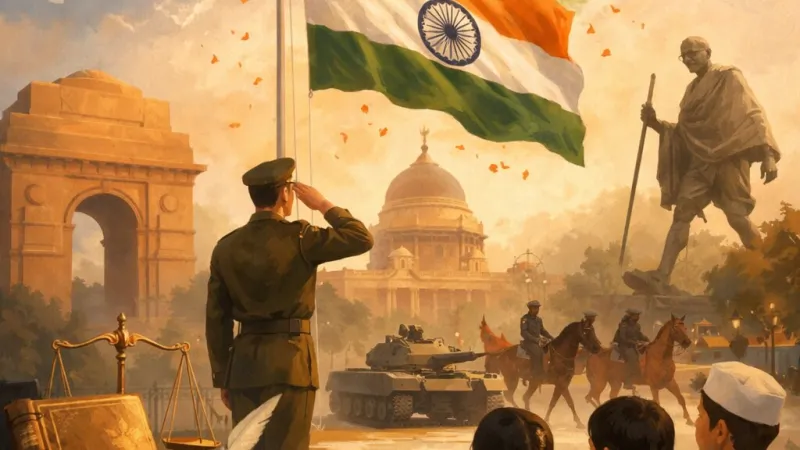
The Republic Day parade at Kartavya Path (previously Rajpath) in New Delhi is the most spectacular public expression of national pride. Early morning, the President of India unfurls the national flag, setting the stage for a ceremony that captivates not only those in attendance but also millions watching from home. The dignified march past by the armed forces, paramilitary contingents, NCC cadets, and vibrant tableaus from every state and ministry, display both our defence capabilities and our stunning cultural diversity—from the classical Bharatnatyam dancers to Ladakh’s traditional folk troupes.Gallantry awards, such as the Ashok Chakra and Param Vir Chakra, are presented to soldiers and civilians who have shown exceptional courage and devotion to duty. This official recognition stirs the sense of service and sacrifice in young and old alike.
In educational institutions, Republic Day is one of the busiest mornings of the year. Children dress as historical figures—Mahatma Gandhi, Lakshmi Bai, Chandrashekhar Azad—and perform skits, recite patriotic poems by Ramdhari Singh Dinkar or Subhadra Kumari Chauhan, and sing the national anthem “Jana Gana Mana,” written by Rabindranath Tagore. Schools also conduct essay writing, painting competitions, and debates focused on the significance and values of Republic Day, instilling patriotism and a sense of responsible citizenship. The streets and houses adorned with paper flags, rangoli in tricolour, and the air echoing with “Vande Mataram” create a festive, unified atmosphere from the largest cities to remote villages.
Republic Day’s Role in Promoting Values and Civic Awareness
The conscious celebration of Republic Day is, at its heart, an act of education—forging a sense of pride, belonging, and commitment to the nation. The day becomes a gentle yet powerful reminder to uphold the constitutional values of justice, equality, and mutual respect.Through lectures, cultural programmes, and public discussions, societies reinforce the importance of tolerance, communal harmony, and India’s cherished pluralism. For instance, the inclusion of tableaus depicting different religious and linguistic communities, the speeches highlighting common struggles, and the communal offerings at temples, mosques, and gurudwaras—all underline solidarity amid diversity.
Republic Day also serves as a platform for social messages—spreading awareness about civic duties like voting, environmental protection, and gender equality. The emphasis on “Unity in Diversity” is more than a slogan; it is a call to action, especially for the youth. By reflecting on the sacrifices made for independence, each citizen is reminded that freedom is both a precious right and a responsibility to be nurtured.
Recent and Notable Themes in Republic Day Celebrations
In recent years, Republic Day festivities have taken innovative forms. For the 74th Republic Day in 2023, the presence of Smt. Droupadi Murmu, India’s first tribal woman President, presiding over the function was a bold symbol of inclusion and the progress of democracy.Themes of environmental awareness were evident in the use of eco-friendly materials for float decoration, digital displays, and efforts to reduce single-use plastics. The increasing participation of women in the armed forces, as seen in all-women marching contingents, and the recognition given to local heroes—from health workers during the COVID-19 pandemic to innovators in rural India—reflect how Republic Day is evolving to celebrate not just past glories but present achievements and hopes for the future.
Conclusion
In summing up, Republic Day stands as an unshakeable pillar in the consciousness of every Indian. It commemorates a landmark historical event, the adoption and enforcement of the Indian Constitution, and upholds the democratic, secular, and pluralistic ideals fundamental to our republic. The day’s grandeur—whether reflected in the military parade, the colourful tableaus, or the simple school flag-hoisting—reminds us of the price of freedom and the sanctity of our rights and duties.As India marches ahead on the world stage, Republic Day’s significance only grows. It is a yearly opportunity to remind ourselves, especially the youth, to protect and strengthen our legacy—a republic defined not by force, but by the strength of its Constitution and the will of its people. Let us all pledge, in the words of our elders, not just to celebrate Republic Day but to live its ideals each day, building an India united in its glorious diversity.
Rate:
Log in to rate the work.
Log in