Top 10 Key Facts About Tigers for Secondary School Students
This work has been verified by our teacher: 16.04.2026 at 9:05
Type of homework: Essay Writing
Added: 14.04.2026 at 10:26
Summary:
Discover the top 10 key facts about tigers, their physical traits, habitat, and role in India’s ecosystem, perfect for secondary school students’ essays. 🐅
10 Lines on Tiger: An Original, Comprehensive Essay
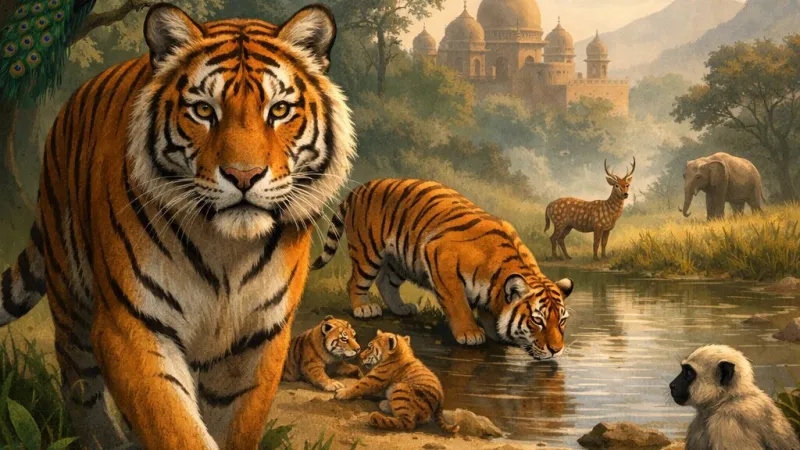
Among all the wild animals in the forests of India, the tiger stands out as a creature of grace, power, and deep mystery. Called ‘Bagh’ or ‘Sher’ in many Indian languages, the tiger belongs to the Felidae family (the cat family), and is not only a vital part of the forest ecosystem but also holds the distinguished status of being the National Animal of India. In legends, paintings, stories, and folklore across our country’s regions, the tiger is admired as a symbol of strength and bravery. This essay will present ten essential and fascinating facts about the tiger, expressed simply for students, while reflecting on its physical features, behaviour, life, and its place in our culture.
---
Physical Characteristics of the Tiger
Tigers are the largest members of the cat family found in the wild, easily recognised by their enormous size and powerful build. Adult male tigers can weigh more than 220 kilograms and stretch over three metres in length, including their long tails. Unlike many domesticated animals, a tiger’s body is like a well-tuned machine made for hunting—strong muscles, flexible spines, and sharp senses.What sets the tiger apart in appearance is its radiant orange coat marked with bold, black vertical stripes. These stripes act as camouflage, helping it to blend with the long grasses and shadows of the jungle, allowing it to sneak up on its prey almost invisibly. Visitors to Indian zoos and sanctuaries are sometimes lucky to spot the rare white tiger, particularly in states like West Bengal and Madhya Pradesh. These majestic creatures have snowy white fur and blue or greenish eyes, making them look almost mythical. Each tiger's stripe pattern is unique, like human fingerprints, which helps forest guards to identify and protect them.
Another interesting physical feature is the tiger's robust tail, which helps it balance while running, and its sharp claws and teeth that play a crucial role in catching and killing prey. Its eyes shine at night, which helps them see better in the dark forests.
---
Habitat and Distribution
Tigers need large territories and specific kinds of habitats for survival. In India, tigers are often found in dense forests, thick mangrove swamps like those of the Sundarbans, hilly bamboo jungles, and lush grasslands. These habitats provide them not only with prey but also with water from rivers, streams, or lakes – as tigers are one of the few wild cats that genuinely enjoy swimming.While India is proud to be home to the highest number of wild tigers in the world, these majestic animals also exist in other Asian countries like Nepal, Bangladesh, Bhutan, China, Malaysia, and even in the cold forests of Siberia in Russia. However, the forests of India, stretching from Bandhavgarh and Kanha in the central heartland to the Western Ghats, are famously rich in tiger populations, giving rise to the phrase “tiger country” for our nation.
---
Behaviour and Life Activities
Tigers are strictly carnivorous and their diet consists mainly of large animals like deer (chital, sambhar), wild pigs, and sometimes even young buffalo or gaur. A healthy tiger can consume about 20 to 25 kilograms of fresh meat in one night, though it does not always make a kill every day.A remarkable aspect of the tiger’s hunting strategy is its patience. Moving quietly with calculated steps, it uses its striped body to blend with the foliage, then attacks with tremendous speed, reaching as fast as 60–65 km per hour in short dashes. Interestingly, tigers are skillful swimmers and have even been seen crossing rivers in national parks like Jim Corbett or Kaziranga. Sometimes, they hunt animals in water, a behaviour not seen in lions or leopards.
Tigers are solitary by nature. Unlike lions who move in groups (called prides), each tiger lives and hunts on its own, except during mating or when the tigress is raising her cubs. The male is called a tiger, the female a tigress, and the young ones are known as cubs. Usually, a tigress gives birth to a litter of two to four cubs, which she looks after and teaches to hunt until they are old enough to live alone.
---
Unique Qualities and Abilities
Apart from their physical power, tigers possess skills unique among the world's big cats. Their swimming ability enables them to travel across rivers or swampy areas to search for food or territory. They communicate in various ways—roaring to mark their territory or calling others. A tiger’s roar is said to travel as far as 3 kilometres through thick forests, a sound both awe-inspiring and frightening.Just as every human has different fingerprints, no two tigers have the exact same pattern of stripes. This individuality allows wildlife experts in India to track and study tigers in their natural habitats.
---
Conservation and Protection
Despite their regal image and ecological importance, tigers face serious threats today. The current global population is frighteningly low, with around 4000 tigers left in the wild, and just over 2200 of them in India, as per recent government estimates.The biggest dangers to tigers are humans—poachers hunt them for their beautiful skin, bones, and other body parts that are in demand for illegal trade. Forests where tigers roam are often cut down for farming or construction, shrinking their homes and leading to conflict with humans.
To save the tiger, India has taken special steps. The launch of ‘Project Tiger’ in 1973 by the Government of India is a notable effort, which led to the establishment of dozens of Tiger Reserves like Ranthambore, Bandipur, Tadoba, and Periyar. NGOs also spread awareness and help patrol forests. However, tigers kept in zoos rarely experience the same quality of life as those in the wild, often suffering from stress and living fewer years.
---
Interesting Facts About Tigers
Among all tiger subspecies, the Siberian tiger, also called the Amur tiger, is the largest and toughest, surviving in freezing temperatures. Some types of tigers that once lived in places like the islands of Bali and Java or the vast lands of Central Asia are now extinct due to hunting and loss of habitat.Throughout Indian history, the tiger has been a symbol of royalty and courage. Emperors and kings, from the Mughal rulers to the Maharajas of Rajasthan, used tiger motifs on thrones, flags, and jewellery. Famous festivals and rituals in many regions depict the tiger, and in mythology, Goddess Durga rides a tiger to represent triumph of good over evil.
---
Conclusion
The tiger, with its splendid colour, immense power, and mysterious grace, has always captured the Indian imagination. It plays a vital role in keeping the forests healthy by controlling the number of herbivores. Yet, due to neglect and greed, these magnificent animals are now in danger. If we want our future generations to know the sound of a tiger’s roar or see one hidden among the reeds, we must act to protect and preserve them.Simple steps like visiting national parks, learning about tigers, and supporting conservation work can make a difference. Let us remember: the tiger is not just an animal, but a part of India’s soul—majestic, fierce, and deserving of our respect.
---
10 Lines on Tiger (For Quick Revision)
1. The tiger is the biggest and most powerful wild cat found in Indian jungles. 2. Its orange fur with black stripes helps it hide while hunting. 3. Tigers are skilled hunters that eat other animals like deer and wild pigs. 4. They are excellent swimmers and often cross rivers in search of food. 5. Each tiger has a unique pattern of stripes, just like human fingerprints. 6. Tigers mostly live alone and mark their own territory in the forest. 7. A tiger’s loud roar can be heard from up to 3 kilometres away. 8. The female tiger is called a tigress, and her baby is known as a cub. 9. Tigers are in danger because of hunting and forest loss, with only around 2200 left in India. 10. India’s tiger reserves and projects work hard to save these wonderful creatures for the future.---
By understanding and spreading knowledge about the tiger, every student can help protect this king of Indian forests and keep its legacy alive for many years to come.
Rate:
Log in to rate the work.
Log in