Understanding the Role of Elections in India's Democracy
This work has been verified by our teacher: 15.04.2026 at 9:46
Type of homework: Essay Writing
Added: 14.04.2026 at 12:44
Summary:
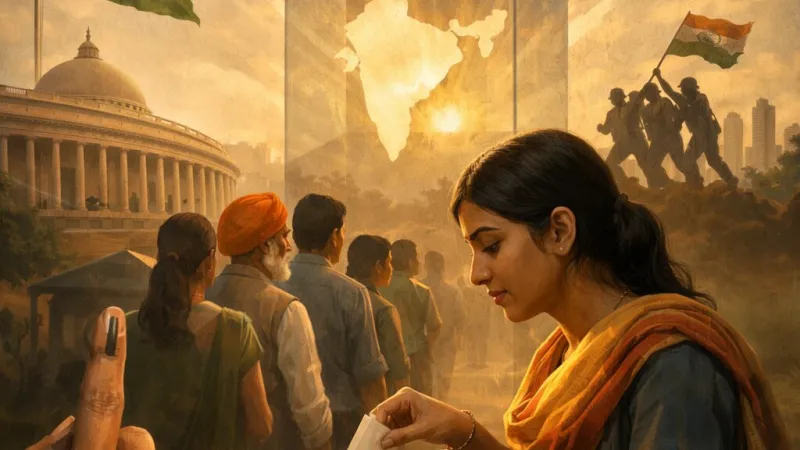
Explore the vital role of elections in India's democracy and learn how voting shapes governance, rights, and the future of the nation. 🗳️
Election and Democracy
Democracy and elections are two concepts which are deeply embedded in the Indian political and social consciousness. India, being the world’s largest democracy, offers a vivid landscape where every citizen has the power—and responsibility—to shape the nation's future through democratic processes. This essay explores the profound connection between election and democracy, delves into their significance in India, and analyses how these principles not only define our governance but also influence the everyday life and rights of Indian citizens.: Understanding Democracy and Election
Democracy, derived from the Greek words “demos” (people) and “kratos” (power), literally means the rule of the people. To most Indians, democracy is not just an abstract principle, but a living tradition. The idea is that true power rests with the people, and that they must have a direct and meaningful say in who governs them.
An election, in essence, is the process through which this power is exercised. It is a formal mechanism allowing individuals to choose representatives who will voice their concerns and interests at various levels of the government. Elections thus serve as the bedrock upon which the entire structure of democracy rests. Without them, the spirit of democracy would be hollow and powerless.
In the Indian context, these concepts are not distant ideals but everyday realities. With over 900 million eligible voters and periodic elections from the Panchayat level to the Parliament, India is proof of the scale and depth to which elections are intertwined with democracy. Understanding this relationship is crucial for all, especially for students who represent the next generation of voters and leaders.
The Historical Roots: Democracy and Elections in India
When we look back at history, traces of democratic thought are found not only in ancient Greece but even in India itself. The “sabhas” and “samitis” of the Vedic period were early gatherings where deliberation and collective decision-making took place. Ancient republics such as the Lichchhavis in what is now Bihar had forms of governance that bore a resemblance to modern democracy.However, the real journey towards mass democracy in India gathered momentum with the freedom movement. Under British colonial rule, the Indian people had highly restricted voting rights, mostly limited to the wealthy or propertied classes. The struggle for independence was deeply tied to the demand for self-representation and broadened suffrage.
With the adoption of the Constitution in 1950, India boldly declared itself a sovereign, democratic republic. One of the first great milestones was the historic general election of 1952, conducted on the basis of universal adult franchise. For the first time, every adult Indian, regardless of caste, creed, gender, or wealth, had the right to vote. It was an unprecedented event—Jawaharlal Nehru described it as “the greatest adventure in democracy.” Today, periodic elections continue to be held at national, state, and local levels, cementing their role in our political culture.
Core Principles of Democracy Upheld by Elections
Popular Sovereignty and Choice
At the heart of democracy is the notion that people must have the power to choose their own rulers. Elections give expression to the people’s will. During elections, every eligible citizen gets one vote, and thus one equal say, whether they live in a Mumbai high-rise or a remote village in Nagaland. As legendary leader Dr. B.R. Ambedkar emphasised, the right to vote is the axis of all democratic rights, for without it, democracy is incomplete.Political Equality
One of the most remarkable features of elections in India is that every vote matters equally. The humble rickshaw puller’s vote weighs as much as that of a wealthy industrialist. The Indian Constitution forbids discrimination on the grounds of religion, race, caste, sex, or place of birth. This principle of political equality has, over the decades, empowered the most marginalised to participate in governance.Accountability and Regularity
Elections serve as a powerful instrument for holding rulers accountable. The prospect of facing the electorate forces politicians to fulfil their promises, and if they fail, voters have the power to remove them. The fixed periodicity of elections—Lok Sabha every five years, state assemblies, local bodies—insures against any group monopolising power for too long. This regular opportunity to choose new leaders is a safeguard against tyranny.Rule of Law and Constitutionalism
Indian elections are conducted strictly within the framework of the Constitution. According to the law, no one is above it. Whether it is the ruling party or the opposition, everyone is bound by constitutional provisions, and the Election Commission acts as a watchdog to ensure free and fair polls.The Electoral Process: How Democracy Operates in Practice
The Role of the Voter
The health of any democracy is determined by the active participation of its citizens. From registering to vote, understanding candidates' manifestos, to actually casting the ballot, each step gives Indians a stake in the political process. Eminent personalities like Mahatma Gandhi repeatedly urged people to exercise not only their rights, but also their duties as citizens.Universal Adult Franchise
Since independence, India has embraced universal adult franchise. All citizens aged 18 and above can vote. This rejection of any form of exclusion (be it based on caste, literacy, gender, or property) stands as a victory for egalitarian values.Political Parties and Candidates
Political parties, whether national like the Indian National Congress or local ones like DMK and TMC, field candidates and articulate visions of governance. They represent various social, economic, and regional interests. Indian parliamentary democracy encourages lively competition between parties, resulting in a dynamic political scene reflective of the country’s diversity.Safeguarding Free and Fair Elections
India takes immense pride in the integrity of its electoral system. The independent Election Commission of India plays a pivotal role, overseeing everything from updating voter lists to counting votes. The introduction of Electronic Voting Machines (EVMs) and VVPATs has made the process more efficient, tamper-proof and transparent.The Mechanics: From Polling to Counting
Voting is conducted by secret ballot to protect voter privacy. Once the polling concludes, votes are counted under strict supervision and security. Result declarations are followed by the formation of government, or, in case no party secures a majority, alliances are made.How Elections Strengthen Democracy
Elections bestow legitimacy upon those who govern. A government chosen through free and fair elections enjoys both legal and moral authority. This regular, peaceful transfer of power reduces the likelihood of coups or civil unrest, something not always seen in non-democratic societies.Moreover, elections encourage mass political awareness. Campaigns, debates, and rallies make people more conscious about public policies, pressing issues, and their own rights. Over the years, reservation policies—such as those for Scheduled Castes, Scheduled Tribes, and women—have increased participation of previously marginalised communities, bringing more voices into the mainstream.
Challenges Before Indian Elections
No system is perfect. India faces electoral malpractices such as vote-buying, bogus voting, and sometimes, intimidation. While the Election Commission has made great strides, such issues occasionally undermine faith in the process.Another concern is declining voter turnout, especially in urban areas. Factors such as disillusionment, apathy, long queues, or lack of information contribute to this trend.
The role of money and media has become highly significant. Campaign financing and the rise of social media have introduced both opportunities (more information, quick outreach) and problems (fake news, polarisation). Additionally, logistical challenges—ensuring security in conflict-prone areas or delivering ballot papers to remote Ladakh villages—require constant innovation.
The Role of the Citizen: Democracy’s Torchbearer
The strength of democracy lies in the hands of its citizens. Voting intelligently, evaluating candidate backgrounds, avoiding being swayed by empty promises—these are all responsibilities of the individual voter.Respecting rules, peacefully accepting election outcomes, resisting divisive propaganda, spreading voter awareness, and holding public representatives accountable even after the polls—these steps are what make democracy robust. Youth, especially students, have a vital role to play in this, as seen in nationwide voter awareness campaigns like SVEEP (Systematic Voters’ Education and Electoral Participation).
Indian Examples: How Elections Keep Democracy Vibrant
India’s electoral history is marked by frequent peaceful turnovers of power. For instance, the 1977 general election saw the first non-Congress government come to power after a massive political shift, demonstrating that even powerful governments can be replaced.The Election Commission has built global respect for its neutrality and efficiency. Through measures like Model Code of Conduct, strict spending limits, and voter education, it has fostered trust.
Notably, women’s and marginalised communities’ participation has consistently increased, thanks to 33% reservation at Panchayat level and targeted awareness campaigns. The use of high-tech like EVMs and VVPATs—sometimes even carried by boat or elephant to isolated villages—exemplifies India’s commitment to inclusion.
Conclusion
Elections are the very heart that keeps the democratic spirit of India alive. They uphold the principle that real power lies with the people, regardless of their background. Through elections, democracy renews itself, rewarding the deserving and removing the complacent. Challenges remain, yes, but the spirit of reform and participation is ever present.Going forward, continuous improvement in electoral processes, wider citizen engagement, and spirited defence of democratic norms are essential. Every Indian’s vote is not just a right, but a sacred responsibility to ensure that the world’s largest democracy becomes, with each election, more just, inclusive, and true to its founding vision. Let us all remember that by casting our ballot, we do not merely choose a government—we shape the destiny of our great nation.
Rate:
Log in to rate the work.
Log in