Exploring Identity: Defining Ourselves by What We Reject
This work has been verified by our teacher: 15.04.2026 at 10:10
Type of homework: Essay Writing
Added: 13.04.2026 at 12:40
Summary:
Discover how identity is shaped by what we reject in this insightful essay on self-definition through negation, tailored for Indian secondary students.
The Search for Identity: A Journey through Negation
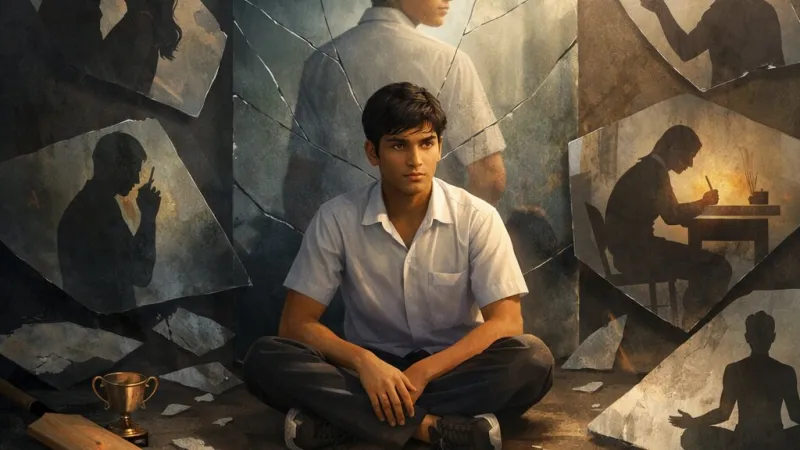
“What if the path to discovering ourselves lies not in asking ‘Who am I?’ but in bravely stating ‘I am not this’?” In the complex web of Indian society, criss-crossed with languages, cultures, religions, castes, and expectations, the search for identity is often depicted as a quest for uncovering some hidden, pre-existing, ‘true’ self. Yet, this idea is increasingly challenged, both philosophically and in the lived experiences of young Indians today. Perhaps it is less about locating a pure core, and more about whittling away the false, the imposed, the not-me. In truth, our sense of who we are is carved out by what we refuse: the labels we cast off, the roles we deny, and the definitions we reject. Especially in a country as diverse and dynamic as India, the journey of self-discovery is deeply entwined with conscious negation. This essay seeks to explore how identity emerges not by searching for the essence of who we are, but by recognising—and distancing ourselves from—what we are not, drawing on philosophies both local and global, historical realities, and the day-to-day choices that shape Indian youth.
---
Conceptual Foundations: Redefining Identity Through Negation
Typically, we are taught to understand identity as a discovery of the unchanging ‘real me’—something essential, authentic, often waiting, as if buried beneath the noise of society. This view, encouraged by well-meaning adults and sometimes even educators in our schools, suggests that identity is a secret chest inside us, patiently waiting for the right key. School textbooks might echo this sentiment, urging students to uncover their natural talents or to express their ‘inner self’.However, this “essentialist” view is limiting. It treats identity as something static and whole, while in reality, it is anything but. Our sense of self is malleable. It shifts with age, with experience, and according to the situations we inhabit—think of how different we might feel as a dutiful student in a uniformed classroom compared to the unguarded laughter at home with friends. Identity is not a single truth but a process: a continual negotiation, a boundary that gets redrawn every time we say, “No, that’s not me.”
Negation, in this sense, is neither pessimistic nor escapist. It provides the sharp knife with which we sculpt our distinctive figures out of the mass of expectations. To say 'I am not...'—not just in rebellion, but in honest reflection—enables us to see our shape more clearly. Psychology, philosophy, and cultural tradition offer different lenses to understand this boundary-making as fundamental to shaping who we are.
---
Philosophical Roots: From Neti Neti to Rebellion
The philosophical richness of the Indian tradition presents a direct and profound engagement with identity through negation. The ancient Upanishadic phrase ‘Neti Neti’, which translates as ‘not this, not that’, is a classic example. In Advaita Vedanta, seekers are encouraged to peel away layers of misidentification—the body, the mind, attachments, and social positions—in a meditative search for the Self, which transcends all conditioned forms. This is an inquiry that involves rigorous negation, until ‘what remains’ cannot be negated further.Modern philosophy, too, picks up this narrative. French existentialist Jean-Paul Sartre writes, “existence precedes essence”—meaning, no identity is handed over at birth. It is through the choices we make, and crucially, through the roles and paths we reject, that we fashion ourselves. To refuse the roles society hands us automatically—be it gendered expectations, caste positions, or generational pressures—is to begin writing one’s own script.
Psychological theory complements these traditions. Carl Jung introduces the idea of the “shadow”: the denied, rejected parts of oneself that are unconsciously kept at bay. Understanding who we are, Jung suggests, involves not only affirming what is in the light but acknowledging everything we reject or suppress. Our boundaries—what we keep out—are integral to who we become.
In India’s own modern history, postcolonial thinkers like Frantz Fanon and B.R. Ambedkar argue that oppressed identities are forged through the powerful act of negation. When Dalits refuse the degraded identities assigned by caste society, or when Indians, during the freedom movement, rebuffed colonial images of inferiority, new and vibrant identities arose from these away-movements. The search became not for a pristine essence, but for freedom from imposed definitions.
---
Historical Illustrations: Building Identity by Refusal
Nowhere is this theme clearer than during India’s national awakening. The British Raj not only ruled India politically—it also constructed Indians, in their writings and policies, as ‘effeminate’, ‘uncivilized’, and inherently incapable of self-government. In response, leaders from all walks of life launched a cultural and intellectual struggle to shed those definitions. Whether by popularising swadeshi (rejection of foreign goods), or by foregrounding forgotten histories (like the proud legacy of the Cholas or the Mauryas), the Indian freedom movement solidified its sense of self precisely by casting off what it was not: neither the loyal colonial subject nor the caricatured, one-dimensional native. This dynamic is seen in the way the Constituent Assembly debates unfolded: what kind of India was possible could only be answered by first clarifying what kind of India was not.Within society, movements for social justice have always been marked by negation. The works of Jyotirao Phule and Savitribai Phule, who rejected Brahmanical superiority and patriarchal norms, paved the way for marginalised communities to forge new ways of being, grounded in what they refused to accept. The Dalit movement, literature by writers like Omprakash Valmiki or Bama, is rife with this self-liberating negation—rejecting the ‘othered’ identity foisted on them and articulating something truer, often painfully so.
The process is ongoing even today as young Indians negotiate caste, regional, linguistic, or sexual identities in classrooms, workplaces, and within their own families. Each negotiation is marked by lines drawn: “I am not just my surname.” “I am not the gender role assigned at birth.” This is not to say one floats in a perpetual ‘no’, but rather that each ‘no’ creates space for a new, self-chosen ‘yes’.
---
Contemporary Life: Indian Youth and the Negation of The Not-Me
For today’s students, the world is as much online as offline. On platforms like Instagram or Twitter, young Indians assemble their own ‘feeds’ by choosing what not to see or follow. Here too, identity is a process of curation—one shaped as much by exclusion (unfollowing a toxic influencer, blocking a bullying peer, rejecting fake news) as by what is included. The hashtags one participates in, the reels one skips, the memes one disavows—all help mark the edges of the self.The ongoing debates about caste and gender on college campuses, the growing confidence of sexual minorities, and the assertion of regional identities all illustrate this ongoing process. Students in urban Bengaluru or rural Punjab may reject the ancestral trades, or in the case of first-generation learners, sidestep the fatalistic idea that “people like us do not deserve more.” They not only chase dreams, but do so by swerving away from dead-ends mapped by tradition or stereotype.
Minimalism—a growing trend among urban youth—is another example. To ‘not be’ a helpless consumer of global brands, or to refuse to be defined by wealth or possessions, is considered almost radical. The identity of the minimalist arises through the proud negation of clutter, both material and digital.
Indian students abroad serve as another poignant example; their sense of Indianness is often shaped more by what they consciously preserve and, equally, by what they decide to set aside. For some, it might mean not conforming to the most conservative traditions of their families. For others, it’s about refusing to dissolve completely into the host country’s cultural stew, keeping alive at least some fragment of their heritage.
---
Psychological and Social Implications
There are undeniable strengths to defining ourselves through what we are not. It hands us agency, allowing us to decide the fields of our own possibility. It allows the oppressed or the misunderstood to refuse victimhood, to carve out dignity from what is denied. It brings clarity—our identities crystallize through every stereotype discarded, every inherited expectation challenged.Yet, there are dangers, too. If identity is always oppositional, forged only by ‘not them’, then it can become defensive, or lead to exclusion, rivalry, or even violence. Some campus protests, for instance, run the risk of becoming so “anti” that they never articulate what positive values they stand for. Excessive denial without subsequent affirmation can leave one rootless or perpetually restless.
The goal, then, is balance. In the words of the Bhagavad Gita, one must learn both to act and to renounce attachment to the act. Similarly, healthy identity involves both the courageous rejection of false or imposed labels, and the conscious pursuit and acceptance of values, associations, and dreams that enrich us.
---
Practical Steps for Students
For Indian students wrestling with these questions today, a few practices can make this philosophical idea concrete:- Scrutinise the labels: When someone (family, friends, society) says you are a ‘good girl’, ‘backbencher’, ‘maths whiz’, or ‘just arts material’, ask yourself: does this fit? If not, feel empowered to politely decline. - Challenge unexamined beliefs: Question the stories you’ve been told about class, caste, religion, and gender. What doesn’t sound right? Often, the seeds of your identity hide in these cracks. - Practice self-inquiry: Inspired by Neti Neti, try quietly asking, “Am I defined by this body? By these scores? By this language?” See what falls away when you let go. - Journaling and Dialogue: Keep a diary of identities you’ve tried on, ones you’ve rejected, and how each revelation felt. Talk to peers from backgrounds different from your own; sharing and hearing ‘I am not that’ can be liberating. - Work with your shadow: Notice the traits or habits you most dislike in yourself or others—the roots of our ‘nos’. Try to understand where they come from, and whether they are truly to be locked away forever. - Curate online influences: Be intentional about what and whom you allow into your digital world; make space for what genuinely reflects your values. - Accept fluidity: Allow yourself to change, to say ‘no’ to things today that you once identified with yesterday. This flexibility is a strength, not a weakness.
---
Conclusion
The search for identity is a creative, ongoing process—not a hunt for a finished product, but a journey of continuous sculpting through conscious rejections. Indian philosophy, history, and contemporary life all echo that identity is built as much by what we say ‘no’ to as by what we claim as ‘ours’. Whether rejecting colonial characterisations, caste oppression, gender binaries, or the background noise of consumerism, Indian youth can turn negation into an act of empowerment and clarity.Let us then approach the puzzle of ‘who we are’ not as a quest for a static self, but as an adventure in courageous discernment: tearing off the masks we never chose, refusing the boundaries others set, and making space—bit by bit—for the selves we are free to become. My hope is that every student, every curious seeker, will be bold enough to echo our Upanishadic ancestors: “Neti, Neti... Not this, not that... till what remains is truly yours.”
Rate:
Log in to rate the work.
Log in