The Internet: Connecting India and Transforming Lives Today
This work has been verified by our teacher: 21.04.2026 at 15:31
Type of homework: Essay Writing
Added: 18.04.2026 at 11:21
Summary:
Explore how the internet connects India, transforms lives, and empowers students with knowledge on its impact, use, and importance for responsible digital access.
Paragraph on Internet: A Window to the World and a Call for Responsible Use
The internet is often described as the greatest invention of our times, a virtual web spun across continents, connecting millions of computers, smartphones, and devices into a vast, seamless network. In simple terms, the internet is a gigantic, invisible road on which messages, videos, documents, and ideas travel from one corner of the world to another in the blink of an eye. For Indians, spanning from the bustling lanes of Delhi to the remote villages in Mizoram, the internet has rapidly become an essential part of everyday life. But how did this web come to be such a powerful force? The story goes back to the latter half of the twentieth century, when early networks like ARPANET in the US and similar communication technologies in Europe marked the beginnings of global connectivity. Over decades, these small, isolated networks grew and merged into the diverse and complex internet we know today—ushering in a revolution that forever changed how humanity communicates, learns, and works.
The purpose of this essay is to dive deep into how the internet functions, its impact on Indian society, its tremendous potential for education and business, and the pitfalls that come with its overuse or misuse. In doing so, I hope to underline the importance of using the internet wisely, especially for the youth of India.
The Architecture and Accessibility of the Internet
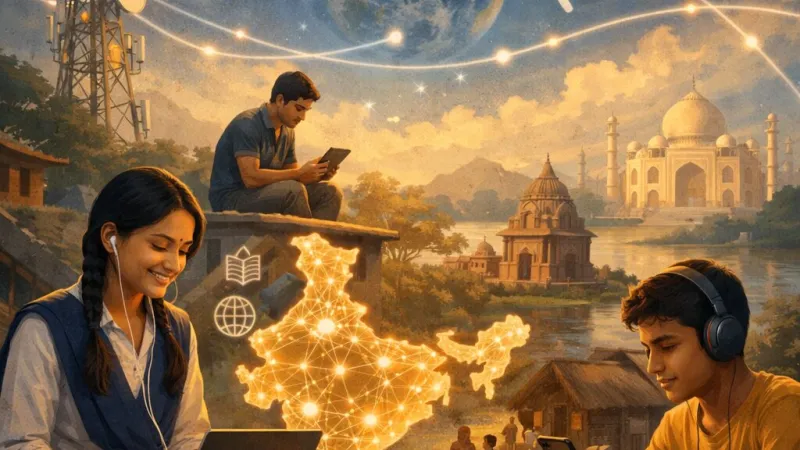
Before we explore its uses, let us briefly understand how the internet works. Behind the friendly icons on our phone screens, the internet is supported by a network of physical servers, cables running through oceans, satellites, and data centres. Internet Service Providers (ISPs) act as gatekeepers, supplying us with connectivity. Devices such as laptops, smartphones, and tablets connect through Wi-Fi or mobile networks, allowing even those in small towns to access the same information as someone sitting in an IIT classroom.India’s internet penetration has grown massively, especially with the government’s “Digital India” campaign. According to the Telecom Regulatory Authority of India’s 2023 report, the country crossed the 800 million internet user mark, yet significant gaps remain. While metropolitan cities like Mumbai, Bengaluru, and Hyderabad boast high-speed connections and near-universal coverage, many rural regions still face network issues, low speeds, and affordability hurdles. Notably, digital literacy has not kept pace—many Indians, especially the elderly and those less educated, struggle to use the internet safely and effectively.
Despite these challenges, the internet has already become a bridge over the educational divide, especially since the COVID-19 pandemic forced schools to shift to online classes. Businesses, too, moved online, and digital payments using UPI, Google Pay, and Paytm have now become the norm in most urban and even many rural settings. The push for e-governance through portals like UMANG and digitisation of services such as passport or Aadhaar applications showcases the internet’s critical role in streamlining public service delivery.
Uses and Benefits of the Internet
The range of uses the internet offers is as numerous as the Ganga’s tributaries. To begin with, it is an unparalleled ocean of information. Students, professionals, and homemakers alike can access encyclopedias, research papers, news websites, or government documents with a simple search. Platforms such as the National Digital Library of India have become treasure troves for anyone preparing for competitive examinations, be it the UPSC, SSC, or the IIT-JEE. Moreover, educational YouTube channels in Hindi, Tamil, and regional languages provide free tutorials breaking the English-language barrier common in traditional textbooks.Communication is another significant aspect. Gone are the days of waiting for inland letters to reach from Kerala to Kashmir. Messaging apps like WhatsApp, video conferencing on Google Meet, and sharing updates on Instagram have brought friends and families closer, especially the generation of NRIs and overseas students yearning for a taste of home.
Online education deserves special mention. The arrival of platforms like BYJU’S, Unacademy, and Vedantu has transformed the exam preparation ecosystem. From live interactive classes to practice tests and doubt sessions, these platforms offer flexibility and high-quality instruction even to students in isolated towns. The government’s own SWAYAM portal also hosts thousands of free online courses for higher education. This democratisation of learning is a true game-changer in a country where coaching classes were earlier the privilege of a few.
The business world, too, has undergone a massive transformation. Digital wallets and UPI-based transfers power small and medium enterprises, while vendors list their wares on online marketplaces like Flipkart or Meesho. During the pandemic, thousands sustained livelihoods through remote working and freelancing, a trend that continues in a hybrid format. From a local saree shop conducting WhatsApp sales to a tech start-up pitching via Zoom to overseas clients, the internet’s impact on the Indian economy is unmistakable.
Governance benefits as well—candidates can apply for PAN cards, pay electricity bills, and even lodge legal complaints, all from their phones. Government schemes are not only more accessible but also more transparent, minimising the notorious “middlemen” culture.
The Role of the Internet in Social and Cultural Spheres
The social dimensions of the internet in India are rich and evolving. Social media platforms—often referred to as the modern-day chowk or adda—allow citizens of all backgrounds to interact, debate, and organise. Campaigns like “Swachh Bharat Abhiyan” gained momentum precisely because local youth groups could share before-after photos and inspire change. Internet petitions, Twitter hashtags, and Facebook groups have amplified voices previously drowned out by mainstream media.Entertainment has taken an entirely new route. From streaming hit Malayalam films on Netflix to watching IPL highlights on Hotstar, content is now available in nearly every Indian language. This has allowed regional content creators—be it folk singers from Rajasthan or aspiring animators in Assam—to find national and even international audiences. Podcasts on mythology, stand-up comedy in Haryanvi, and Instagram reels in Hinglish all thrive side-by-side, contributing to cultural inclusivity.
The preservation and popularisation of cultural artefacts owes much to digitisation. Websites by bodies like the Archaeological Survey of India offer virtual tours of forts, temples, and galleries—making India’s artistic legacy accessible to students from Sikkim to Kanyakumari. Vernacular content platforms like Pratilipi have fostered a resurgence of writing in Indian languages, keeping our literary traditions alive in the digital age.
Challenges and Risks Associated with Internet Use
However, every lotus comes with its muddy water. The internet, for all its marvels, poses significant dangers. The first is the persistent digital divide. Millions, especially women and marginalised groups in rural India, remain offline. Sometimes, boys are given priority over girls in access to smartphones and data, worsening the educational gender gap.Privacy and security risks loom large. With online frauds, phishing, identity theft, and cyberattacks making news headlines, internet users need to be ever vigilant. Stories abound—someone’s bank account gets drained through a fraud call, or confidential data leaks out due to weak passwords.
The menace of misinformation and fake news is especially severe in India, where social media forwards can impact elections, spark communal violence, or spread dangerous health rumours. The need for digital literacy—that is, the skill to tell apart verified information from hoaxes—cannot be overstated.
Internet addiction and overuse have become common in urban households. Students who spend hours playing games or scrolling reels may suffer from anxiety, poor eyesight, and declining academic performance. Furthermore, the rise in cyberbullying and online harassment, particularly targeting young women and teens, is a growing social problem. Support systems, reporting mechanisms, and awareness in families and schools are the need of the hour.
Responsible Internet Usage: Guidelines and Recommendations
Given these challenges, using the internet with mindfulness is essential. Students should remember to balance online and offline activities, focusing on learning and skill-building while controlling distractions. When faced with sensational news or suspicious links, they should cultivate the habit of cross-checking sources, using websites such as PIB Fact Check or Alt News.Teachers and parents play a vital role—by guiding students to quality educational content, ensuring parental controls, and having open conversations about online experiences, both positive and negative. They should encourage healthy digital habits and restrict entertainment browsing during study hours.
Basic online safety practices such as regularly updating software, using strong passwords, and never sharing OTPs or personal documents with strangers should be second nature. Equally important is polite and respectful behaviour online—avoiding hate speech, bullying, or trolling. The internet is best seen as a tool for growth and social good, not just mindless entertainment.
The Future of the Internet in India and Globally
India now stands on the threshold of a new phase in internet evolution. With 5G networks rolling out, faster and more stable connections will become accessible. Technologies like IoT (Internet of Things) and AI (Artificial Intelligence) will soon transform everything—from healthcare, where AI analyses X-rays remotely, to agriculture, where sensors predict rainfall.The government and various NGOs are investing in bridging the last-mile connectivity gap, popularising digital literacy, and bringing even the remotest households online. With proper regulation, including strengthened cyber laws and data protection, India can ensure that technology uplifts rather than divides. Policymakers must continue building on net neutrality, user privacy, and ethical AI use.
Rate:
Log in to rate the work.
Log in