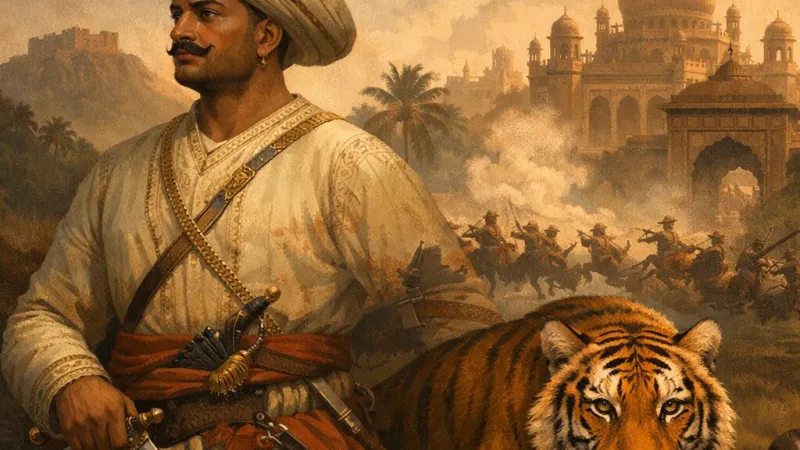
Key Facts and Legacy of Tipu Sultan, the Tiger of Mysore
This work has been verified by our teacher: 24.04.2026 at 9:05
Type of homework: History Essay
Added: 22.04.2026 at 9:15
Summary:
Explore key facts and legacy of Tipu Sultan, the Tiger of Mysore. Learn about his life, battles, reforms, and impact on Indian history in this detailed essay.
The Life and Legacy of Tipu Sultan: The Tiger of Mysore
Tipu Sultan remains one of the most dynamic and debated personalities in Indian history. Famous as the “Tiger of Mysore,” his relentless opposition to British colonial domination, innovative governance, and vibrant patronage of arts have made him a formidable figure, particularly in Karnataka and across southern India. More than two centuries after his tumultuous rule came to an end, Tipu Sultan continues to inspire discussions in classrooms, political debates, and literature. This essay aims to provide a comprehensive understanding of his multifaceted life, beginning from his early years, traversing through his illustrious military engagements, delving into his progressive reforms, and finally assessing his enduring legacy and place in Indian memory.---
Early Life and Background
Tipu Sultan was born on 20th November 1750, in Devanahalli near Bangalore, into a family that was already reshaping the fate of southern India. His father, Hyder Ali, had risen from the ranks of the Mysorean military to become the de facto ruler of Mysore, replacing the Wodeyars and transforming the region into a powerful and modernising state. Tipu’s mother, Fatima Fakhr-un-Nisa, was known for her wisdom and religious devotion. Growing up in a kingdom often caught between Marathas, the Nizam of Hyderabad, and the encroaching British East India Company, Tipu was exposed to a highly volatile political environment.From an early age, Tipu was provided an extensive education, unusual for many contemporary Indian princes. Apart from Persian, Arabic, and Kannada, he became proficient in military science, statecraft, and diplomacy. French military advisers, who were present in the Mysorean court thanks to Hyder Ali’s pro-European policies, played a crucial role in shaping Tipu’s martial training and attitude towards technology and innovation. Even before attaining adulthood, Tipu had accompanied his father on military campaigns and demonstrated remarkable leadership, particularly during the wars with the Marathas and the British.
This combination of early intellectual and military grooming laid the foundation for Tipu’s later successes and signalled his capacity for innovation, resilience, and adaptability.
---
Rise to Power and Political Challenges
When Hyder Ali died in 1782, Mysore was embroiled in the Second Anglo-Mysore War. Rather than stepping back or giving in to the adversaries, the young Tipu Sultan ascended to the throne amid chaos, inheriting not just a kingdom but a freight of unfinished battles and fractured allegiances. His coronation in Srirangapatna was marked by worries both internal, with factions among the nobility and military, and external, with rival powers circling like vultures.Tipu’s political acumen soon became evident. He reinforced the alliance with the French, seeing them as vital to counterbalance the mounting British pressure. At the same time, he held difficult negotiations with the Marathas and the Nizam, sometimes as competitor, sometimes as reluctant collaborator. His letters, many of which are preserved today, show a monarch deeply immersed in the realpolitik of the era. Tipu Sultan’s titles—“Sultan Fateh Ali Bahadur,” “Sher-e-Mysore,” and “Sultan-i-Muazzam”—unmistakably projected his image as a just yet spirited ruler, determined to protect his land and people from foreign domination.
---
Military Campaigns: The Anglo-Mysore Wars
Tipu Sultan’s military career is most noted for his central role in the series of Anglo-Mysore Wars, which pitted Mysore against one of the early prototypes of the modern colonial juggernaut. His leadership in the Second, Third, and Fourth Anglo-Mysore Wars tested the limits of indigenous resistance.Perhaps the most remarkable of his innovations was the development and use of iron-cased rockets. Building upon traditional pyrotechnic knowledge in the subcontinent, Tipu’s rocketeers created a formidable force that left the British both shocked and intrigued. These “Mysorean rockets” were later studied and adapted by the British themselves, ultimately influencing European military technology.
His victories at places like Coorg, Malabar, and Travancore are well-recorded, but so are setbacks, particularly after the Third Anglo-Mysore War, where massive territorial concessions had to be made due to the superior resources of the British and shifting allegiances of regional allies. Yet, despite losses and betrayals, Tipu Sultan never faltered in asserting Mysore’s sovereignty.
The Fourth Anglo-Mysore War culminated in the famous Siege of Srirangapatna in 1799. Refusing offers of surrender, Tipu fell fighting, his body discovered amidst his soldiers. His legendary words, reportedly uttered during battle—“Better to live one day as a tiger than a thousand years as a sheep”—echo the ethos of a king who preferred a glorious death to ignominious submission. In the Indian imagination, his martyrdom came to symbolise ultimate sacrifice in the cause of freedom.
---
Progressive Governance and Reforms
Beyond the battlefield, Tipu Sultan was a far-sighted administrator. He reorganised Mysore’s financial system, introducing new coinage bearing his name and emblems. The revenue system was rationalised, often inspired by Persian administrative models, but modified for local needs. Taxation was made more systematic, and both artisans and peasants found new opportunities under policies which encouraged local industry and sustainable farming.Silk weaving in Mysore flourished during Tipu Sultan’s reign; he introduced sericulture and fostered it as a state-driven industry, which remains a hallmark of Karnataka’s economy even today. Markets were developed, customs were regulated, and international trade—particularly with French, Arab, and Turkish partners—was actively encouraged.
His administration also invested in public works. He renovated old temples, mosques, and forts, and is credited with extending the famed Lalbagh Botanical Gardens in Bangalore. Far from being a religious bigot, as some detractors allege, records show that he made grants to several temples, protected priests from harm, and patronised scholars irrespective of religious background. Sanskrit, Persian, and Urdu literature found new life in his court, and literary works flourished.
---
Cultural Contributions and Controversies
Tipu Sultan’s court was a confluence of martial tradition, poetry, and cultural patronage. He was himself a poet in Persian, and stories abound of his wit and sharp intellect. The Indo-Islamic architecture of his era—seen in the grand Jama Masjid of Srirangapatna or the colourful murals of the Daria Daulat Bagh—reflect not just the luxury of a royal court but Tipu's passion for art and beauty.Yet, his legacy is not without controversies. Historians continue to debate his treatment of certain communities, especially in regions like Coorg and Malabar, where accusations of forced conversions and harsh reprisals have surfaced. However, many scholars point out the context of rebellion and war, and posit that Tipu’s actions, though undoubtedly harsh at times, were often motivated more by politics than sectarian animosity.
Given these complexities, Tipu Sultan’s image has been appropriated by various groups: heroes of resistance for some, rulers with flaws for others. But the academic consensus, as seen in the works of writers like Bhagwan Gidwani and Mohibbul Hasan, accepts Tipu's major contributions to statecraft, his advanced vision of modernity, and his indomitable will to resist colonialism.
---
Tipu Sultan’s Impact on Indian Freedom Movement and Modern Memory
Tipu Sultan’s defiance of British expansion inspired generations. Legends of his courage were retold in the freedom struggle, cited by both Gandhian pacifists and revolutionaries. In Karnataka and across India, schools, roads, and institutions bear his name; his sword, banners, and personal effects are revered as national heritage.His life features in the writings of famous Indian authors like Girish Karnad, whose celebrated play “The Dreams of Tipu Sultan” explores his ambitions and struggles. The annual Tipu Jayanti in Karnataka is both a celebration and a moment for reflection on communal harmony, national identity, and resistance against oppression.
---
Conclusion
Tipu Sultan stands out in history not just as a military commander who fiercely fought the powers of his time, but as a visionary ruler, a reform-minded administrator, a lover of arts, and a figure whose legend has outgrown the boundaries of his kingdom. His life is a tale of extraordinary courage, ambition, and complexity—a testimony to the potential of Indian kingdoms to embrace modernisation even amidst stormy times. While debates about some of his policies will continue to enrich our historical understanding, there is little doubt that Tipu’s passion for freedom, his innovations in technology, and his zeal for good governance made an indelible mark.In remembering Tipu Sultan, we are reminded of the steadfast spirit required to stand against domination and injustice, and of the importance of progressive governance for the welfare of all citizens. As students and citizens, studying the life of Tipu Sultan helps us appreciate not only a fascinating epoch in Indian history but also the timeless values of courage, innovation, and harmony in diversity.
Rate:
Log in to rate the work.
Log in