A Vibrant Overview of Durga Puja: Tradition, Culture, and Celebration
This work has been verified by our teacher: 20.05.2026 at 13:02
Type of homework: Essay Writing
Added: 19.05.2026 at 13:50
Summary:
Explore the rich tradition, cultural significance, and vibrant celebration of Durga Puja, perfect for secondary school homework and essay writing.
Paragraph on Durga Puja
Durga Puja, also fondly called ‘Sharadotsav’, stands as a shining jewel in the crown of Indian festivals, epitomising the intermingling of vibrant faith, artistic grandeur, and collective joy that characterises our culture. Not just a religious occasion, Durga Puja is woven into the fabric of Indian social and cultural identity, holding a sacred place especially in the hearts of Bengalis and millions across eastern India. Each autumn, as the earth dons a festive look with swaying ‘kash phool’, the gentle breeze smells of incense, and the sound of dhak fills the air, signalling the homecoming of Maa Durga to her maternal abode on earth. Though the modern-day celebrations evoke images of sprawling pandals in Kolkata or the humming energy of C.R. Park in Delhi, Durga Puja’s roots dig deep into ancient myth and collective memory, carrying forward the cyclical story of good triumphing over evil, generation after generation.Historical and Mythological Background
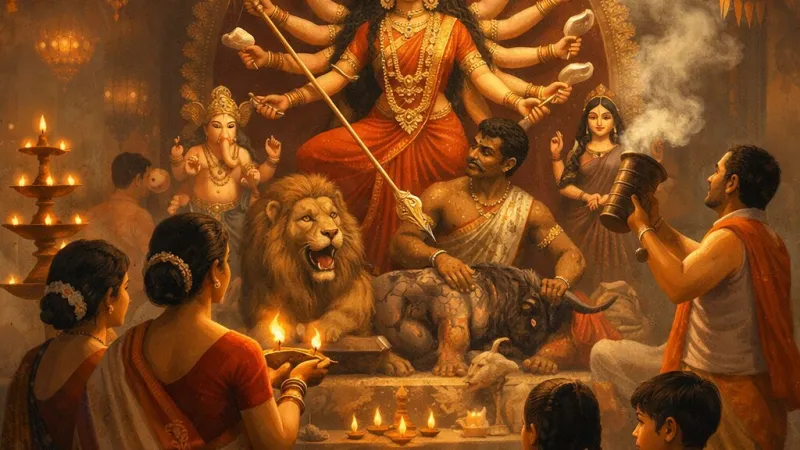
The enduring mythology behind Durga Puja is one that resounds with hope and inspiration. Legend has it that Mahishasura, a formidable demon king blessed with invincibility against any man or god, unleashed terror across the worlds. Desperate, the gods—led by Brahma, Vishnu, and Shiva—combined their divine energies to create Durga, a ten-armed goddess, each arm wielding a weapon gifted by a god, embodying ‘Shakti’, the cosmic feminine force. Riding her lion, Durga waged a fierce battle for nine days and finally vanquished Mahishasura on the tenth, a day celebrated as Vijayadashami. This myth, enshrined in the pages of the ‘Devi Mahatmya’—an important text of the Markandeya Purana—shows Mahishasura’s defeat as the victory of righteousness, inner strength, and moral order.Interestingly, Bengal’s version of Durga Puja is also entwined with the Ramayana. In his moment of doubt before battling Ravana, Lord Rama is said to have invoked Devi Durga with 108 blue lotuses, seeking her blessings for victory. This ‘Akalbodhan’ (untimely awakening) is mirrored in the autumnal timing of the festival, as opposed to the traditional springtime worship of the goddess. Thus, Durga Puja is as much a narrative about spiritual awakening as it is about cultural adaptation—and this flexibility is perhaps why the festival remains ever-relevant.
Religious Significance
At its core, Durga Puja is a deeply spiritual observance layered with rituals, symbolism, and heartfelt devotion. The festival stretches over ten days—beginning with Mahalaya, which marks the invocation of the goddess, and culminating in Vijayadashami. Each of the nine days honours different forms of Durga, collectively called Navadurga, from ‘Shailaputri’ to ‘Siddhidatri’, each symbolising unique virtues. The days are marked by rituals like Bodhon (welcoming the goddess), Anjali (floral offerings), Sandhi Puja (performed at the magical intersection of Ashtami and Navami), and Dhunuchi Naach (a dance with incense-filled earthen pots), weaving together prayers, chants, and joyous fervour.One of the most moving rituals is Sindoor Khela, where married women smear each other with sindoor (vermilion) on the last day, praying for marital bliss and sisterhood—a sight breathtakingly colourful and emotionally evocative. While fasting is common, particularly on Ashtami, the focus is on introspection and purification, rather than austerity. Alongside Durga, idols of Ganesha (symbolising wisdom), Lakshmi (wealth), Saraswati (knowledge), and Kartikeya (valour) are also installed and worshipped in the pandals, further enriching the festival’s symbolism.
At a deeper level, Durga’s slaying of Mahishasura goes beyond a literal battle—it speaks to the conquest of ignorance and inertia within the human soul, urging devotees to kindle self-belief and embrace the empowering feminine. The resonance of ‘Ya Devi Sarvabhuteshu Shakti Rupena Samsthita’—‘O Goddess, the power dwelling in every living being’—reverberates through puja pandals, evoking not just devotion, but a call to inner strength.
Cultural and Social Aspects
What truly sets Durga Puja apart is its transformation into a dazzling cultural spectacle and an unparalleled social event. Preparation for the festival begins months in advance, as idol-makers—specially those of Kumartuli in Kolkata—carefully mould clay into majestic images of Durga, painting expressive eyes with masterful skill during ‘Chokkhu Daan’. Pandals, the temporary temples, bloom overnight in city parks, street corners, and even rural fields. Some are ultra-traditional, featuring terracotta or shola (pith) art, while others embrace daring themes, drawing inspiration from Ajanta caves, Santiniketan’s art, Madubani paintings, or even contemporary social messages such as women’s empowerment or environmental conservation.Durga Puja is a festival of community, breaking barriers of class, caste, and creed. In cities like Kolkata, the entire metropolis glimmers—friends, families, and strangers become one in ‘pandal hopping’, exchanging greetings of ‘Subho Sharodiya’ and sharing moments over plates of khichuri, labra, luchi-alu’r dum, and signature sweets like rosogolla and sandesh. Food stalls, ‘mela’ grounds, bustling with laughter and colour, become mini-fairs, while cultural shows showcase recitations of Tagore’s poems, Rabindra Sangeet, dramatic plays, and folk dances like Dhunuchi Naach. There is a sense of belonging and unity; even non-Hindus join the festivities, underscoring the festival’s inclusive spirit.
The economic ripple effect is remarkable. For thousands of idol-makers, designers, decorators, flower-sellers, and sweet shop owners, Durga Puja is a lifeline. Fashion retailers launch puja collections, gifting shops do brisk business, and local musicians find vital opportunities. Durga Puja thus not only connects people emotionally, but also sustains livelihoods, linking art, industry, and tradition in a uniquely Indian way.
Regional Variations and Observances
Despite its Bengal-centric glamour, Durga Puja’s brilliance radiates far and wide across India. In Tripura, Assam, Odisha, and Jharkhand, the celebrations bear local hues—Assam’s ‘Bhotia Puja’ features folk performances, while in Odisha, ‘Chandi Medha’ comes alive with intricate silver filigree work. Bihar and Jharkhand blend Puja with local fairs, while Maharashtra’s Navratri echoes similar themes with traditions like garba and dandiya, paying homage to the goddess in vigour-filled dance.Across northern India, Dussehra—the tenth day—gains prominence through Ram Leela performances, dramatic enactments of the Ramayana that culminate in burning effigies of Ravana, signifying the defeat of evil. In Tamil Nadu and Karnataka, ‘Bommai Golu’ and ‘Ayudha Puja’ put unique spins on the celebrations. Among the Indian diaspora—whether in London’s Wembley, Dubai’s Hindi Lane, or Singapore’s Little India—Durga Puja brings communities together in shared nostalgia. Pandals are set up in school halls or makeshift tents, rituals are streamed online for loved ones back home, and cultural nights keep Indian traditions alive in foreign lands.
The contrast between sprawling urban celebrations, marked by elaborate thematics and lighting competitions, and simpler rural festivities—folk songs, local processions, and understated yet heartfelt rituals—adds to the festival's mosaic.
The Culmination: Vijayadashami / Dussehra
The festival’s emotional crescendo arrives on Vijayadashami. After days of prayer, music, and revelry, devotees bid farewell to Maa Durga in a mist of ‘Bolo Durga Mai Ki Jai’ chants and rhythmic drumbeats, as idols are slowly carried to rivers or lakes for immersion. The procession is a spectacle—women lead ‘Baran’ rituals, applying sindoor to the goddess and to each other; men, women, and children dance, often teary-eyed yet filled with pride. The immersion, called ‘Bisarjan’, is symbolic of the cyclical rhythms of nature—what comes must go, only to return next year with renewed joy and anticipation.Vijayadashami is not only an end but a new beginning—people exchange sweets and ‘Bijoya’ greetings, elders bless youngsters, and new bonds are formed. Many regions link this day to the victory of Lord Rama over Ravana, celebrating through community feasts, processions, and even kite flying in places like Gujarat.
Modern Relevance and Challenges
In an era of rapid urbanisation and changing lifestyles, Durga Puja preserves its grandeur while adapting to modern realities. Contemporary pandals explore themes like digital India, environmental conservation, and social justice, fostering awareness alongside worship. There’s a growing movement towards eco-friendly idols, made of clay and natural colours, as awareness rises about pollution caused by chemical paints and Plaster of Paris.The role of technology has been profound—pujas are live-streamed for faraway devotees, social media competitions decide the best pandals, and mobile apps guide visitors through ‘pandal-maps’. The festival is now more accessible, with ramps for differently-abled people and special initiatives to include underprivileged children, reflecting a broader social conscience.
Yet the core remains unshaken—annual reunions, the warmth of anjali (prayer), the artistry, and the collective hope that, just as Durga vanquished Mahishasura, we too can overcome our struggles.
Rate:
Log in to rate the work.
Log in