Discovering Rainbows: A Colorful Natural Wonder Explained in 10 Lines
This work has been verified by our teacher: yesterday at 10:58
Type of homework: Essay Writing
Added: 1.06.2026 at 11:18
Summary:
Explore the science behind rainbows in 10 lines and learn how sunlight and rain create this colorful natural wonder that fascinates students across India. 🌈
The Rainbow: A Miraculous Embrace of Colours in Nature
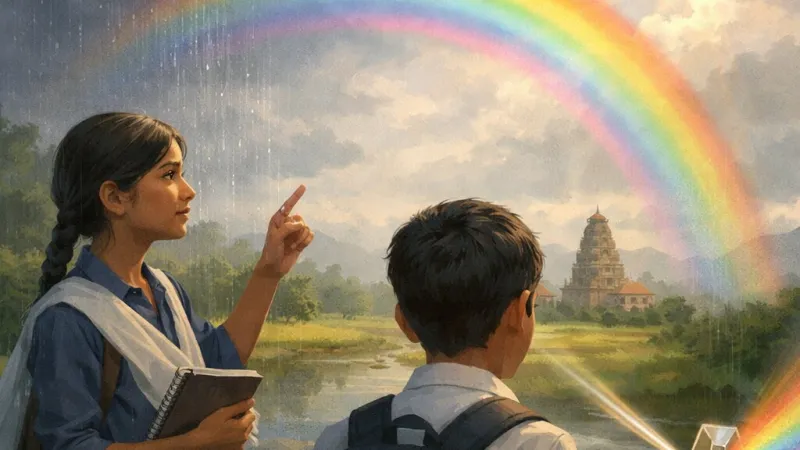
If one looks up at the monsoon sky after rain, sometimes what unfolds is nothing less than a spectacle—a luminous arc bursting with myriad colours. Whether you are a child peering out of your classroom window or an elderly person pausing in your evening walk, the appearance of a rainbow never fails to invite awe and wonder. In Indian literature, rainbows feature in poems and stories as bridges between earth and sky, symbols of harmony, and expressions of nature’s artistic flair. This essay aims to present a well-rounded exploration of rainbows: from their scientific secrets and the play of light, to the emotional and cultural meanings attached to them, drawing examples from our Indian context. Along the way, I will describe how rainbows mesmerise, educate, and inspire us—making each sighting a precious memory.---
The Science Behind Rainbow Formation
Understanding a rainbow begins with the interplay of two fundamental aspects of nature—sunshine and rain. It is a sight that tips us to the perfect balance: not a storm but a gentle shower, when the sun emerges, especially in the late afternoons during the monsoon. The magic starts when sunlight hits countless tiny water droplets suspended in the air. But what plays out after this is a fascinating dance between light and water.The journey begins with refraction—as sunlight enters a raindrop, it bends because light travels at different speeds in air and water. Immediately, dispersion takes place. Because white sunlight is actually a blend of many colours (each with a slightly different wavelength), when it bends, it splits into its constituent colours—the famous VIBGYOR: Violet, Indigo, Blue, Green, Yellow, Orange, and Red. Inside the droplet, the colour rays hit the back and reflect—a process called internal reflection. They then exit the droplet, bending a second time (refraction again), and finally reach our eyes. This process happens in uncountable droplets, but only those at a particular angle send the right rays to our vision.
The shape of the rainbow—almost a semicircle—also has a logical explanation. The arc is actually part of a full circle, but we see only the upper part from the ground as the earth itself blocks the rest. If someone is in an aeroplane, it is sometimes possible to view a whole circular rainbow!
A key figure in this phenomenon is the 42-degree angle. Each colour emerges from the drop at a unique angle with respect to the original direction of the sunlight—red, for instance, is seen at about 42 degrees, and violet at about 40 degrees. This is precisely why the sequence and positioning of the rainbow never change. Also, since the sun always has to be behind us and fairly low in the sky, rainbows are usually visible in early mornings or late afternoons. The lower the sun, the higher the rainbow appears to arch in the sky.
---
The Spectrum of Colours: Nature’s Own Palette
Every rainbow shows a fascinating gradation, progressing from deep red at the outer edge, filtering down to the delicate violet at the inner edge. These seven standard colours have found their way into mnemonics like “VIBGYOR” to help students remember the order. But why do these particular colours stand out, and in this order? The answer lies in the differing wavelengths of sunlight’s colours. Red light, having the longest wavelength, bends the least, while violet bends the most. Thus, we get the familiar colour sequence, radiant and well-defined, particularly after heavy humidity or monsoon showers.In rare cases, nature serves up surprises in the form of *double rainbows*. Here, a fainter, larger arc appears outside the main rainbow, with the colour order reversed—a phenomenon easily observed during the intense monsoon showers over rural fields or tea estates in Assam or Kerala. There are also rare “monochrome” rainbows, most often bathed in shades of red, which can be noticed during early sunrise or before sunset, as the sun’s rays travel a longer distance through the atmosphere, dissipating the bluish hues.
Some lucky observers might see *supernumerary rainbows*—extra faint bands, especially if the raindrops are uniform and fine. In the foggy hill stations like Munnar or Mussoorie, a “fogbow,” which is a pale, ghostly arc, might be visible too—testimony to the endless creativity of Indian weather.
---
Rainbows in Indian Culture and Folklore
Rainbows are not just a matter of physics; they hold deep meaning in our collective consciousness, art, and storytelling. Across India’s myriad communities, rainbows are woven into folklore, symbolising hope after turmoil, or acting as bridges between the worldly and the divine.In many Indian mythologies, such as those narrated in the *Puranas*, the rainbow is associated with divinity—a divine bow wielded by Lord Indra, the god of rain and thunder. In folk tales told in Kerala or Bengal, rainbows are seen as the sari of the goddess as she visits earth to spread blessings after a storm. The epic *Ramayana* alludes to rainbow-like images during moments of transition and hope.
Our literature paints rainbows vividly: In the works of Rabindranath Tagore, references to “Indradhanu” (Indra’s bow) abound as symbols of peace and unity. The colourful festival of Holi, though not strictly tied to rainbows, celebrates the joy of colour and harmony, echoing the exuberance of nature’s own colour spectrum in the sky.
In modern times, rainbows have become emblems of harmony and inclusiveness. The LGBTQ+ pride movement in India, for example, uses the rainbow flag as a symbol of diversity and acceptance. Each sight of a rainbow, especially during school breaks, brings a collective pause and smiles across the playground, a brief, shared optimism, and a universal acknowledgment of beauty in difference.
---
Fascinating Facts and Sightings of Rainbows
Rainbows can emerge wherever the dual conditions of sunlight and water droplets meet—not just in rural landscapes but even amidst the skyscrapers of Mumbai, or over paddy fields in Odisha. The best chances to spot a rainbow in India are during the monsoon, especially if the rain has just slowed and the sun peeks through. Notably, very heavy downpours make sightings unlikely, as the density of water in the air obscures the light.India’s hill stations and river valleys are perfect stages for rainbow performances. In the Nilgiris, after a fresh drizzle, rainbows often arc above tea plantations, a sight sketched lovingly in many school essays by students in southern India. Interestingly, while most rainbows last only minutes, records elsewhere in the world note longer displays—such as the six-hour marvel over Sheffield. In Meghalaya, the “abode of clouds,” rainbows can be a frequent delight due to the region’s unique climate.
Another wondrous occurrence is the *moonbow*, a rare nighttime cousin, which can occasionally be seen over waterfalls or in places like Cherrapunji, famed for its monsoon deluge. Scientists and enthusiastic “rainbow chasers” use instruments like spectroscopes to study these phenomena, deepening our understanding of light’s behaviour.
---
Rainbows as Teachers: Lessons from Nature
In Indian classrooms, rainbows are a favourite topic in science lessons—whether as hands-on experiments with a prism, or as painting assignments during art class. Teachers use the rainbow as a vivid demonstration of *light’s dispersion*—a concept that can otherwise seem abstract and dull from a textbook. When a child observes a rainbow, it becomes a living, breathing model of physics at work.But beyond science, rainbows spark curiosity and a sense of environmental stewardship. They remind us of the water cycle, the sun’s journey, and the delicate balance of our climate. During environment weeks or exhibitions, school projects often centre on the rainbow to raise awareness about the importance of clean air, water conservation, and the urgency of fighting climate change.
Rainbows inspire not just scientific discovery but also artistic creativity—schools across India hold painting and poetry competitions themed around this enchanting arch. In a world sometimes darkened by news and despair, rainbows offer a glimpse of unabashed beauty, restoring hope and a sense of wonder in young minds.
---
Conclusion: The Rainbow’s Lasting Legacy
In summary, the rainbow is a perfect blend of science, imagination, and cultural richness—a legacy written in the sky for those willing to look up. Its fleeting beauty blends the precision of optics with the joy of colours, offering scientific lessons and emotional warmth in equal measure. For Indian children, whether reciting “VIBGYOR” in class, spotting a double rainbow from the school bus, or listening to grandma’s stories of Indra’s bow, every rainbow sighting is a chance to dream and marvel.Rainbows teach us that even after the heaviest downpour, something magical can appear. They remind us of the interconnectedness of natural forces and human emotions, linking generations in shared wonder. By paying attention to simple wonders such as rainbows, we enrich our understanding of the world and deepen our sense of gratitude for nature’s endless creativity.
In the end, one cannot help but feel that rainbows are not just physical arcs of colour—they are timeless bridges joining curiosity and culture, science and the soul, inviting us all to pause, reflect, and rejoice in the marvels above us.
Rate:
Log in to rate the work.
Log in