Comprehensive Overview of the Jallianwala Bagh Massacre and Its Impact
This work has been verified by our teacher: 15.03.2026 at 16:41
Type of homework: History Essay
Added: 14.03.2026 at 11:51
Summary:
Explore the causes, events, and lasting impact of the Jallianwala Bagh Massacre to understand its pivotal role in India's fight for independence.
A Detailed Examination of the Jallianwala Bagh Massacre: Causes, Events, Impact, and Legacy
The dawn of the twentieth century was a period of unrest and resistance in India, as the yoke of British oppression pressed even harder on the masses. While many Indians had contributed resources and manpower to the British war effort during the First World War, their hopes for self-rule and liberal reforms were met with disappointment and greater repression. The struggle between the demands for Indian autonomy and the British colonial government’s determination to maintain control led to growing political tension. Against this backdrop, the infamous Rowlatt Act was enacted in 1919, curtailing basic freedoms and inciting anger among Indians from every walk of life.
It was in these feverish times that the Jallianwala Bagh Massacre unfolded on the blood-soaked afternoon of 13 April 1919. In the walled courtyard of Jallianwala Bagh in Amritsar, thousands had assembled peacefully—some to mark the joyous festival of Baisakhi, others to protest against the draconian Rowlatt Act. The brutality that erupted that day sent a shockwave throughout the country, exposing the cruelty of British rule and forging a new unity among Indians in their quest for freedom. The Jallianwala Bagh Massacre did not merely represent a single act of violence; it served as an irreversible turning point that redefined India's battle for independence.
Historical and Political Context Leading to the Massacre
Post-War Discontent and Societal Tensions
The end of World War I had revived Indians’ expectation of fair treatment and a gradual move toward self-governance. Leaders like Bal Gangadhar Tilak, Annie Besant, and Lala Lajpat Rai had tirelessly advocated for Home Rule. Ordinary citizens, too, imagined that their sacrifices in the war—both on foreign battlegrounds and in the resource-starved villages of India—would be rewarded with civil rights. Instead, they faced spiralling inflation, soaring food prices, and increasing unemployment. The economic distress intensified the sense that British rule was fundamentally unjust.The Rowlatt Act and Its Aftershocks
The Rowlatt Act of 1919, passed hurriedly by the British in the name of security, shattered any remaining illusions of benevolence. The law authorised the government to arrest and detain individuals without trial on dubious grounds of “national security.” Across India, newspapers decried this “Black Act,” and protests erupted. Amritsar, a city already simmering with anti-colonial sentiment, quickly became a focal point for agitation. The unity of Punjab—forged across religious communities—proved a challenge to the divisive policies of the Raj.Punjab’s Social Fabric and Symbolism of Baisakhi
Punjab had historically been the heart of both resistance and reconciliation in India. With its plural population of Hindus, Muslims, and Sikhs, the unity displayed in the anti-Rowlatt agitation was remarkable. The festival of Baisakhi, a harvest celebration dear to Punjabis and Sikhs across the world, coincided with these protests. People thronged into Amritsar from nearby villages for both religious observance and civil protest. As it happened, the sacred and the political intermingled at Jallianwala Bagh that fateful afternoon.The Incident: Detailed Account of the Massacre
The Gathering at Jallianwala Bagh
On 13 April 1919, the city of Amritsar bustled with activity. In Jallianwala Bagh, a walled garden with narrow gateways and few escape routes, thousands assembled. Families came to celebrate Baisakhi, unknowing of the tragedy to come. Others met to register their opposition to the Rowlatt Act. The atmosphere was hopeful and peaceful. There were no arms, no incitement to violence—just ordinary people seeking to make their voices heard.General Dyer’s Arrival and Preparations
Brigadier-General Reginald Dyer, then acting military commander of Amritsar, viewed gatherings of Indians with suspicion bordering on paranoia. Believing erroneously that the assembly might turn into an uprising, Dyer marched toward the Bagh with fifty riflemen. Without warning or an attempt to disperse the crowd peacefully, he stationed his troops at the main entrance, blocking all major escape routes.The Catastrophic Firing
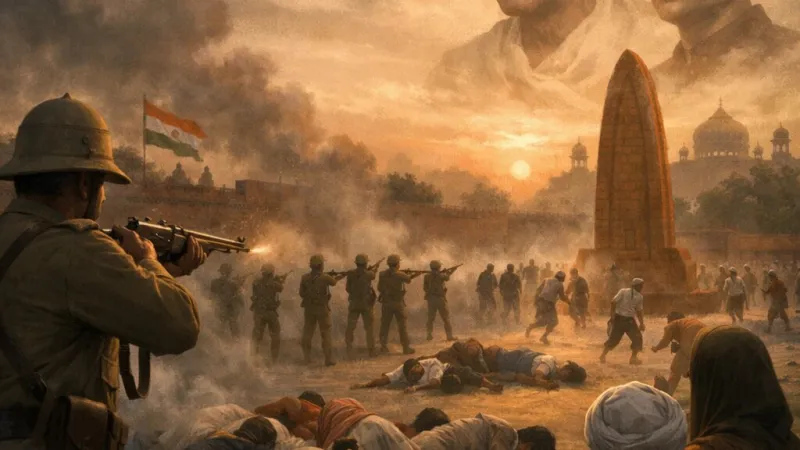
At Dyer’s callous command, his troops opened fire on the unarmed crowd. The gunfire rained down for about ten minutes, as 1,650 rounds were discharged into the mass of men, women, and children. Eyewitness accounts, such as those later collected by the Hunter Commission, recall the unfathomable panic—people scrambling toward exits only to be cut down or trampled, others leaping into wells to escape bullets. Dyer later claimed his intention was to “produce a moral effect,” but his actions went far beyond deterrence.The Toll and Immediate Aftermath
The British authorities claimed around 379 people were killed, but Indian estimates—supported by survivors’ testimonies—place the figure as high as 1000, with many more injured. The true toll may never be known, partly due to the haste with which the dead were removed and families forbidden to mourn publicly. Many wounded were left to bleed without medical aid, as a curfew prevented help from reaching the garden until the next morning. The horror of that afternoon echoed through Punjab and the nation.Reactions and Responses to the Massacre
Immediate Outrage across India
The news of the massacre spread like wildfire. Public figures denounced the atrocity in newspapers and speeches; religious leaders held prayer meetings for the dead. In Amritsar, shops shuttered, and people mourned openly despite the risk of further reprisal. Instead of breaking the spirit of protest, the British administration had poured oil on a blazing fire.Debate and Division within Britain
Within the British establishment, initial reactions varied. Some officials in India praised Dyer for his promptness, arguing he had prevented a rebellion. However, as details emerged, the horror expressed by British MPs and writers such as Charles Freer Andrews became unmistakable. The government commissioned the Hunter Committee to investigate, but its findings were deeply unsatisfying—while Dyer’s conduct was censured, he escaped punishment, and some in Britain even raised a fund to honour him.Powerful Indian Voices
Rabindranath Tagore, who had become the first Asian laureate of the Nobel Prize in Literature, returned his knighthood in protest, writing eloquently of “the helplessness of my countrymen.” Mahatma Gandhi reassessed his own strategy and leadership, recognising that faith in British justice was unfounded. The poet Subhadra Kumari Chauhan, known for her evocative verses, immortalised the pain of Jallianwala Bagh in her poetry. Even moderate leaders, who had advocated dialogue and reform, now spoke the language of mass resistance.Long-Term Impact on the Indian Freedom Movement
A Fissure Beyond Repair
Jallianwala Bagh marked the moment when any lingering faith in the fairness of British rule was shattered for millions. The episode laid bare the contradictions of a government claiming to uphold justice yet deploying brutal violence on a festival day. The moderate politics of earlier decades no longer appealed to most Indians, as trust was replaced by deep anger.A Surge of Revolutionary Spirit
In the years that followed, more radical leaders and movements gained ground. The youth, inspired by the martyrdom at Amritsar, joined revolutionary organisations. The spirit of non-cooperation, soon to find its fullest expression under Gandhi, took on a national character. Slogans echoing "Jallianwala Bagh" became rallying cries from Bengal to Maharashtra.Policy Shifts and Half-hearted Reforms
The British government, feeling the pressure both at home and abroad, introduced the Montagu-Chelmsford Reforms, offering limited self-government to selected provinces. But these gestures were seen as inadequate. Indian historians like Bipan Chandra have argued that the massacre’s real legacy was the sweep of mass politics it unleashed—a citizenry now united in its drive for total independence.Enduring Memory in Literature and Culture
Across decades, Jallianwala Bagh became less a place and more a symbol. Literary works, films, and folk songs narrate the story for each new generation. The site was consecrated as a national memorial in 1951, a place of pilgrimage and sorrow. Children in Indian schools recite the names of martyrs, while artists continue to depict the tragedy in their canvas and verse: "Khoon se khelenge Holi gar watan mushkil mein hai!" (We will play Holi with our blood if our nation is in danger).Critical Analysis: Lessons and Reflections
Unjustifiable Use of Force
Despite Dyer’s claims of military necessity, the massacre stands as a terrifying example of the abuse of power. No serious attempt was made to disperse the crowd peacefully. Most tragic of all, the victims included women and children, people who had no part in any imagined threat to order.The Dilemma of Indian Soldiers
Perhaps most painfully, many of the soldiers who fired into the crowd were themselves Indian, caught between survival and loyalty to their colonial masters. This raises enduring questions about identity, coercion, and the role soldiers play in the machinery of oppression—issues explored by writers from Saadat Hasan Manto to Khushwant Singh.Impact on India-Britain Ties and the Shape of Protest
After Jallianwala Bagh, the relationship between ruler and ruled changed irrevocably. If the earlier freedom movement had been marked by appeals and petitions, now it became a mass phenomenon, fuelled by common suffering and a shared vision of justice. The techniques of non-violent resistance, while inspired by Gandhi, also owed their energy to the grief and anger born at Amritsar.Conclusion
The Jallianwala Bagh Massacre was not just the tragedy of a single afternoon; it was the crucible in which modern Indian nationhood was forged. Its causes—the unjust laws, the hardened attitudes of colonial administrators—demanded a response. The massacre’s events, marked by unprecedented brutality, provoked not despair but a regenerative indignation across India.The memories of Jallianwala Bagh galvanised leaders and ordinary people, inspiring protest, poetry, and political action. Today, as we walk through the chiaroscuro of history, the lessons of that day remain urgent—not merely as a record of colonial violence, but as a warning that injustice, if unopposed, breeds more suffering.
It is imperative that the story of Jallianwala Bagh be remembered in classrooms and commemorations, not as an episode of bereavement alone, but as a symbol of resistance against all oppression. Only by learning from such chapters can we work towards a future where dignity and justice are not denied to any people, anywhere.
Rate:
Log in to rate the work.
Log in