Brief Overview of Mangal Pandey and His Role in India’s 1857 Uprising
This work has been verified by our teacher: 22.03.2026 at 18:39
Type of homework: History Essay
Added: 20.03.2026 at 8:39
Summary:
Discover the key role of Mangal Pandey in India’s 1857 uprising and learn how his courage sparked the first war of independence. Essential history for students.
10 Lines on Mangal Pandey – The Spark of India’s First War of Independence
---Introduction
When we study the roots of India’s independence movement, the name of Mangal Pandey stands out as a symbol of courage and sacrifice. His story isn’t merely a collection of dates and events, but a living reminder of the power of resistance against injustice. In the annals of Indian history, Mangal Pandey is often remembered as the torchbearer whose bravery ignited the rebellion of 1857. As students, understanding his life helps us connect with our heritage and appreciate the sacrifices that form the foundation of our modern nation.---
Mangal Pandey: Early Life and Social Background
Mangal Pandey was born on 19th July 1827 in the village of Nagwa, in the Ballia district of present-day Uttar Pradesh. He belonged to a Brahmin family, where devotion to duty and strict adherence to religious customs were deeply instilled in daily life. Growing up in a period when India was ruled by the British East India Company, Pandey would have witnessed the transformations and growing hardships that Indian society faced under foreign rule. Like many young men of his time, the promise of a stable income and a respectable position encouraged him to join the British forces. In 1849, he enlisted as a sepoy (infantryman) in the 34th Bengal Native Infantry.The position of a sepoy, however, was fraught with contradictions. On the one hand, the job provided food and income. On the other hand, it often required Indian soldiers to serve foreign masters whose ways conflicted with their values and beliefs. Thus, from the very beginning, Mangal Pandey’s career was set against a background of tension—between loyalty to the job and loyalty to the community, between economic need and national pride.
---
Religious Sentiments and Seeds of Dissent
The period leading up to the great revolt saw several policies introduced by the British that trampled on the social and religious sensitivities of Indian people. Among the changes, the most notorious was the arrival of the new Enfield P-53 rifle. The cartridges of this rifle were reported to be greased with animal fat—specifically, from cows and pigs. To load the rifle, soldiers had to bite the cartridge open with their teeth. This act seemed innocent to the British officers, but it carried deeply troubling implications for their Indian sepoys.For Hindus, the cow is considered sacred, while Muslims regard the pig as unclean. The mere suspicion that the cartridges were greased with cow or pig fat was enough to provoke outrage. The news spread rapidly amongst the barracks, stirring unease and anger. Stories of disrespect towards traditions and forced assimilation had been simmering for years. Now, with this direct affront to religion, discontent was set to explode.
---
The Barrackpore Incident: Mangal Pandey Takes a Stand
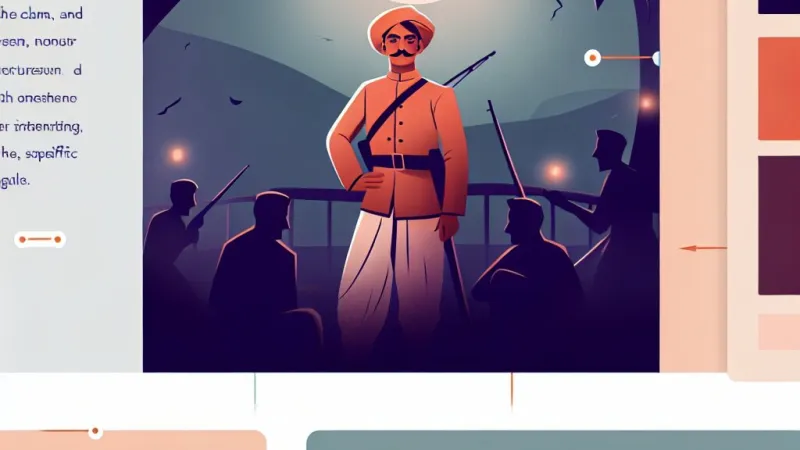
It was in this atmosphere of suspicion, pain, and humiliation that Mangal Pandey’s defining moment arrived. On 29th March 1857, at Barrackpore near Kolkata, Pandey took a dramatic and irreversible step. Armed and agitated, he called upon fellow soldiers to rise up against foreign oppressors. He targeted British officers, firing upon and injuring two—one of whom later died from the wounds. In that single act, Pandey transformed personal anguish into public resistance.Though many of his comrades watched in confusion and fear, Pandey’s rebellion sent a clear message. For the first time, a sepoy dared to openly attack unjust authority, risking not just his life, but his family's prestige and everything he owned. He was quickly subdued by his superiors and fellow soldiers. After a hasty trial, Mangal Pandey was sentenced to death and was hanged on 8th April 1857.
---
The Wider Impact: Spark Ignites the Flame
What followed the incident at Barrackpore was no longer limited to one man’s defiance. Mangal Pandey’s protest set off a chain reaction. News of his actions and martyrdom fanned the flames of resentment burning in the hearts of thousands of Indian soldiers and civilians. Within weeks, the Indian Rebellion of 1857—also called the First War of Indian Independence—spread across the North. Cities like Meerut, Kanpur, Lucknow, and Jhansi became centres of uprising. Leaders like Rani Lakshmi Bai, Nana Sahib, and Tatya Tope joined the growing revolt.Although the rebellion was ultimately suppressed, and the British responded with brutal measures, it changed the course of Indian history. The East India Company lost its hold over India, and direct rule by the British Crown—commonly called the British Raj—was established. The idea of Indian unity and the dream of self-governance, once sown by the likes of Pandey, could not be uprooted.
---
Mangal Pandey’s Place in Indian History and Culture
In our textbooks, Mangal Pandey is celebrated as a nationalist and a martyr. His life and actions are taught as one of the early and defining acts of resistance against foreign domination. Over the years, his story has been kept alive not just through history books, but also in literature, cinema, and public commemorations. The film "Mangal Pandey: The Rising," for example, rekindled popular interest in his legacy and introduced new generations to his heroism.Statues and memorials dedicated to Mangal Pandey stand in Barrackpore and his native village. His name is associated with annual observances, inspiring speeches, and patriotic songs. Schools throughout India celebrate him as one of the precursors to Mahatma Gandhi, Sardar Patel, and other great leaders of the 20th century. In this way, his tale continues to be an integral part of our collective memory.
---
Mangal Pandey as an Inspiration
Why do we still read about Mangal Pandey? His story is a lesson in challenging injustice, even when all odds are stacked against us. His resolve, despite the threat of death, reminds us of the importance of personal conviction and courage. The values Pandey stood for—dignity, unity, and resistance to injustice—are central to the spirit of India. In schools and colleges, his life continues to inspire, reminding us that freedom is precious and often bought with immense sacrifice.---
10 Lines on Mangal Pandey – A Detailed List
1. Mangal Pandey was a brave sepoy in the 34th Bengal Native Infantry of the British East India Company. 2. He was born on 19th July 1827, in Nagwa village in Uttar Pradesh, into a devout Brahmin family. 3. Driven by necessity, Pandey joined the army in 1849, like many young Indians seeking stable employment. 4. He became disillusioned with British military practices that disrespected religious customs. 5. The introduction of rifle cartridges greased with cow and pig fat insulted both Hindu and Muslim beliefs. 6. On 29th March 1857, at Barrackpore, Pandey bravely attacked British officers, calling for a revolt. 7. His act of mutiny became the first spark of the great uprising against colonial rule. 8. Mangal Pandey was captured, tried, and executed by hanging on 8th April 1857. 9. Though his life was cut short, his rebellion inspired widespread uprisings that marked the beginning of India’s first major resistance. 10. Today, Mangal Pandey is honoured as a courageous freedom fighter whose actions laid the foundation for India’s long journey toward independence.---
Conclusion
Mangal Pandey’s courage and sense of justice transformed a common soldier into a symbol of hope and revolt. His willingness to stand up for religious faith and national pride, even in the face of certain death, teaches us about conviction and sacrifice. The events at Barrackpore marked not just the start of a war, but the awakening of an entire nation’s spirit. Viewing history through the lens of ordinary individuals like Mangal Pandey helps us realise that revolutions are built by everyday people who choose bravery over fear.As students, when we revisit the story of Mangal Pandey, we connect with a heritage shaped by struggle and unity. The freedom we enjoy was won, not in a single moment, but through the bravery of many like Mangal Pandey. Let us remember and respect that sacrifice, drawing inspiration to stand firm for justice and truth.
---
Tips for Writing about Mangal Pandey (for Students)
- Use clear, easy-to-understand language while explaining historical facts. - Always mention important dates, places, and events accurately for credibility. - When discussing sensitive issues like religion, do so with respect and context. - Draw connections from the past to present-day notions of patriotism and unity. - Expand on each line by adding a few sentences to offer depth and perspective. - Couple historical facts with stories or references from Indian literature and culture—such as Bharatendu Harishchandra’s essays or Amrita Pritam’s poems on freedom. - Remember: Every freedom fighter contributed uniquely. Honour their memory by writing with honesty and empathy.---
Mangal Pandey may have lived almost two centuries ago. Yet, his spark, courage, and commitment to India’s freedom continue to guide and inspire us, reminding us that the spirit of resistance lives on in every generation of Indians.
Rate:
Log in to rate the work.
Log in