Top 10 Facts About Hawa Mahal: Jaipur’s Iconic Wind Palace
This work has been verified by our teacher: 6.04.2026 at 13:33
Type of homework: Essay Writing
Added: 4.04.2026 at 13:33
Summary:
Explore the top 10 facts about Hawa Mahal, Jaipur’s iconic Wind Palace, to learn its history, architecture, and cultural significance for your homework or essay.
10 Lines on Hawa Mahal: A Glimpse into Jaipur's Living Heritage
Nestled in the vibrant heart of Jaipur, the capital of Rajasthan, stands the enchanting Hawa Mahal, an architectural wonder that has become almost synonymous with the city itself. Jaipur, often affectionately called the ‘Pink City,’ is renowned for its distinct rosy buildings, lively bazaars, and deep connection to Rajasthan’s royal past. Against this rich historical and cultural backdrop, the Hawa Mahal (meaning ‘Palace of Winds’) rises like a delicate honeycomb, simultaneously embodying Jaipur’s grace, legacy, and innovation. In this essay, I will share ten key insights about Hawa Mahal, weaving together its history, design, significance, and its place in the lives of locals and tourists alike.
---
The Story Behind Hawa Mahal
Hawa Mahal owes its existence to Maharaja Sawai Pratap Singh, one of Jaipur’s most visionary rulers, who ordered its construction in 1799. The late 18th century was a time of transformation for Jaipur, as the city expanded both culturally and strategically under the Kachwaha Rajput dynasty. Sawai Pratap Singh, deeply inspired by his devotion to Lord Krishna as well as his admiration for Rajasthani artistry, wanted to create a structure that would itself become a legend in stone.The responsibility of bringing this dream to life was entrusted to Lal Chand Ustad, an architect celebrated in Jaipur’s courts. Ustad blended Rajput valour and Mughal elegance into a unique manifestation. Interestingly, it is widely believed the design took inspiration from the peacock feathered crown of Lord Krishna (Mor Mukut), reflecting not only the king’s faith but also blending mythology with architectural innovation.
---
Architectural Marvels and Intricacies
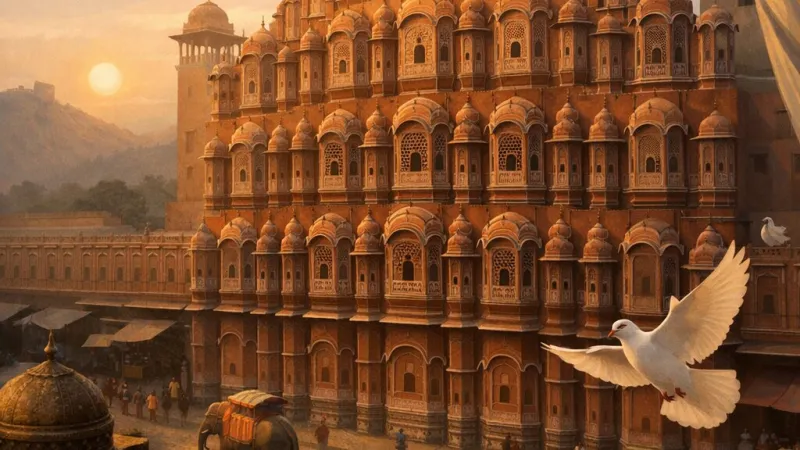
Hawa Mahal’s facade is instantly recognisable: a five-storey edifice of pink and red sandstone, soaring to around 50 feet, tapering off like a delicate pyramid. Unlike the imposing forts of Rajasthan, there is a surprising lightness to its structure, almost like a lattice of air and stone.The most striking feature of Hawa Mahal is its multitude of tiny windows—famously 953 jharokhas, though some say the number is slightly less. These windows set in a delicately carved façade, are more than just decorative elements. Designed with intricate latticework (jali), they allow the cool breezes to circulate freely through the palace—even in Rajasthan’s notorious summer heat. This earned it the poetic name ‘Palace of Winds’. The jharokhas also served an important social function: they let royal ladies observe the bustling city streets below without being seen themselves, in keeping with the strict practice of purdah.
What sets Hawa Mahal apart from other historical buildings in Rajasthan is its fusion of two grand traditions. The outward show of strength, with the Rajputana jharokhas and chhatris, is softened by the flowing arches and floral patterns inspired by Mughal gardens. The rich sandstone, hewn from Rajasthan’s earth, not only contributes to the city’s pink glow but also ensures the palace’s longevity, a testament to the royal taste.
---
Purpose and Daily Life in the Palace
Hawa Mahal was never intended to be a majestic residence like Amber Fort or the City Palace. Instead, its primary function was to serve as a high vantage point for the women of the royal household. The Rajput tradition of zenana—women’s quarters—meant queens and princesses lived in seclusion, protected from the public gaze. The Hawa Mahal allowed them to feel connected to the wider life of Jaipur, to view parades, processions during Teej or Gangaur, and the daily rhythm of Sireh Deori Bazaar, all from behind the safety and privacy of their intricately screened windows.A fascinating practical detail is that there are no stairs leading to the uppermost floors. Instead, gently sloped ramps were constructed, making it easy for palanquins (palkis) to be carried up for the royal ladies’ comfort. The central courtyard, open to the sky, provided a well-ventilated, communal space that could host intimate celebrations, music recitals, and evening gatherings.
---
Hawa Mahal: Pride of Jaipur and Rajasthan
When one thinks of Jaipur, a vivid image of Hawa Mahal often springs first to mind. It graces numerous postcards, paintings, and travel brochures—becoming the signature symbol of the city. The palace’s image inspires immense local pride, reminding people of the artistic, architectural, and cultural achievements of their ancestors.Tourists from all corners of India and the world flock here, drawn by its fairy-tale appearance and storied past. The economic upliftment through tourism cannot be understated—guides, craftsmen, photographers, and local shops all benefit from the steady stream of visitors. Simple yet elegant, Hawa Mahal speaks to universal themes: beauty, privacy, comfort, and ingenious problemsolving, all born of Rajasthan’s climate and customs.
Modern times have seen conscious efforts for its preservation. Over the centuries, weather, pollution, and neglect had begun to leave their mark, but government-led restoration efforts (notably in 2006) have sought to protect its intricate screens and stonework for generations to come. In a rapidly changing world, the conservation of such monuments is both a necessity and a responsibility.
---
Visiting Hawa Mahal: An Immersive Experience
Situated right in the thick of Jaipur, along the bustling Johari and Bapu Bazaars, Hawa Mahal is both accessible and prominent. The best time to visit is early in the morning, when the gentle rays of the sun bathe its carvings in a soft, golden hue—a photographer’s delight. Entry to Hawa Mahal requires a modest ticket fee, making it accessible to students, families, and travellers alike.Inside, visitors can explore not just the upper galleries, but also the small onsite museum. It is filled with relics that shed light on Jaipur’s history, the everyday lives of its royals, and fascinating details about Rajasthani culture. To really understand the palace, one must climb through its narrow corridors, peer through the jharokhas, and imagine the colourful processions passing by below, centuries ago.
Guided tours are recommended, as they offer captivating legends and historical anecdotes that are often missed by casual visitors. It is always important to follow instructions: respecting no-photography zones and leaving the monument as clean and undisturbed as you found it.
---
Jaipur’s Other Wonders and Festivals
Hawa Mahal is rarely visited in isolation. Just a short auto-ride away are the formidable Amer Fort, the mystical Nahargarh Fort perched on the Aravallis, and Jantar Mantar—a UNESCO World Heritage site showcasing ancient Indian astronomy. These sites, together with Hawa Mahal, offer a complete journey through the grandeur and scientific brilliance of Rajasthan’s past.Festivals such as Teej and Gangaur transform the city into a riot of colour and joy. During these celebrations, Hawa Mahal becomes a stage for dancers, musicians, and processions, its balconies looking down on the vibrant spectacle. Experiencing such a festival from the Palace of Winds is a memory to cherish for a lifetime.
---
Conclusion
Hawa Mahal is not just an architectural gem, but a living testament to the values, ingenuity, and aesthetic sense of its creators. From its distinctive façade and hidden stories of royal women to its practical design for desert summers, every aspect of Hawa Mahal offers lessons for students of history, architecture, and culture. It reminds us how India’s heritage is not simply a matter of grand palaces and monuments, but also about the interplay of environmental adaptation, social customs, and creativity.For students and young minds, a visit—virtual or real—to Hawa Mahal is an education in itself. It is a chance to walk through the lanes of the past, to realise how culture, geography, and history are intimately intertwined in shaping our world. Even in a fast-modernising India, Hawa Mahal stands tall, whispering secrets of a golden era to anyone willing to pause and listen.
---
Quick Recap: 10 Lines on Hawa Mahal
1. Hawa Mahal is a famous monument located in Jaipur, Rajasthan, often called the ‘Pink City’ of India. 2. It was built in 1799 by Maharaja Sawai Pratap Singh, a ruler who loved art and architecture. 3. The architect of Hawa Mahal was Lal Chand Ustad, who merged Mughal and Rajput styles. 4. The palace is made from stunning pink and red sandstone, matching Jaipur’s signature colour. 5. Its five-storey, pyramidal façade is about 50 feet tall and resembles Lord Krishna’s crown. 6. There are 953 tiny windows, or jharokhas, designed for ventilation and privacy. 7. These windows allowed royal women to view city life and festivals without being seen. 8. No stairs are present on top floors; inclined ramps helped queens use palanquins. 9. Hawa Mahal’s unique design keeps it cool even in the intense Rajasthani heat. 10. Today, it is a top heritage site, with a museum, attracting visitors from all around the world.---
In conclusion, the Hawa Mahal is truly a jewel of Rajasthan. It is not only a marvel of architecture but also a symbol of Jaipur’s layered history and royal grandeur. For anyone interested in India’s heritage, the Palace of Winds is a must-see, promising inspiration, beauty, and a deeper appreciation of our cultural roots.
Rate:
Log in to rate the work.
Log in