The Fun They Had: Summary, Explanation & Word Meanings for Class 9
This work has been verified by our teacher: 17.04.2026 at 12:55
Type of homework: Essay Writing
Added: 14.04.2026 at 14:25
Summary:
Explore The Fun They Had summary, explanation, and word meanings for Class 9 students to understand this sci-fi story’s lessons on education and technology.
The Fun They Had – Summary, Explanation, and Word Meanings (Class 9)
“The Fun They Had” is a short story by Isaac Asimov that belongs to the genre of science fiction, yet it carries profound social meaning, especially in the context of education. Through a simple narrative about two children in the future, the story raises important questions about technology and tradition, the changing face of learning, and the importance of human relationships in education. For students growing up in India, where schools have always been seen as places of not just learning, but also friendships, memories, and life lessons, this story serves as both a reflection and a gentle warning. As students, we often dream of less homework or fancier technology in schools, but what do we lose when human connection is missing? This is the central question the story explores.
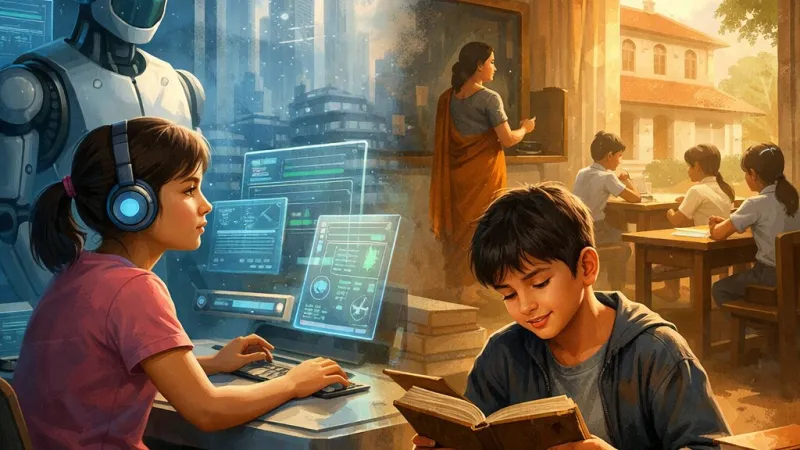
Set in a distant future, the events take us to the year 2157. Imagine a world where there are no school assemblies, no blackboard chalk, no playgrounds echoing with laughter, and no teachers with their unique quirks. Instead, children study alone at home with mechanical teachers, and even books are a thing of the past. The characters Margie and Tommy stumble upon something rare—a printed book—which triggers a journey into discovering how different, and perhaps more enjoyable, school used to be. This story urges us to appreciate the real joy and learning that happens within the walls of our schools.
Detailed Summary of ‘The Fun They Had’
The story opens with a nine-year-old girl, Margie, writing in her diary on 17 May 2157 about something “very strange.” The “strange” event begins when her friend, Tommy, who is thirteen years old, finds an old, dusty book in his attic. Margie is immediately intrigued, as the concept of a physical book, with pages that one must turn, is completely foreign to her. She has only ever read stories on screens. Just like many of us see our grandparents’ stories as old-fashioned, Margie too listens to tales from her grandfather about “schools in the olden days,” where boys and girls learned together in buildings called schools.Up to this point, both Margie and Tommy receive their instructions from large, screen-based mechanical teachers, set up in their houses. For Margie, schooling is boring and lonely. She is further frustrated because her teacher is malfunctioning and has been sending too many tests for her liking. An official called the County Inspector visits to fix her mechanical teacher, which raises Margie’s hopes of missing school but sadly, the teacher is back in working order quickly.
Through the old book, Tommy and Margie learn that schools in earlier times were very different. Children used to gather together, laugh together, and learn lessons taught by human teachers. They would all be taught collectively, play during intervals, and sometimes even rebel together against strict rules. Margie finds this idea not only fascinating but also enviable. She cannot believe that students went to a physical place every day—no studying alone, no constant supervision by the machine, and probably less monotonous. The story ends with Margie hoping for such fun, but she is brought back to her reality, sitting alone before her screen, wishing for a school life she can only imagine.
Explanation and Analysis
Value of Traditional Schooling
Reading this story, one realises the value of traditional schooling. In India, schools are much more than centres of learning. They are vibrant communities—spaces for shared tiffins at lunchtime, cricket or kho-kho during the break, rangoli competitions, and friendships that last a lifetime. The acclaimed Indian writer, R.K. Narayan, often depicted Indian schools in his stories such as “Swami and Friends,” where the real lessons happen not just in classrooms, but in playgrounds, corridors, and sometimes empty classrooms waiting for teachers.Margie, through her longing, helps us see how much joy is lost in a life where education is nothing more than solitary work delivered by a cold, emotionless machine. Her nostalgia for a life she has never experienced feels genuine because, as humans, we crave companionship and warmth—even in learning. While the mechanical teacher may deliver perfect lectures and never get tired, it cannot offer encouragement, a gentle smile, or even a scolding that comes from real concern.
Impact of Technology on Education
There is no doubt that technology has transformed education. In today’s India, many students in cities and even villages have experienced online schooling because of the COVID-19 pandemic. While online learning offers convenience, flexibility, and sometimes personalised attention, it often fails to replicate the excitement and engagement of face-to-face classrooms. During the pandemic, many of us missed jokes shared with benchmates, lively debates in group projects, and even the excitement of preparing for annual day or sports meets.In the world of 2157, education seems efficient, but it also seems mechanical and colourless. The mechanical teachers provide lessons adapted to each child, but the sense of togetherness is missing. The advantages—personal pace, tailored syllabus—are overshadowed by disadvantages: no group activities, no emotional intelligence, and a monotonous learning environment. Even the best computer cannot celebrate a student’s achievement with a warm handshake, or gently correct a mistake knowing your personality, as teachers in real-life schools do every day.
The Perspective of the Characters
Margie represents every child who seeks joy in learning, who wants to laugh, play, and sometimes even grumble about waking up early for school. Her reaction to the printed book shows an innocent curiosity and a longing for something more human in her educational journey. Tommy, on the other hand, is sharp, perhaps more prepared for accepting the world as it is, but even he is intrigued by the stories of the past. Their interactions, questions, and excitement highlight the innocence and openness of young minds.Setting – The Futuristic World
The story’s futuristic setting is not just a backdrop but an essential element. It asks us to imagine what our world may become if we let technology dominate without considering our emotional needs. India has a rich tradition of gurukuls, where students lived and learned together, even if under humble circumstances. The move from gurukul to modern schools was itself a change, but “The Fun They Had” asks if future changes might take away the core of what makes schooling so memorable—community and connection. The author warns gently: let us not allow progress to rob us of our happiness.Word Meanings and Usage
Here are some important words from the story along with their meanings and use in sentences:1. Mechanical – Relating to machines. *My mechanical pencil broke during the Maths exam.*
2. Computerised – Operated by computers. *Exams are increasingly computerised with the new online system.*
3. Inspector – An official who checks or investigates. *The fire inspector visited the school to check safety measures.*
4. Imagination – The ability to form ideas in the mind. *Children’s imagination makes their stories so interesting.*
5. Ancestors – People from whom one is descended. *Our ancestors lived in villages and respected nature.*
6. Malfunction – Not working properly. *The projector malfunctioned before the presentation.*
7. Attic – Room under the roof used for storage. *She found her grandmother’s old sarees in the attic.*
8. Boring – Not interesting; dull. *Rote learning can make even History boring.*
9. Fun – Enjoyment or amusement. *Annual day rehearsals were the most fun part of school.*
10. Future – The time yet to come. *We should build a better future for the next generation.*
Tips: - To learn new words, always read them in the context of the story; make your own sentences. - Collect words in a diary. Use them in conversations with friends or parents.
Importance and Moral Lessons
Appreciating Real Schools
This story reminds us to value the everyday joys of school. In our Indian context, school is not only about examination marks, but also about building confidence, teamwork, and lifelong friendships—like those seen in Hindi films such as “Taare Zameen Par” or “3 Idiots,” where learning happens inside and outside classrooms.Balanced Use of Technology
While we should embrace technology, we must remember that it is meant to assist, not replace, human interaction. The best schools blend smartboards and e-learning with school assemblies, sports, and cultural programmes. Teachers’ wisdom and empathy cannot be replaced by even the most advanced computer.Curiosity and Open-mindedness
Margie and Tommy’s curiosity about the past teaches us never to stop asking questions about our own world. Whether it’s about chalk slates our great-grandparents used, or programming robots today, the journey of learning is most fun when we keep our minds open.Conclusion
Through the eyes of Margie and Tommy, “The Fun They Had” gives us a unique opportunity to appreciate the irreplaceable value of human connection in education. It gently reminds us that knowledge is best shared, laughter is best enjoyed together, and memories are best created in the company of friends and teachers. As technology continues to change how we learn, let us hold on to what makes our years in school truly special—the experience, the friendships, and the fun we have together.Additional Tips for Class 9 Students
- Writing Summaries: Focus on main events, write clearly, and avoid adding opinions unless asked. - Explaining Themes: Discuss each theme separately with examples, relating them to what you see around you. - Learning Vocabulary: Regularly revise words, use them in your own sentences, and test yourself. - Answering Questions: Always read questions carefully, understand what is being asked, and answer in your own words.Practice Questions
1. Why did Margie find the mechanical teacher dull? 2. Explain, with examples from the story, the differences between past and future schooling. 3. Describe Margie’s emotions when she reads about old schools. 4. What lesson does the story hold for us about the nature of education? 5. Why is the story titled "The Fun They Had"? What kind of fun does it refer to?---
By reflecting on Asimov’s timeless story, let us all appreciate and cherish the fun and togetherness that our schools give us—something that even the most advanced machines will never be able to replicate.
Rate:
Log in to rate the work.
Log in