10 Interesting Lines on Bats for Indian Secondary School Students
This work has been verified by our teacher: 3.05.2026 at 9:21
Type of homework: Essay Writing
Added: 1.05.2026 at 15:30
Summary:
Discover 10 interesting lines on bats for Indian secondary students and learn key facts about these unique flying mammals and their role in nature. 🦇
10 Lines on Bats – An Essay for Indian Students
India, with its lush forests, broad river plains, and bustling villages, is home to a hidden world that awakens with the setting sun. Among the creatures that emerge in this twilight are bats – mysterious mammals both misunderstood and essential to our ecosystems. While people often think of bats with a sense of fear or superstition, these flying mammals have fascinating qualities and play a crucial role in nature. For students in India, learning about bats not only connects us to our natural heritage but also helps bust popular myths passed on through generations. In this essay, I will share ten important and interesting facts about bats — drawing on Indian examples and highlighting their significance for young minds.---
1. Bats Are the Only Mammals That Can Truly Fly
Many animals can glide, like the flying squirrel seen in Indian forests, but bats stand alone as the only mammals capable of genuine, sustained flight. Their wings are made up of a thin, flexible membrane stretched over elongated arm and finger bones — the word “Chiroptera,” describing their scientific order, literally means “hand wing.” The unique wing structure gives bats greater manoeuvrability than birds, helping them swoop and glide with amazing agility even in thick groves or around temple towers.---
2. Bats Show Incredible Diversity in Species
India alone is home to nearly 130 species of bats, from tiny insect-eating pipistrelles to the grand Indian Flying Fox, whose wingspan can be over 1.5 metres! Globally, more than 1,400 species of bats are known, making them the second largest group of mammals after rodents. This amazing variety allows bats to live in many habitats across India: dense rainforests of the Western Ghats, the high mountains of the Himalayas, and even city parks.---
3. Bats are Both Megabats and Microbats
Although all bats share certain traits, scientists divide them into two groups: megabats and microbats. Megabats—in India, the most famous is the Indian Flying Fox—mostly eat fruit and have big eyes for seeing at night. Microbats are smaller, feed mainly on insects, and rely on a special skill known as echolocation. This division helps them fill different roles in our ecosystems and adapt to a variety of Indian landscapes, from fruit orchards to village ponds.---
4. Echolocation: A Natural “Radar”
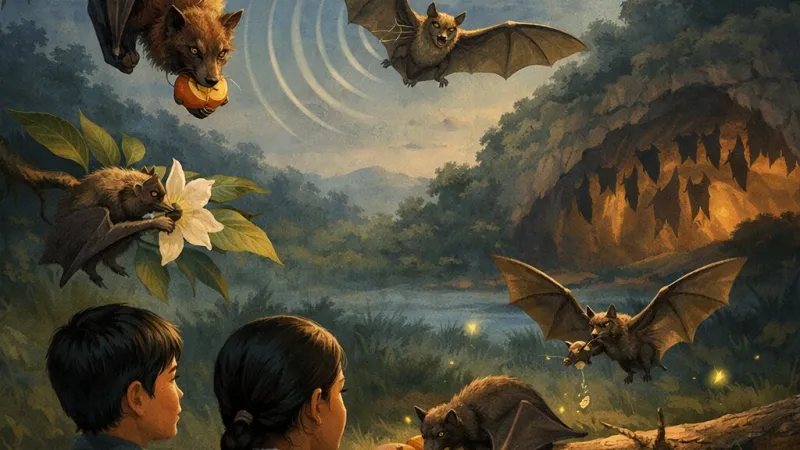
If you go near an old fort or banyan tree at dusk, you may hear the high-pitched cries of bats as they swirl overhead. In the darkness, microbats emit ultrasonic sounds (usually not audible to humans), which bounce off objects and return to their incredibly sensitive ears. This process, called echolocation, allows bats to “see” with sound and precisely catch flying insects in pitch-black surroundings—a marvel of natural engineering. Megabats, meanwhile, rely more on their sharp eyesight and sense of smell.---
5. Nocturnal Lifestyle and Daytime Roosts
Bats are truly the “night shift” of our animal world. They rest during the day in caves, tree hollows, old buildings, or under bridges. In India, Chitrakoot and the Bhimbetka caves shelter large bat colonies, and it’s not unusual to find bats roosting under the tiled eaves of rural homes. Hanging upside down not only helps them rest but also gives them a quick take-off if danger approaches. At dusk, these mysterious mammals stream out in search of food, performing their crucial ecological services under the cover of darkness.---
6. A Varied Diet That Benefits Nature
Depending on the species, bats enjoy an impressive menu. Insect-eating bats can consume thousands of mosquitoes, beetles, and moths in a single night. This natural insect control helps protect Indian crops like rice, sugarcane, and cotton, reducing the need for chemical pesticides. Fruit bats, including India’s Kalabaz (Flying Fox), feast on guavas, bananas, mangoes, and figs, helping disperse seeds and pollinate flowers as they travel from tree to tree. Some cave-dwelling bats also feed on nectar, ensuring the continued survival of certain rare plants in India's forests.---
7. Bats Live in Colonies and Are Social Creatures
Bats are not solitary creatures; they often gather in colonies that can range from just a handful to over a million individuals. In Maharashtra’s Lonar lake caves and the ancient temples of Karnataka, vast colonies of bats provide awe-inspiring sights. These colonies offer protection against predators and a warm environment for raising their young, known as pups. Bat mothers are attentive, feeding and carrying their single pup till it can fly independently.---
8. Long Lifespans and Unique Breeding Habits
Despite their small size, bats enjoy surprisingly long lives—some can live for over 20 years! Breeding usually depends on the food available and the onset of monsoon or fruiting season. For instance, Indian fruit bats often have babies at the start of the mango or banana season when food is abundant. The young grow rapidly under the care of their mothers, learning to fly and hunt within a few weeks.---
9. Bats and Their Relationship with People
Many people in India grow up hearing tales about bats—some say they bring good luck to homes, while others unnecessarily fear them. In reality, bats are gentle, shy animals and are an invaluable part of our environment. It is true that a small number of bats may carry diseases like rabies, but simple caution, such as not touching grounded or sick bats, keeps us safe. The greater threat is to bats themselves: deforestation, urbanisation, and the destruction of ancient trees and caves threaten their survival. Conserving bat habitats is crucial for ecological health and the wellbeing of future generations.---
10. Surprising Facts about Bats
Bats take grooming seriously, spending hours cleaning their fur with their tongues and claws, much like cats. Their droppings, called guano, are an excellent natural fertiliser—a valuable resource for organic farming in India. In past centuries, guano deposits from bat caves like those in Meghalaya were even used for making saltpetre, an ingredient in fireworks. And finally, did you know the Mexican Free-tailed Bat (not found in India, but equally swift) is among the fastest flying animals? Indian bats too are speedy fliers, zipping about at surprising speeds and making sharp, acrobatic turns—an awesome sight on a warm summer evening.---
Connecting Bats to Indian Life and Folklore
Bats flutter through Indian folktales, appearing sometimes as omens or as guardians of sacred groves. In many tribal cultures, bats are respected for their role in controlling insect populations and maintaining ecological balance. India’s Wildlife Protection Act includes certain species of bats, underscoring their ecological importance. Museums such as the BNHS in Mumbai and books by Dr. Sálim Ali, India’s celebrated ornithologist, offer stories and studies on bats for curious young minds.Classroom projects can spark further interest: students might observe a colony near their home, draw different bats, or even visit a nature park to see fruit bats dangling from tall trees. Documentaries on Doordarshan or nature channels feature bat behaviour in Indian settings, making learning lively and real.
---
Conclusion
From their silent flights on moonlit nights to their quiet guardianship of our fields and orchards, bats remain one of India’s most interesting and valuable wild neighbours. As we have seen, bats are more than “creatures of the night”; they are pollinators, pest controllers, and an integral part of our natural heritage. It is up to each of us, especially young students, to banish age-old fears, respect these fascinating mammals, and do our bit in conserving their habitats. The next time a dark wing flutters in the evening sky, remember: it may be a gentle fruit bat, helping keep India’s forests alive.---
Glossary
- Echolocation: Locating objects by reflected sound, used by microbats to find prey. - Megabat: Larger bats, mostly fruit-eating, with good eyesight, e.g., Indian Flying Fox. - Microbat: Smaller bats, primarily insect-eating, using echolocation. - Colony: A group of bats living together. - Nocturnal: Active at night. - Guano: Bat droppings, used as a natural fertiliser.---
Suggested Reading:
- "The Book of Indian Bats" by Dr. T. Ganesh - Wildlife Trust of India website, section on bats - “Common Bats in Indian Cities” – Poster by Bombay Natural History Society
Let us strive to know more about these unique creatures and share our learning with others. After all, respecting bats means respecting the delicate balance of Indian nature itself.
Rate:
Log in to rate the work.
Log in