Tatya Tope: Remembering a Courageous Leader of India’s 1857 Revolt
This work has been verified by our teacher: 26.03.2026 at 15:10
Type of homework: History Essay
Added: 25.03.2026 at 8:15
Summary:
Explore Tatya Tope’s courageous leadership in India’s 1857 Revolt and learn how his military strategy shaped the First War of Independence. 📚
The Life and Legacy of Tatya Tope: A Hero of India’s First War of Independence
India’s fight for freedom is interwoven with the stories of heroic individuals who fearlessly defied foreign domination. The Revolt of 1857, often called the First War of Independence, marks a major turning point in the long struggle against British colonial rule. While names like Rani Lakshmi Bai and Bahadur Shah Zafar shine bright in history, the saga of Tatya Tope stands out for his remarkable military acumen and undying spirit of patriotism. His contributions not only shaped the course of the 1857 uprising but also continue to inspire the nation even today. This essay delves into the extraordinary life, dynamic leadership, and enduring legacy of Tatya Tope, a valiant figure whose dedication to motherland remains immortal in the annals of India’s freedom movement.Early Life and Background
Tatya Tope was born Ramachandra Panduranga Tope in 1814 in the town of Yeola, located in present-day Nashik district, Maharashtra. Hailing from a Marathi Brahmin family, his upbringing was deeply influenced by strong cultural values and traditions rooted in Maharashtra’s rich heritage. His father, Panduranga Rao Tope, served at the court of the Peshwa of Pune, while his mother Rukhmabai instilled in him the spirit of righteousness and duty. The close association with the Peshwa led the family to Bithoor, near Kanpur, following the abolition of the Peshwa’s position by the British.In Bithoor, young Ramachandra became close friends with Nana Sahib, the adopted son of Peshwa Bajirao II. This bond was instrumental in shaping Tatya’s political and military consciousness. Surrounded by tales of Maratha bravery and the injustices faced by Indian rulers under British rule, Tatya Tope developed early on traits of leadership, a keen military mind, and an unwavering sense of loyalty. Even before the events of 1857, his sharp intellect and commitment to justice were evident in the way he conducted himself and the deep trust bestowed upon him by the Peshwa’s family.
Tatya Tope’s Role in the Revolt of 1857
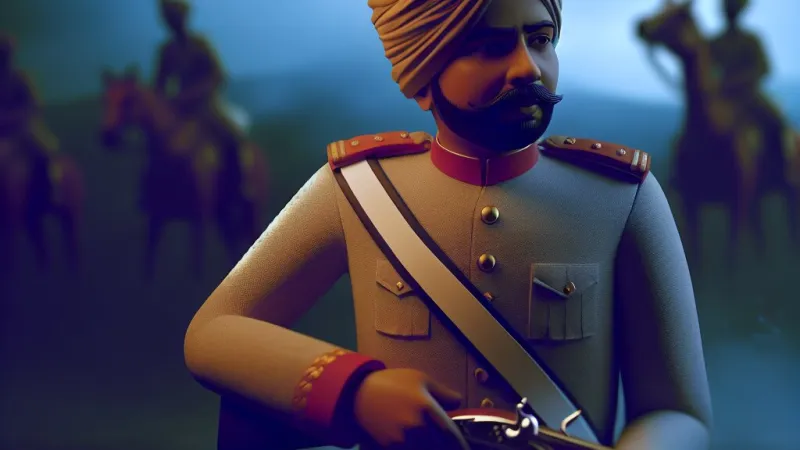
The Revolt of 1857 erupted as a spontaneous uprising against British excesses, resonating across the heartland of India. Tatya Tope emerged as a pivotal leader, working side-by-side with Nana Sahib when tensions erupted in Kanpur. Recognising the critical nature of the moment, Tatya became the chief military strategist for the rebel forces in the region.He led Indian soldiers and civilians in the siege of Kanpur, orchestrating attacks that dealt a heavy blow to the British and briefly liberated the city. The events at Kanpur, including the tragic massacre at Satti Chaura Ghat, remain controversial, but Tatya’s role as a soldier committed to the cause is clear. His leadership did not end in Kanpur alone; when news spread of Rani Lakshmi Bai’s fight in Jhansi, Tatya Tope marched with his troops to support her. His collaboration with the “Jhansi Ki Rani” is the stuff of legend, as they joined forces to defend and attempt to recapture fortresses from the British.
A master tactician, Tatya Tope embraced guerrilla warfare, making him a thorn in the side of the colonial power. Eschewing traditional battle formations, he preferred swift, surprise attacks, and ambushes, which not only exhausted the British troops but also rekindled hope among local populations. Whether it was night raids on enemy camps or the sudden disruption of supply lines, Tatya’s ability to evade capture earned him a reputation as an elusive warrior, instilling fear and respect even among his adversaries.
Revolutionary Campaigns and Military Genius
The legend of Tatya Tope is inextricably linked with his relentless military campaigns across Central India. After the fall of Kanpur and Jhansi’s recapture, Tatya did not abandon the struggle; instead, he travelled from Malwa to Bundelkhand, rallying support, gathering volunteers, and launching counter-offensives against British strongholds. Fortresses like Gwalior and Kalpi became rallying points for rebels, thanks to Tatya’s vision of striking where the British were weakest.Understanding the need for arms and ammunition, Tatya established makeshift factories near Kalpi, where local artisans crafted gunpowder and repaired weapons. Even when besieged and low on resources, he showed remarkable resourcefulness—relying on intelligence, local knowledge, and the wholehearted backing of peasants and zamindars alike. His ability to inspire loyalty was extraordinary; oral accounts from Bundelkhand and Malwa still recall how ordinary villagers risked their lives to shelter and feed his troops.
Over two fierce years, it is said Tatya Tope participated in nearly 150 battles, from minor skirmishes to major confrontations. His strategies forced the British to divert massive resources and delay their campaigns elsewhere, buying crucial time for the cause of independence. The sheer scale of his military activities and the tenacity he displayed despite repeated setbacks speak volumes about his persistence and strategic brilliance.
Trials, Betrayal, and Martyrdom
Like many stories of rebellion, Tatya Tope’s quest was riddled with tragedy and betrayal. The fall of Jhansi, especially after the martyrdom of Rani Lakshmi Bai in June 1858, marked a difficult juncture. The rebellion’s leaders were forced into desperate retreats, and the unity of rebel forces began to fray as British counterattacks intensified.Despite overwhelming odds, Tatya Tope refused to surrender. He continued guerrilla operations across Central India, but resources dwindled and trusted allies fell away. His downfall was precipitated not on the field of battle, but through betrayal. Maan Singh, a local chieftain whom Tatya had considered an ally, lured him into a trap in exchange for British clemency. Captured in April 1859 by General Napier’s forces, Tatya Tope faced a summary military trial.
Displaying singular courage, he accepted his fate with composure. On 18th April 1859, he was hanged in Shivpuri, Madhya Pradesh. His last words reportedly echoed unwavering devotion to the nation, asserting that as long as his blood nourished Indian soil, the battle against colonialism would not be in vain. His execution marked not a defeat, but the ascension of a martyr whose sacrifice fuelled the fires of later freedom movements.
The Enduring Legacy of Tatya Tope
Voices from every corner of India have since celebrated Tatya Tope as an embodiment of fearless resistance. School textbooks, especially in Maharashtra, Uttar Pradesh, and Madhya Pradesh, recount episodes from his life to kindle patriotic fervour among new generations. Freedom fighters of the 20th century, from Bhagat Singh to Subhas Chandra Bose, have cited Tatya’s strategies and spirit as inspiration for their own struggles.Tatya Tope’s name lives on in cultural memory. The Tatya Tope Memorial Park in Shivpuri stands as a silent tribute to his bravery, drawing students and citizens alike who seek to reconnect with the sacrifices made for India’s liberty. The Government of India has honoured him by issuing commemorative postage stamps. Stories of his exploits are woven into Marathi and Hindi literature, ballads sung by folk singers, and dramatised in plays and TV serials watched across rural and urban India.
His greatest legacy, perhaps, lies in the very idea he represented—that united, coordinated resistance could shake even the strongest colonial power. The campaigns led by Tatya Tope, dotted with courage, imagination, and resilience, laid the foundation for future struggles that ultimately achieved India’s independence in 1947.
Conclusion
Tatya Tope’s life is a shining example of devotion, resourcefulness, and the indomitable will to fight injustice. From his early ties with Nana Sahib and the Peshwa legacy to his ingenious guerrilla tactics and heroic final stand, every chapter of his life is a lesson in true patriotism. His journey through battlefields, his unbroken resolve despite betrayals, and his supreme sacrifice make him one of India’s foremost martyrs.Remembering Tatya Tope is more than just a tribute to an individual—it is an acknowledgement of the diversity and richness of India’s freedom struggle. In a world where history often overlooks its lesser-known heroes, Tatya Tope’s story rekindles our awareness of the collective sacrifices that won us our independence. He is a beacon of spirit and courage, whose echo resounds whenever justice is at stake and resistance called for. Even today, the memory of Tatya Tope inspires Indians to cherish and preserve the hard-earned freedom bequeathed by their ancestors.
Rate:
Log in to rate the work.
Log in