Short Essay: Top 10 Facts About Uttar Pradesh for Students
This work has been verified by our teacher: 24.04.2026 at 13:59
Type of homework: Essay Writing
Added: 21.04.2026 at 7:52
Summary:
Discover the top 10 facts about Uttar Pradesh and learn its geography, history, culture, and significance in India with this concise essay for students. 📚
10 Lines on Uttar Pradesh: An In-depth Essay
Uttar Pradesh, frequently referred to as the "heartland of India," is not merely the country's most populous state but also a region deeply woven into the nation's historical, cultural, and spiritual tapestry. For generations, its fertile plains have nurtured rich civilisations, mighty empires, and cultural movements. Its rivers, literature, majestic monuments, and vibrant people have continually shaped India's social and political narrative. This essay delves beyond the usual ten lines to comprehensively explore Uttar Pradesh’s unique identity, combining facts, literary references, and issues relevant to Indian students today.
I. Historical and Geographical Overview
Uttar Pradesh, commonly shortened as UP, is situated in the northern part of India. Geographically, it is remarkable for sharing borders with as many as eight states—Rajasthan to the west, Haryana and Delhi to the northwest, Uttarakhand and Himachal Pradesh to the north, Bihar in the east, Madhya Pradesh in the south, and Jharkhand in the southeast—besides having a long international boundary with Nepal. This strategic location has historically made UP a crossroads of diverse cultures and influences.The state’s terrain is dominated by the fertile Gangetic plains, crisscrossed by major rivers like the Ganga, Yamuna, and Sarayu. These rivers, often personified as goddesses, carry immense spiritual and economic importance. The mention of these rivers in Tulsidas’ *Ramcharitmanas* and the Vedas attests to their ancient reverence. Spread across nearly 2.4 lakh square kilometres, UP is the fourth largest state in India by area, but stands first in terms of total population.
Historically, UP has been the epicentre for Indian civilisation. From the ancient kingdoms of Kosala and Vatsa, which find mention in the Mahabharata and Buddhist literature, to being the seat of the illustrious Mughal Empire, Uttar Pradesh’s soil has witnessed the rise and fall of dynasties. Varanasi, often considered the world’s oldest living city, and Prayagraj (earlier Allahabad), the confluence of three sacred rivers, occupy pivotal places in both religious and freedom movements. The revolt of 1857—often referred to in history textbooks as the First War of Indian Independence—began in Meerut, and resonated dramatically across UP. Following independence, the United Provinces was rechristened Uttar Pradesh in 1950.
II. Demographics and Diversity
Uttar Pradesh is home to over 23 crore people—a population exceeding several European countries combined. This makes the region incredibly dynamic, but also brings challenges like congestion and resource management. The official language is Hindi, but its dialects—including Awadhi, Bhojpuri, and Braj—enrich the state’s literary and oral traditions. Legendary poets like Kabir, Tulsidas, and Raskhan have immortalised these dialects, ensuring their continuing relevance.Culturally, UP is one of India’s richest states. Its music ranges from the soulful thumri of Benaras to qawwalis in Awadh. Kathak, one of India’s most celebrated classical dance forms, originated here and is still performed in cities like Lucknow and Kanpur. Festivals like Diwali, Holi, Eid, and Chhath Puja are marked with fervour across urban and rural UP. The state’s religious composition sees Hinduism as the majority faith, with a sizable Muslim population, shaping a unique shared culture but also witnessing occasional tensions.
The majority of people still live in villages and are engaged in agriculture. However, cities like Lucknow (the capital), Kanpur, Agra, and Varanasi have grown into major urban centres, blending tradition with modernity. The urban-rural divide remains prominent, reflected in access to education, healthcare, and employment opportunities.
III. Political Landscape
With 80 Lok Sabha seats, Uttar Pradesh is pivotal in shaping the central government, sending the largest contingent of MPs to Parliament. It has produced numerous prime ministers, including Jawaharlal Nehru, Indira Gandhi, and Atal Bihari Vajpayee. Administratively, UP is divided into 75 districts and 18 divisions, governed through a mix of Panchayati Raj institutions at the grassroots and municipal corporations in urban areas.Lucknow is both the administrative and legislative capital, while Prayagraj houses the High Court, making it the judicial nerve centre. The present political leadership includes Chief Minister Yogi Adityanath, who has introduced several ambitious reforms in fields such as infrastructure and education. The state’s politics, often a microcosm of India’s larger realities, are known for their diversity, vibrancy, and sometimes, volatility.
IV. Economy and Occupations
UP wields enormous economic impact, with its Gross State Domestic Product ranking second among all states in India. Agriculture forms the backbone of its economy, especially the cultivation of wheat, rice, and, most notably, sugarcane—UP leads India in sugarcane output. The state also grows a significant portion of the country's potatoes and mangoes.Traditional crafts such as chikankari (embroidery from Lucknow), glasswork from Firozabad, and brassware from Moradabad are internationally acclaimed. Cities such as Kanpur are famous for their leather industries, although these face environmental scrutiny. IT and service sectors, though relatively new, are gaining traction in cities like Noida and Lucknow. Despite this, unemployment and poverty remain pressing problems, exacerbated by rapid population growth and uneven development. Infrastructure improvements, particularly rural electrification and road expansion, are ongoing priorities.
V. Education and Institutions
UP’s contribution to India’s educational lineage is immense. Aligarh Muslim University (AMU) and Banaras Hindu University (BHU) are jewels in India’s academic crown, attracting students from all over the country and abroad. The state houses dozens of universities—government, private, and deemed—along with several institutes for science, medicine, law, and engineering.There have been significant government drives to improve primary and secondary education, including free books, mid-day meal schemes, and campaigns to increase girls’ enrolment. The literacy rate has improved over decades, but gaps remain, especially among women and rural communities. Technical education is another focus area, evidenced by the proliferation of polytechnics and ITIs (Industrial Training Institutes) in recent years, catering to the state’s burgeoning youth population.
VI. Tourism and Cultural Heritage
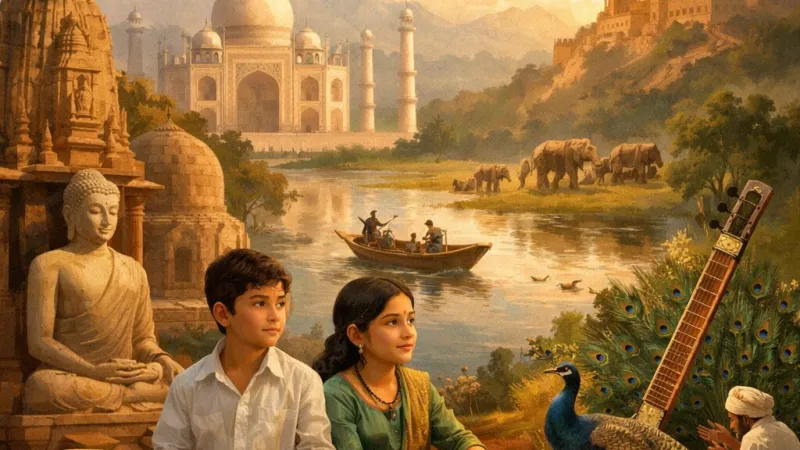
Few other Indian states can match UP’s tourism magnetism. The Taj Mahal in Agra, an enduring symbol of love and one of the Seven Wonders of the Modern World, draws millions annually. Equally significant is Varanasi (Kashi), where dawn on the ghats of the Ganga embodies India's spiritual ethos. Ayodhya, believed to be Lord Rama’s birthplace, and Mathura-Vrindavan, associated with Krishna, are central to Hindu devotees.Fatehpur Sikri, a city built in red sandstone by Akbar, is cited in countless Indian history books for its unique blend of Hindu and Islamic architecture. Prayers at Prayagraj’s sangam during the Kumbh Mela, the world’s largest religious congregation, paint a canvas of faith and tradition unmatched anywhere. Such diversity makes UP a paradise for cultural tourism.
Festivals are the heartbeat of UP life. Ramleela performances, the Holi of Barsana, the solemnity of Muharram, and the Urs at Dargah Sharif in Bareilly attract pilgrims and travellers from every walk of life.
VII. Social Issues and Challenges
Yet, UP’s impressive statistics and heritage are counterbalanced by numerous challenges. The state has for years reported high crime rates, a legacy grappled with by successive governments. Incidents of communal violence, caste-based discrimination, and gender injustice continue to make headlines. Overpopulation puts enormous pressure on every resource, leading to unemployment, slums in urban peripheries, and strain on infrastructure.Environmental issues too are acute, with air pollution in Kanpur and Varanasi ranking among the world’s worst, and rivers continually facing the threat of industrial discharge and domestic waste. The ambitious Namami Gange programme, launched by the central government, is an attempt to alleviate river pollution. Healthcare infrastructure in many parts is inadequate, but new government schemes are making some inroads.
VIII. Infrastructure and Modern Development
Transport and infrastructure in UP have improved significantly in the last two decades. The Agra-Lucknow and Purvanchal Expressways, the metro rail in Lucknow, and modern railway stations are symbolic of the new face of UP. Noida and Ghaziabad have emerged as IT and industrial hubs, part of the National Capital Region (NCR).Lucknow and Varanasi now have international airports, expanding UP’s global connectivity. The Smart Cities Mission has selected several UP cities for urban renewal, aiming at better waste management, public transport, and digital amenities.
Conclusion
To sum up, Uttar Pradesh is a land of contrasts—deep tradition and dynamic modernity, immense wealth and undeniable poverty, glorious past and complex present. Its geographical expanse, demographic might, economic muscles, and cultural legacy give it a place of pride in India’s story. The road ahead is challenging, demanding innovation in education, governance, and social welfare. But with its historic ability to adapt and reinvent, UP stands poised to continue as a vital pillar of an ever-evolving India—faithfully holding the legacy of its ghats, bazaars, poets, and revolutionaries.---
Interesting Facts
- Varanasi is often considered the world’s oldest continuously inhabited city. - The Taj Mahal is not just a tourist attraction but a UNESCO World Heritage Site. - UP’s Kumbh Mela in Prayagraj attracts a gathering so huge, it is visible from space! - The renowned "Lucknowi tehzeeb" reflects the state’s unique blend of etiquette, speech, and cuisine.This much more than just a list of ten lines—the above narrative offers a holistic understanding of why Uttar Pradesh is one of India’s most important, complex, and fascinating states.
Rate:
Log in to rate the work.
Log in