Significance and Celebration of National Constitution Day in India
This work has been verified by our teacher: 26.04.2026 at 17:04
Type of homework: Essay Writing
Added: 24.04.2026 at 9:29
Summary:
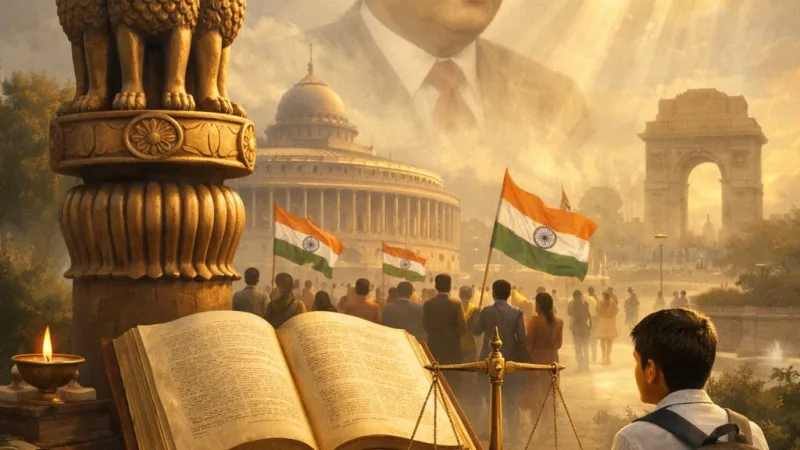
Explore the significance and celebration of National Constitution Day in India to understand its history, importance, and how it shapes Indian democracy today.
Paragraph on National Constitution Day
India, a country of vibrant diversity and ancient heritage, takes immense pride in its democratic ideals. At the heart of these ideals lies the Constitution of India, a document that not only outlines the legal framework of governance but also embodies the aspirations, rights, and responsibilities of its people. National Constitution Day, observed every year on 26th November, is a solemn occasion dedicated to commemorating the adoption of this visionary document. The significance of the Constitution in shaping India's future and safeguarding its pluralistic society cannot be overstated. This essay aims to delve into the historical context, significance, methods of celebration, and the enduring relevance of National Constitution Day in contemporary India.
Historical Background of the Indian Constitution
The story of the Indian Constitution begins during a pivotal period in India's history. After attaining independence from colonial rule in 1947, the country's leaders faced the daunting task of laying down a blueprint for a new nation. In December 1946, the Constituent Assembly was formed, consisting of representatives from varied backgrounds — lawyers, freedom fighters, social reformers, and intellectuals. Notably, Dr. B.R. Ambedkar was appointed as the Chairman of the drafting committee. Widely revered as the ‘Father of the Indian Constitution’, Dr. Ambedkar's expertise in law, commitment to social justice, and visionary outlook were instrumental in crafting a document that balanced the need for unity with respect for diversity.The Constitution was formally adopted on 26th November 1949, after nearly three years of rigorous debates and discussions, and it came into force on 26th January 1950—a date now celebrated as Republic Day. Written in both English and Hindi, the Constitution of India stands as one of the longest in the world, with over 450 articles and numerous schedules. Its comprehensive nature has allowed it to be amended over time, helping it remain relevant to a rapidly changing society.
Genesis and Official Recognition of Constitution Day
While Republic Day has long been celebrated, 26th November was not always officially recognised as Constitution Day. Earlier, it was informally observed as National Law Day. The change came in 2015, when the Government of India, under Prime Minister Narendra Modi, declared 26th November as ‘Samvidhan Divas’ or Constitution Day, coinciding with the 125th birth anniversary of Dr. Ambedkar. This announcement was seen as an effort to not only honour Dr. Ambedkar's indelible contribution but also to invigorate constitutional awareness among citizens.Through an official Gazette notification, the Union Ministry of Social Justice and Empowerment mandated the observance of Constitution Day in schools, colleges, and government institutions. The primary objective was to familiarise all Indians, especially the younger generations, with the basic tenets of the Constitution and to encourage a deeper appreciation of its values.
Significance of Celebrating National Constitution Day
The observance of Constitution Day holds profound significance for Indian society. Firstly, it serves as an annual reminder of the rights and privileges guaranteed to every individual, irrespective of caste, religion, or gender. By promoting constitutional literacy, the day helps spread awareness about the six fundamental rights — from equality and freedom to protection against exploitation and the right to constitutional remedies — that are enshrined for every citizen.Secondly, Constitution Day is a moment to reflect on the vision of the founding fathers. Visionaries such as Pandit Jawaharlal Nehru, Sardar Vallabhbhai Patel, Maulana Abul Kalam Azad, and of course, Dr. B.R. Ambedkar, were committed to building a society based on justice, secularism, liberty, and fraternity. These ideals continue to resonate, especially in the face of social challenges and inequalities.
Moreover, the day inspires every citizen to not only claim their rights, but also to shoulder their duties. As Dr. Ambedkar once said, “Rights are protected not by law but by the social and moral conscience of society.” Constitution Day, thus, is as much about introspection and responsibility as it is about celebration.
Celebrations and Observances Across India
National Constitution Day is marked by a wide array of activities and events. The Union government plays a leading role, with the Ministry of External Affairs directing Indian embassies worldwide to observe the occasion. In Parliament, both houses convene special sessions, paying tribute to the Constitution and its framers.Educational institutions act as vital centres for spreading constitutional values. Schools across the country commence the day with the recitation of the Preamble, often conducted during the morning assembly. Students participate in essay writing, debates, quizzes, and story-telling contests centred on the Constitution's history and principles. Colleges may organise seminars or invite eminent legal experts to deliver talks on the evolution and current status of constitutional law in India.
In addition to academic events, cultural programmes and sports activities also form an integral part of the observance. For instance, the “Run for Equality,” inspired by the constitutional commitment to equality, sees enthusiastic participation from young and old alike in cities such as Pune and Delhi. Regional languages receive their due attention too, as the government ensures that copies of the Constitution — originally written in English and Hindi — are translated and distributed in more than 22 recognised languages to promote inclusivity and accessibility. Regulatory bodies such as the University Grants Commission (UGC) regularly roll out competitions and awareness campaigns to reinforce the importance of constitutional literacy.
Challenges in Spreading Awareness
Despite these initiatives, certain challenges persist in making constitutional awareness truly universal. For many in rural and remote areas, especially where educational infrastructure is weak, the Constitution remains a distant concept. Linguistic barriers can further limit access to authentic translations or easy versions of constitutional texts.Furthermore, mere observance of Constitution Day is insufficient unless educational curricula embed constitutional principles deeply and meaningfully. Civic education remains sporadic in many schools, with focus often limited to rote learning rather than critical engagement. For the diverse and multi-lingual fabric of India, creative efforts such as local language plays, street theatre, and interactive workshops could be more effective.
The Role of Citizens in Upholding the Constitution
The Constitution is not merely a legal document; it is a living, breathing framework that depends on collective participation. Every citizen bears the responsibility of understanding their rights — such as freedom of speech, right to education, and equality before law — and respecting the rights of others. Beyond knowledge, true constitutionalism demands action: law-abiding behaviour, respect for institutions, and engagement with democratic processes such as voting.Historic movements like the Chipko Andolan and the Narmada Bachao Andolan, led by ordinary citizens, stand as proof that people’s participation can strengthen constitutional values. Encouraging civility in public discourse, promoting gender equality, and standing against discrimination are all ways by which individuals can honour the spirit of the Indian Constitution.
Contemporary Relevance of Constitution Day
In the digital age, the reach of Constitution Day has expanded manifold. Social media plays a critical role in disseminating information, with hashtags, digital pledges, and online quizzes making constitutional awareness accessible to millions. Yet, India faces modern challenges — from debates over freedoms to demands for social justice — that test the strength and relevance of the Constitution.It is, therefore, crucial for each generation to safeguard the hard-won democratic values bequeathed by the Constitution. The recent nationwide discussions on issues such as privacy, gender justice, and secularism underline the continuing importance of constitutional literacy, especially among the youth.
Rate:
Log in to rate the work.
Log in