The Importance of ‘Charity Begins at Home’ in Indian Values
This work has been verified by our teacher: 10.04.2026 at 13:18
Type of homework: Essay Writing
Added: 7.04.2026 at 8:32
Summary:
Explore the meaning of charity begins at home in Indian values and learn how compassion, support, and responsibility shape strong families and communities.
Essay on “Charity Begins at Home”
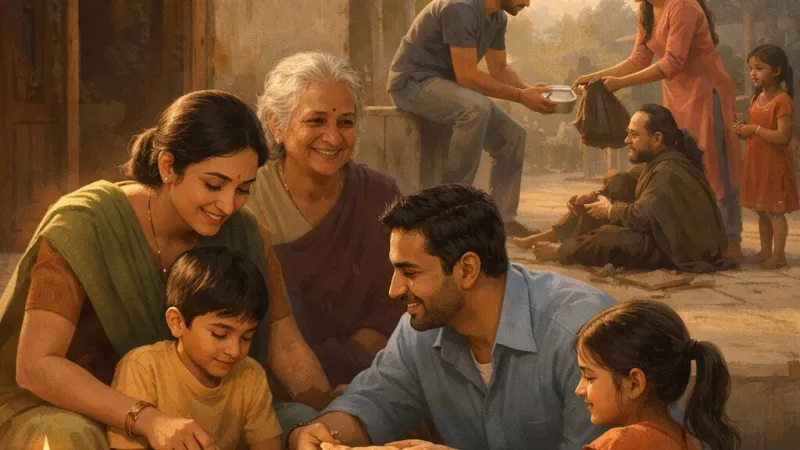
The simple phrase “Charity begins at home” encapsulates profound wisdom rooted deeply in Indian tradition. "Charity" does not simply mean giving away wealth, but encompasses compassion, time, emotional support, and moral guidance. The proverb reminds us that before we set out to change the world, our first obligation is towards those closest to us—our family and immediate community. In the Indian context, where families form the cornerstone of society and are bound by strong ties of affection and duty, this principle carries special significance. The modern world, with its rapid social change and increasing exposure to societal challenges, tempts individuals to look outward. Yet, lasting, effective charity must grow from a solid foundation at home. This essay explores the layers of this proverb’s meaning, especially for young Indians, and argues that true philanthropy always has its roots in our immediate circle. Only when we fulfil our responsibilities towards family can we genuinely extend our hands to the broader society.
---
Understanding Charity: Concepts and Dimensions
What is Charity?
In everyday life, charity is often imagined as donating money to the poor or the sick. However, Indian tradition offers a broader understanding. Drawing from the ancient concept of 'daan' in Sanskrit, we see charity as selfless giving, not limited to material possessions but extending to kindness, knowledge (vidya daan), and service (‘seva’). The Bhagavad Gita emphasises 'nishkama karma', or action without expectation of reward, as one of the highest forms of charity. In the stories of Sant Kabir and Guru Nanak Dev Ji, there are abundant references to sharing one's earnings and supporting those in need, starting with one's relations and extending outward.Different Forms of Charity
Charity wears many forms in Indian homes. It can be as simple as caring for an unwell parent, guiding a younger sibling in studies, or ensuring that the domestic help receives fair treatment and wages. Material charity includes providing food, clothing, education, or shelter. Yet, emotional charity—listening, encouraging, and offering moral support—often has an even greater impact, especially within families. The concept of 'Anna daan' (offering food to the hungry), celebrated in rituals across states, highlights how charity is both spiritual and practical. Likewise, social charity includes helping neighbours during crises, participating in local temple or gurudwara community meals (‘langars’), or supporting community literacy drives.Why Does Charity Matter?
Charity is the glue that binds society. The ethos of mutual aid, instilled by stories like those of Karna’s generosity in the Mahabharata, builds empathy and moral responsibility. Acts of charity foster personal growth, teach gratitude, and create ripples of kindness that strengthen families and communities. Without charity, families would fragment, trust would wane, and society would grow cold and selfish.---
Charity Begins at Home: The Core Logic and Importance
Family as the Foundation
Indian families have always been the bedrock of support, especially in times of distress. From the teachings of Raja Harishchandra—who endured hardships but placed the welfare of his family above all—to the regular customs where elders are revered and cared for, our culture stresses the importance of fulfilling family duties. Our parents and elders, who sacrifice for our upbringing, rightfully look towards us for love and respect in their old age. Children, too, depend on parental guidance and warmth. Neglecting these obligations, in pursuit of grander charitable acts outside, rings hollow and can even be viewed as hypocrisy.The Results of Neglect
History and literature are replete with cautionary tales. Consider the ancient parable of Shravan Kumar, who carried his blind parents on pilgrimage; his story teaches us that neglecting family duties while seeking external fame or recognition is morally problematic. When families are not cared for, misunderstanding, emotional distress, and insecurity thrive. It is not uncommon to find cases where individuals, celebrated for their public generosity, have ignored their own elders, leading to estranged families and personal regret.Community: The Next Circle
The idea that one should care not only for one's immediate family but also for one's extended family, neighbours, and community, is also deeply Indian. Our festivals—such as Diwali, Pongal, or Eid—are times when people come together as a community, helping each other. Community charity might include fundraising for a local child's education, repairing the village well, or organizing blood donation drives. These acts show that a caring attitude at home flows naturally into caring for one's larger "home"—the community.Philosophical and Practical Wisdom
Countless Indian folk tales and proverbs reinforce the importance of first setting one's house in order. "Ghar ki murgi dal barabar," a popular saying, jokes about how we often undervalue those at home. The underlying lesson is clear: the value we place on home defines our capability to make a true difference outside. Practising charity at home is also a learning ground—a child's experience of caring for a sibling or grandparent shapes lifelong attitudes towards service.---
Balancing Charity at Home and Social Philanthropy
Home and Society: A Delicate Balance
Indian society is not a collection of strangers, but rather a tapestry woven from countless families. When families are healthy, happy, and generous, they nurture strong communities. The charity one does at home seeps outward, enriching schools, religious centres, and neighbourhoods, and ultimately lifting society.Rejecting Extremes
Charity must not become a performance to impress others. Some people, in pursuit of social recognition, make large donations to public causes while their own families struggle silently. Swami Vivekananda famously said, “Those who cannot help their own family cannot help others either.” On the other hand, restricting help only to relatives, with no regard for society, fosters selfishness and closes the door to empathy. Instead, balance is vital: families should assist each other while also remaining empathetic to those beyond their doors.Ways to Strike the Balance
Families can work together to make not only the home, but also the community more caring. For instance, a family can jointly volunteer at an orphanage, or celebrate festivals by inviting less fortunate neighbours. Setting aside time and resources for both familial and social causes creates harmony. Many Indian NGOs encourage family-based volunteering, which educates children about both home and community obligations.Indian Examples
Consider the legacy of Mahatma Gandhi, who transformed his family principles into social action. His care for his wife Kasturba and his teachings in the Sabarmati Ashram started with household discipline and simple living, and radiated outwards as a movement for freedom and social justice. Similarly, Sindhutai Sapkal, known as the 'Mother of Orphans', began by caring for abandoned children as her own before establishing schools and homes that have helped thousands.---
Challenges and Modern Realities
Changes in Family Structure
Indian society is rapidly urbanising, leading to smaller nuclear families and less frequent interaction with extended relatives. Traditional support systems are eroding, and individual aspirations sometimes overshadow the collective good. In such circumstances, practising charity at home may require more conscious effort.Economic Pressures
With the rising cost of living and competitive lifestyles, it is not easy to allocate money or time for others. Family needs may strain limited resources, forcing people to choose where and how to give. Government initiatives like the National Family Benefit Scheme and social security pensions are examples of efforts to strengthen familial charity at a policy level, but individual responsibility remains critical.The Role of Social Media
Charity is also influenced by new digital realities. Many people showcase their donations online, sometimes more for appreciation than for genuine intent. The challenge is to remain sincere and not be swept up in acts of symbolic charity that overlook real needs at home.---
Practical Advice for Students and Individuals
1. Self-Reflection: Before embarking on any charitable endeavour, assess your responsibilities at home. Are your parents, siblings, or elders in need of your help, guidance, or time? 2. Start Small: Even simple acts—like helping your mother with chores, teaching a cousin, or assisting a grandparent—build the habit of charity. 3. Family Participation: Get the family involved in social efforts. Preparing food for a community langar or visiting an old-age home together strengthens bonds and teaches valuable lessons. 4. Choose Charity Carefully: Before donating money or volunteering externally, research and choose causes that resonate and make a real impact. 5. Balance: Make sure both emotional and material needs of your family are met before reaching outward. 6. Build Empathy: As you grow in capacity, extend help to those outside the home, but always consider charity as a circle, starting at the centre and expanding outwards.---
Rate:
Log in to rate the work.
Log in